What Is Human Nature? An Explainer Through Key Books About Human Nature
By VoxBrief Team··5 min read
Ever wondered why you feel a pang of guilt over a small misstep, or why office politics seem to follow the same predictable patterns no matter where you work? These questions all point toward a single, fascinating subject: our shared human nature. But what is human nature, really? It’s the collection of fundamental traits, psychological drives, and social behaviors that are common to all of us. This article is your introduction to human nature, exploring its core concepts through the lens of pivotal books about human nature.
Understanding these underlying patterns is more than an academic exercise; it’s a practical tool for navigating life. For anyone just starting this journey, this guide serves as an introduction for beginners, breaking down complex ideas into manageable human nature lessons. By grasping these concepts, you can better understand yourself, improve your relationships, and see the hidden forces that have shaped our world.
The Core Conflict: Instinct vs. Civilization
One of the most important human nature facts is that we are creatures of deep and often contradictory desires. There's a fundamental tension between what we want as individuals and what society needs from us to function. This isn't a new idea; it’s one of the most enduring themes in philosophy and psychology.
Psychoanalyst Sigmund Freud provided a powerful framework for this conflict in his work Civilization and Its Discontents. He argues that there is an "unwinnable war" between our raw instincts—for pleasure, aggression, and freedom—and the demands of civilized life. Society promises safety and order, but at a steep price: the suppression of these very instincts. We trade a degree of personal liberty for collective security, and Freud believed this trade leaves us in a perpetual state of discontent.
To enforce this bargain, civilization helps build what Freud called the "super-ego," essentially an internal police officer. This is the source of our guilt, a relentless inner critic that internalizes society's rules and punishes us for even thinking about breaking them. Ever felt guilty for wanting to relax when you felt you should be productive? That's the super-ego at work, a clear example of human nature explained through this internal conflict. This eternal struggle is a key reason why, despite incredible technological and social progress, feelings of anxiety and dissatisfaction remain a common part of the modern experience.
Decoding Social Behavior: The Masks We Wear
Moving from our internal world to our social one, another critical aspect of human behavior is the way we present ourselves to others. People are rarely an open book; we are complex, and we often project a carefully curated version of ourselves to the world. Understanding this dynamic is central to navigating social situations, from professional negotiations to personal relationships.
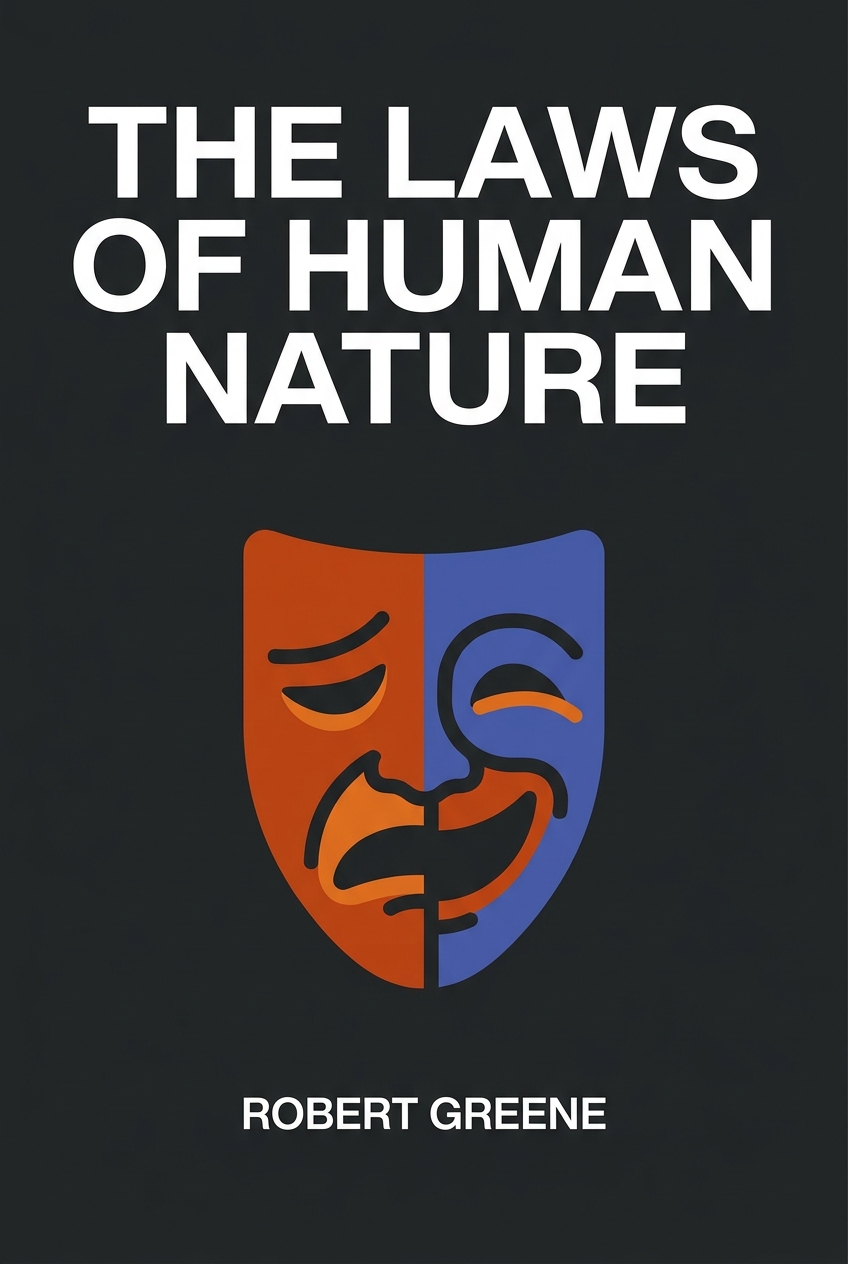
In The Laws of Human Nature, author Robert Greene provides a masterclass in reading the people around you. He argues that we all wear social masks, projecting an image of confidence, agreeableness, and diligence to fit in and get ahead. This isn't necessarily malicious; it's a survival strategy. However, to truly understand people, Greene insists we must learn to see behind these performances. He calls this the Law of Role-playing—the ability to recognize the gap between the role someone is playing and their true character.
This is where an understanding of nature vs nurture becomes practical. While our environment and upbringing teach us which masks to wear, our underlying nature often leaks through in nonverbal cues, emotional outbursts, and unguarded moments. Greene’s work is a guide to spotting these signals, allowing you to gauge people's true intentions and motivations.
Evolutionary Psychology and Social Instincts
Why do we wear masks in the first place? Evolutionary psychology offers some compelling answers. For millennia, our survival depended on our ability to cooperate and function within a group. Being ostracized was a death sentence. As a result, we developed powerful social instincts geared toward conformity and harmony.
Greene explores this with his "Law of Conformity." He explains that when we join a group, a "social personality" can take over. We unconsciously start to imitate the beliefs, speech patterns, and emotions of those around us. This pressure to conform is so strong that it can overwhelm our individual sense of reason, leading to groupthink and irrational behavior. Recognizing this pull is the first step toward maintaining your own judgment and identity within a group setting.
Moral Psychology and Deeper Assessment
Seeing beyond the social mask isn't just about spotting deception; it's about understanding the entirety of a person, including their moral compass. Moral psychology studies how we develop our values and make ethical judgments. Greene builds on this by urging a deeper assessment of character, which he defines as the long-term pattern of a person's actions.
A single action, good or bad, isn’t enough to judge someone. Instead, we should observe their behavior over time, especially how they handle pressure, treat subordinates, and react to failure. These moments reveal the true wiring of their personality far more than the polished image they present. By focusing on these patterns, you move from simply reacting to people's social performance to truly understanding the core of who they are.
Deconstructing Power: Lessons from Books About Human Nature
Nowhere are the dynamics of human nature more visible than in the arenas of power, status, and social hierarchy. From corporate ladders to political movements, our instincts for dominance, rebellion, and alliance play out on a grand scale. To better understand how did human nature shape today, we can look at stories that magnify these dynamics.
Though a work of science fiction, Pierce Brown's Red Rising serves as a brilliant allegory for the psychology of power. The novel presents a society built on a rigid caste system called the Colors, where genetically engineered Golds rule as gods over a vast hierarchy of lesser humans. This "Architecture of Control" is a masterclass in social engineering, built on a story that convinces the lower castes—like the Reds who toil in the mines of Mars—that their servitude is natural and just.
The book's central premise is that such a system, no matter how powerful, can be broken. But it argues that it cannot be broken by force alone. As the revolutionaries in the story realize, "an empire must be destroyed from within." This highlights a timeless lesson about power: systems of oppression are ultimately built on belief. To topple them, you must first create a more compelling story and understand the psychological levers of the people in charge.
The protagonist's journey through the Gold's brutal training ground, the Institute, is a microcosm of this idea. It's a high-stakes game of conquest where leadership, strategy, and the ability to inspire loyalty are tested. It shows that true power isn't just about brute force; it's about understanding and manipulating the ambitions, fears, and desires of others—a core component of human nature.
The Unending Journey of Understanding
From the internal conflict described by Freud to the social masks detailed by Greene and the power dynamics illustrated by Brown, the study of human nature offers a powerful lens for making sense of the world. The key human nature lessons show us that we are emotional, social, and hierarchical creatures, constantly balancing our primal instincts with the complex rules of the societies we build.
The journey to understand ourselves and others is lifelong. It requires observation, reflection, and a willingness to look beyond the surface. Exploring these topics is not just for academics; it's an essential skill for anyone who wants to lead a more conscious and effective life. The insights offered in these works provide a solid foundation, an introduction to human nature that empowers you to keep asking why we do the things we do.
Master key ideas in 15 minutes
Listen to audio summaries of these books on VoxBrief
Studying human nature is crucial because it helps us understand the fundamental drivers of our thoughts, emotions, and actions. This knowledge improves self-awareness, enhances our relationships, and provides a framework for building better societies.
Key lessons include that we are deeply social creatures influenced by group dynamics, and we are often driven by unconscious emotions rather than pure logic. Another core lesson is the constant tension that exists between our innate, individual desires and the rules imposed by society.
Our shared human nature has profoundly shaped history and modern society, from the formation of governments and laws to the structures of our economies. Our instincts for cooperation, competition, and hierarchy are visible in everything from corporate culture to international relations.
A strong book on human nature integrates insights from various fields like psychology, history, and biology to provide a comprehensive view. It should offer not just theories but also practical frameworks for observing and understanding behavior in the real world.