Feeling your heart race before a team meeting? Spending days worrying about a social event you can't get out of? You're not alone. This intense fear of being watched and judged by others is a core sign of social anxiety. While it can feel isolating, understanding and managing it is possible. This guide delves into powerful concepts from some of the social anxiety best books, offering a roadmap to reclaim your confidence and navigate the social world with greater ease.
Understanding the Roots of Social Anxiety
Before diving into solutions, it's crucial to understand what social anxiety is—and what it isn't. It’s more than just being shy. While shyness is a personality trait involving discomfort around new people, social anxiety (also known as social phobia) is a mental health condition characterized by an intense, persistent fear of social situations. The core fear is negative evaluation: being embarrassed, humiliated, or rejected.
This fear isn't just in your head; it manifests physically. Common signs of social anxiety include blushing, sweating, trembling, a rapid heart rate, or feeling your mind go blank. Behaviorally, it often leads to avoidance of feared situations, which can unfortunately reinforce the anxiety over time. The social anxiety causes and effects are complex, often a mix of genetic vulnerability and life experiences, but the effect is often the same: a life that feels smaller than it should be, with missed opportunities for connection and career advancement.
Introversion vs. Social Anxiety
One of the most common misconceptions is confusing social anxiety with introversion. They are fundamentally different. As Susan Cain explains in her groundbreaking book Quiet, introversion is about energy. Introverts get their energy from quiet, low-stimulation environments and can feel drained by excessive social interaction. They might enjoy a deep one-on-one conversation but find a loud party exhausting.
Social anxiety, on the other hand, is about fear. An extrovert who gets energy from being around people can still suffer from social anxiety, dreading those very interactions out of a fear of judgment. The key difference is motivation: an introvert might leave a party because they feel drained, while someone with social anxiety might leave (or not go at all) because they are afraid.
Core Principles from the Social Anxiety Best Books
To truly learn how to overcome social anxiety, we need to tackle it from multiple angles: our internal thoughts, our philosophical outlook, and our practical skills. The most effective books address these pillars, offering a comprehensive toolkit for change.
Cognitive Behavioral Therapy and Rethinking Your Thoughts
Many therapeutic approaches, particularly cognitive behavioral therapy (CBT), focus on the link between our thoughts, feelings, and behaviors. The idea is that it isn't the social situation itself that causes anxiety, but our interpretation of it. Joseph Nguyen's Don't Believe Everything You Think provides a simple yet profound way to apply this principle.
Nguyen introduces a critical distinction between "thoughts" (the fleeting mental events that pop into our heads) and "thinking" (the act of grabbing onto a thought and spiraling with it). For someone with social anxiety, a thought like "I'll say something stupid" can trigger a cascade of anxious "thinking" that leads to panic. Nguyen argues that the solution isn't to fight these thoughts or force positive ones, but to learn to let them pass by without engagement. By cultivating a state of "non-thinking," you starve the anxiety of the fuel it needs to grow. This is one of the most powerful social anxiety coping strategies for beginners, as it doesn't require complex mental gymnastics—only the awareness to step back from the thought-stream.
The Courage to Redefine Your Relationships
The fear of judgment is fundamentally a relational problem. We worry about what others will think of us. The Courage to Be Disliked, based on the work of psychologist Alfred Adler, offers a radical solution: stop trying to live up to others' expectations.
Ichiro Kishimi explains that all human problems are, at their core, interpersonal relationship problems. The book proposes a concept called the "separation of tasks." Your task is to do your best and live authentically. The other person's task is to decide what they think about you—and that is none of your business. This framework is incredibly liberating for anyone whose social anxiety is driven by a need for approval. It gives you the permission to be disliked, and in doing so, frees you from the constant, exhausting effort of trying to please everyone. It’s a philosophical shift that helps you build a sense of self-worth that isn't dependent on external validation.
Building Practical Social Skills
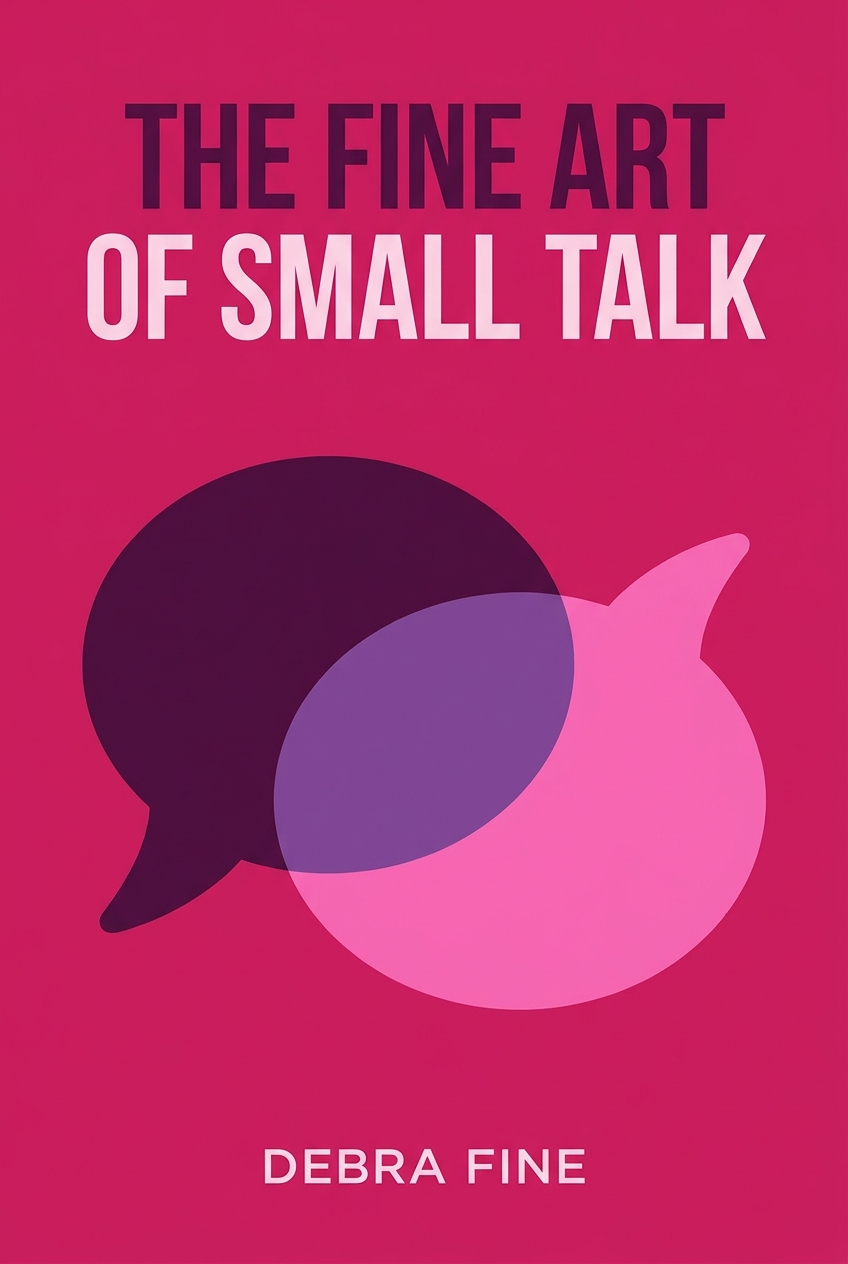
While mindset is crucial, it's hard to feel confident if you don't know what to do or say. This is where practical social skills come in. Debra Fine's The Fine Art of Small Talk is an essential resource for turning theory into action, providing concrete social anxiety exercises you can use immediately.
Fine argues against passively waiting for someone to talk to you. Instead, you must "own the interaction." This means taking the initiative to start conversations. For many with social anxiety, the fear isn't just starting the conversation, but keeping it going. Fine's solution is to master the art of asking open-ended questions—questions that can't be answered with a simple "yes" or "no." Instead of "Are you having a good time?" (which can lead to a dead end), try "What's been the most interesting part of your day?" This invites a story and gives you more material to work with, turning an awkward encounter into a genuine connection.
Practical Strategies for Overcoming Social Anxiety
Armed with these core principles, how do you apply them in the real world? The key is to tailor your approach to specific situations and start small.
Navigating Social Anxiety at Work
The workplace is a common trigger for social anxiety. From presentations to networking events, the pressure to perform is high. This is a scenario where many social anxiety for professionals find themselves struggling. Leil Lowndes's book, How to Talk to Anyone, provides a playbook for exactly these situations.
Lowndes emphasizes that confidence can be projected even when you don't feel it. Her techniques for nonverbal communication—like maintaining good eye contact and adopting an open posture—can change how others perceive you and, in turn, how you feel about yourself. This is critical for managing social anxiety at work, where projecting competence is half the battle. Furthermore, her strategies for handling difficult people and workplace politics provide a sense of control in high-stakes environments, reducing the feeling of being a passive victim of social dynamics.
Exposure Therapy and Gradual Practice
One of the most evidence-based treatments for anxiety is exposure therapy, which involves gradually and repeatedly facing the situations you fear until they no longer hold power over you. You don't have to jump into giving a keynote speech tomorrow. The principles from these books provide a perfect framework for gentle exposure.
Start small. Your goal for this week could be to use one of Debra Fine's open-ended questions with a barista. Next week, you might try to make small talk with a colleague by the coffee machine. Each small success builds momentum and retrains your brain to see social situations as less threatening. This steady, repeated practice is essential for anyone wondering how to deal with social anxiety effectively.
Social Anxiety for Students and Beginners
The principles are the same for everyone, but the context changes. For social anxiety for students, the challenges might be speaking up in class, joining a new club, or navigating dorm life. For social anxiety for beginners, the sheer thought of starting can be overwhelming.
If you're a student, try applying the "separation of tasks" from The Courage to Be Disliked before raising your hand in class. Your task is to share your thought; the professor's and classmates' task is to react. Their reaction is outside your control. Blending this mindset with a practical skill, like preparing a question beforehand, can make participation feel much more manageable. The journey begins with one small, intentional step.
Ultimately, social anxiety is a challenging but surmountable obstacle. It is not a life sentence. By understanding its roots, shifting your core beliefs about yourself and others, and arming yourself with practical skills, you can begin to loosen its grip. Books provide the knowledge, but action creates the change. Start with one idea from one book, and take the first step toward a freer, more connected life.
Master key ideas in 15 minutes
Listen to audio summaries of these books on VoxBrief
Struggling with social anxiety often stems from a combination of factors, including brain chemistry, genetic predispositions, and past negative experiences. Overthinking, fear of judgment, and a tendency to negatively forecast social outcomes are common mental patterns that perpetuate the cycle.
Absolutely. Social anxiety is highly treatable and can be significantly improved with the right strategies. Methods like cognitive behavioral therapy (CBT), building practical social skills, and gradually facing feared situations can lead to lasting change and increased confidence.
Overcoming social anxiety long term requires a consistent commitment to changing both your mindset and behaviors. This involves challenging negative thought patterns, practicing social skills regularly, and reframing your relationship with others' approval. Finding good books for social anxiety like the ones we've explored can provide a structured path and powerful principles for this journey.