All Books
Self-Growth
Business & Career
Health & Wellness
Society & Culture
Money & Finance
Relationships
Science & Tech
Fiction
Topics
Blog
Download on the App Store

A Whole New Mind

Why Right-Brainers Will Rule the Future

13 minDaniel H. Pink

What's it about

Are your analytical skills no longer enough to get ahead? Discover why the future belongs to a different kind of thinker. This summary reveals the six essential "right-brain" abilities—like design, story, and play—that you need to thrive in a world of automation and abundance. Learn how to master these creative and empathetic senses to future-proof your career and unlock your full potential. You'll gain practical techniques to move beyond pure logic and cultivate the whole new mind that today's world demands, turning your unique human talents into your greatest professional assets.

Meet the author

Daniel H. Pink is the bestselling author of multiple provocative books about business and human behavior that have sold millions of copies and been translated into dozens of languages. A former chief speechwriter for Vice President Al Gore, Pink left the world of politics to explore the seismic shifts occurring in work, career, and society. This unique vantage point, moving from the logical world of law and policy to the creative world of independent analysis, directly inspired his groundbreaking insights into the rise of right-brain thinking.
Listen Now

Opens the App Store to download Voxbrief

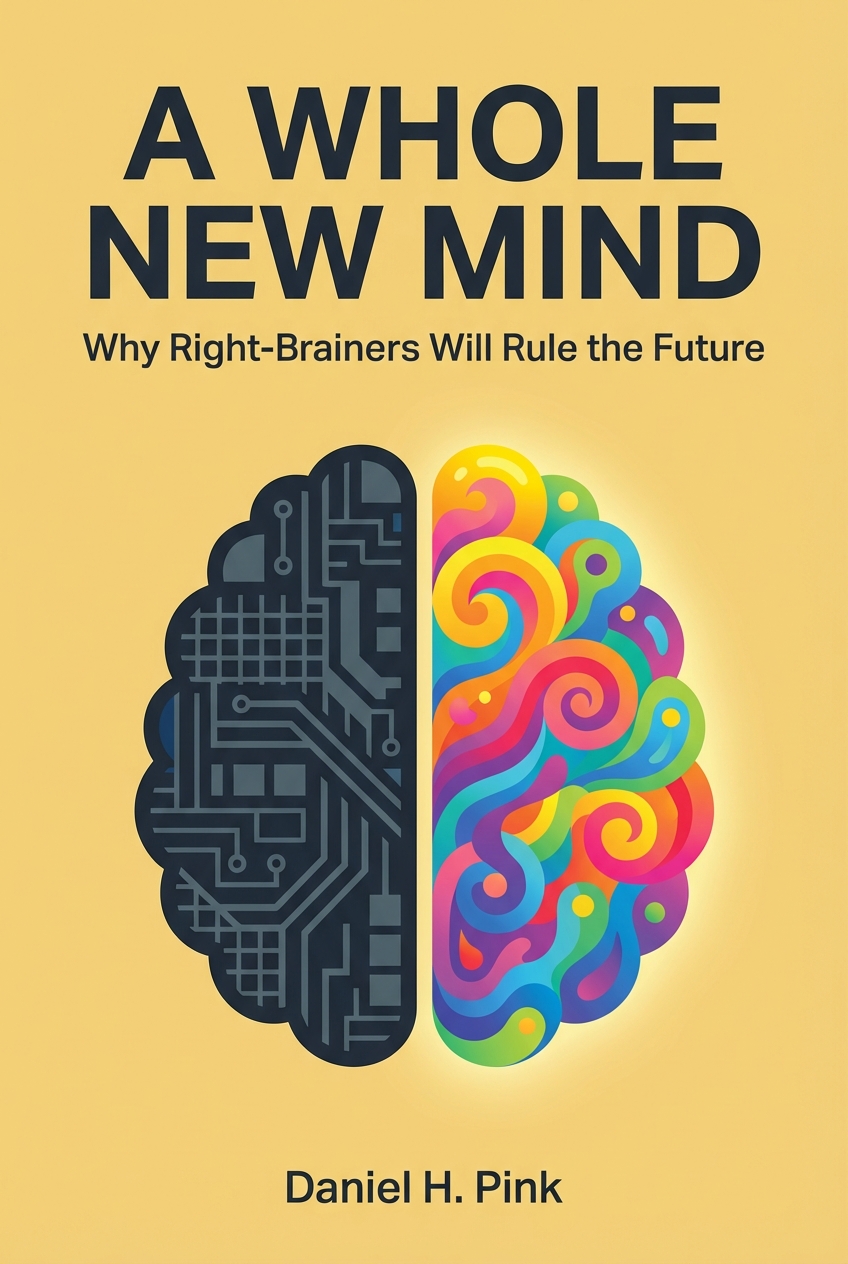
A Whole New Mind book cover

The Script

For generations, the path to a secure, professional life was a straight line paved with logic, analysis, and linear thinking. Accountants, lawyers, and computer programmers were the undisputed architects of prosperity. Their left-brain skills—sequential, logical, analytical—were the currency of the modern age. We built entire education systems and corporate ladders around this ideal, celebrating the spreadsheet over the sketchbook, the argument over the story. But what if the very skills that built the 20th-century economy are becoming a liability in the 21st? What happens when abundance makes logical products cheap, Asia can do the analytical work for less, and automation can do it faster? Suddenly, the straight line to success begins to look like a dead end.

This unsettling shift is precisely what Daniel H. Pink, a former chief speechwriter for Vice President Al Gore, began to observe in the early 2000s. After leaving the world of politics to explore the changing landscape of work and business, he saw a disconnect. The people succeeding weren't just the logical thinkers; they were artists, inventors, designers, and caregivers whose abilities were often dismissed as 'soft' or secondary. Pink realized this was the dawn of a new era. He wrote "A Whole New Mind" as a guide to surviving and thriving in a world where the skills of the right brain—creativity, empathy, and meaning—are the new foundation for a fulfilling life and a successful career.

Module 1: The Great Shift — From L-Directed to R-Directed Thinking

We are leaving the Information Age. We are entering the Conceptual Age. This is a seismic shift in the skills required for success. For decades, the path was clear. Excel at logical, sequential, analytical thinking. Pink calls this L-Directed Thinking. It's the kind of thinking measured by the SATs. It powered the knowledge worker economy. But that era is fading.

Today, those L-Directed skills are necessary, but they're no longer sufficient. The future belongs to those who master R-Directed Thinking. This is the thinking style of the right hemisphere. It's holistic. It's intuitive. It’s non-linear and creative. Pink argues that the abilities once dismissed as soft or secondary are now the key differentiators. These are aptitudes like artistry, empathy, and big-picture synthesis. They are what make us uniquely human in an age of intelligent machines and global workforces.

To make this concrete, Pink introduces a powerful metaphor. The left hemisphere is the detail-oriented fox. It knows many small things. The right hemisphere is the big-picture hedgehog. It knows one big thing. For a long time, we built our entire educational and economic system to reward the fox. But now, the hedgehog is rising.

And here's the thing. You must integrate both L-Directed and R-Directed thinking to thrive. The ideal mind for the Conceptual Age is an androgynous mind. It can toggle between detached analysis and empathic connection. It can build a rigorous argument and also craft a compelling story. It can analyze the data and see the overarching pattern. One without the other is incomplete. You need the whole mind.

So what does this shift actually look like on the ground? It means the MBA is no longer the undisputed king of graduate degrees. Pink points out that the Master of Fine Arts, the MFA, is becoming the new MBA. Why? Because an MFA cultivates creativity, design sensibility, and storytelling. These are the R-Directed skills that can't be outsourced to a programmer in Mumbai or automated by an algorithm. Corporate recruiters are now hunting for talent at top art schools, not just business schools. The numbers back this up. In the U.S., there are now more people working in arts and design than as lawyers, accountants, and auditors combined.

Module 2: The First Three Senses — Design, Story, and Symphony

We've established the "why." Now let's get to the "how." Pink identifies six essential aptitudes for the Conceptual Age. He calls them the Six Senses. They are the practical skills you need to cultivate your R-Directed thinking. Let's start with the first three: Design, Story, and Symphony.

First up is Design. In a world of abundance, function is not enough. To stand out, products and services must be beautiful and emotionally engaging. Think about your phone. You didn't just buy it for its processing speed. You chose it for its feel, its look, its user experience. That’s Design. It's the combination of utility and significance. Pink shows how this is everywhere. Michael Graves designed a toilet brush for Target. Karim Rashid designed a wastebasket. Good design has become democratized. It's an expectation.

The impact of design goes even deeper. Studies show patients in hospital rooms with more natural light recover faster. They even require less pain medication. But bad design can have catastrophic consequences. Pink points to the infamous "butterfly ballot" from the 2000 U.S. presidential election. Its confusing layout in one Florida county likely altered the course of history. Design is a fundamental human capacity with profound power.

Moving on, we come to Story. Facts are now a commodity. They are everywhere and they are cheap. A teenager in a remote village can access the same data as a Harvard librarian. The ability to place facts into a compelling narrative creates true value. Story provides context enriched by emotion. It’s how we persuade, how we communicate, and how we make sense of the world.

This is why top business executives now flock to Robert McKee's story seminars, originally designed for Hollywood screenwriters. They know that a powerful narrative moves people in ways a spreadsheet never can. Even medicine is catching on. The "narrative medicine" movement teaches doctors to listen to their patients' life stories, not just their symptoms. This builds empathy and leads to better diagnoses. We are wired for story. As Pink says, we are our stories.

Finally, let's talk about Symphony. The Information Age demanded specialization. Deep focus in a narrow field. The Conceptual Age rewards the opposite. Symphony is the ability to connect the dots and synthesize the big picture. It's about seeing relationships between seemingly unrelated fields. It's the aptitude of the boundary crosser, the inventor, and the metaphor maker. Think of the person who combines insights from biology and computer science to create a new algorithm. That’s Symphony.

Pink shares a personal story of taking a drawing class. His first self-portrait was terrible. He drew symbols—an eye, a nose, a mouth—but failed to see the relationships between them. After learning to see the negative space and the proportions, his drawing improved dramatically. He learned to synthesize the parts into a whole. Symphony is a critical skill for leaders and innovators. It’s about recognizing the pattern in the noise.

Read More