All Books
Self-Growth
Business & Career
Health & Wellness
Society & Culture
Money & Finance
Relationships
Science & Tech
Fiction
Topics
Blog
Download on the App Store

Adieux

A Farewell to Sartre

14 minSimone De Beauvoir

What's it about

Have you ever wondered what it’s like to watch a brilliant mind fade? This deeply personal account chronicles the final, painful decade of Jean-Paul Sartre's life, offering an unflinching look at the slow decline of a philosophical giant through the eyes of his lifelong companion. You'll gain a raw, intimate perspective on mortality, love, and the complex reality of caring for a partner in their final years. Discover the heartbreaking details of Sartre's physical and intellectual decay, and witness how Simone de Beauvoir grapples with grief, memory, and the end of an era.

Meet the author

A towering figure of 20th-century French philosophy, Simone de Beauvoir was a pioneering feminist writer and existentialist thinker whose work has shaped modern intellectual thought. Her lifelong intellectual and romantic partnership with Jean-Paul Sartre gave her a uniquely intimate perspective on the man and his final years. This profound connection allowed her to chronicle his decline with the unflinching honesty and deep compassion that define Adieux, offering an unparalleled look at the end of a great mind.
Listen Now

Opens the App Store to download Voxbrief

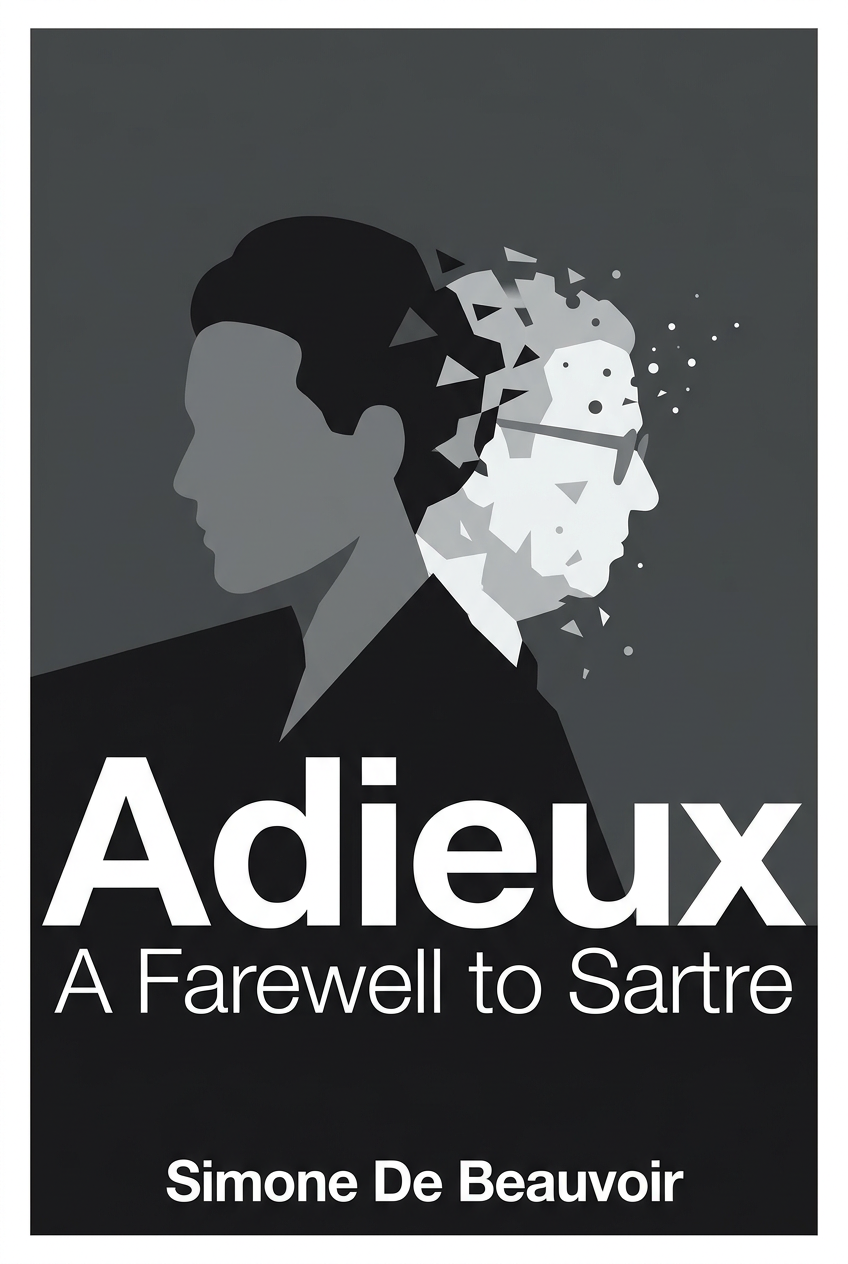
Adieux book cover

The Script

A professional athlete’s career often ends in two distinct phases. First comes the formal retirement, marked by press conferences and highlight reels. But then comes the second, more private ending: the slow, unceremonious fading of the body itself. The explosive first step vanishes, the pinpoint accuracy wavers, the endurance that once seemed limitless becomes a shallow well. What was once an unconscious, fluid extension of will is now a subject of constant, frustrating negotiation. The mind still knows the plays, the body simply can’t execute them. This quiet, personal process—the body’s gradual farewell to its own peak capabilities—is a profound, often lonely, experience of loss that happens long after the crowds have gone home.

It is this second, more intimate ending that fascinated the philosopher and writer Simone de Beauvoir. For the last decade of his life, she witnessed her lifelong intellectual partner, Jean-Paul Sartre, endure his own slow fade. The mind that had reshaped modern thought was now trapped in a body that was steadily failing him—blindness, frailty, and a cascade of physical ailments. Refusing to let this final, crucial chapter of his existence be reduced to a footnote, de Beauvoir documented it with unflinching honesty. "Adieux" is her chronicle of that decade, a powerful and raw account of what it means to accompany a great mind to its end, capturing the moments of lucidity, the frustrating decline, and the difficult, complex act of saying a final goodbye.

Module 1: The Intellectual in Action

Sartre’s final decade was a period of intense, often contradictory, activity. He was grappling with what it meant to be an intellectual in a world on fire. This led to a profound shift in his thinking. He believed the traditional intellectual, isolated by class and knowledge, was obsolete. The new intellectual had to merge with the masses.

So here's what that means. Sartre tried to live the revolution. He saw the gap between thinkers and workers as a critical failure. Sartre believed an intellectual's true purpose was to bridge the divide between theory and the lived experience of the working class. He began editing papers like La Cause du peuple, a publication written by and for workers. He sold the papers on the streets, risking arrest alongside young Maoist militants. In 1970, he spoke to striking Renault workers, arguing that intellectuals and the people must become "one single body" to achieve real change. This was his new ideal in practice.

Building on that idea, Sartre used his fame as a political tool. He understood his name carried weight. He believed it could shield others from state repression. He consistently leveraged his public profile to defend victims of injustice and amplify grassroots movements. In 1970, he co-founded Secours rouge, an organization providing legal and material aid to those targeted by the government. When miners died in a preventable accident, he presided over a "people's court" to hold the state-owned company accountable. He marched for a murdered Algerian teenager. He used his platform as a shield for the powerless.

But flip the coin. This militant activism created a deep tension in his life. He was still, at his core, a writer. Sartre struggled to reconcile his urgent political commitments with his deep-seated literary ambitions. While his Maoist friends pushed him to write simple, revolutionary pamphlets, he was engrossed in a massive, complex study of the author Gustave Flaubert, titled The Family Idiot. It was a dense, academic work written in a bourgeois style. He defended it fiercely. He argued that understanding a person like Flaubert was essential to understanding all people. For him, the literary project and the political one were two sides of the same coin, even if others couldn't see the connection. He was trying to hold two worlds together at once.

Module 2: The Body's Betrayal

While Sartre’s mind remained fiercely engaged, his body was beginning to fail him. Adieux is an unsparing chronicle of this decline. It shows how physical decay slowly dismantles a life, impacting work, relationships, and one's very sense of self. It’s a powerful look at the universal experience of aging, seen through the lens of an extraordinary individual.

The most devastating blow was to his sight. For a man who lived through reading and writing, blindness was a unique form of torture. Beauvoir documents his struggle with agonizing detail. Sartre's loss of sight triggered profound psychological distress because it severed his primary connection to the world and his work. He would repeatedly ask doctors if he would ever read again, clinging to any sliver of hope. The inability to see plunged him into periods of what he called "emptiness." He would withdraw into silence or sleep, a refuge from a world he could no longer access. His identity was so tied to his work that without it, he felt he was "nowhere."

And it doesn't stop there. This physical decline forced him into a new, uncomfortable reality: dependency. Sartre, the philosopher of radical freedom, became reliant on others for everything. His increasing physical dependence reshaped his personal relationships, creating a complex dynamic of gratitude, frustration, and humiliation. He relied on Beauvoir and a circle of close female friends for daily care. They read to him, guided him, and managed his needs. He expressed appreciation for being "coddled," but the loss of autonomy was a constant source of quiet suffering. His body, he felt, was betraying him.

And here's the thing. Even in this state of decline, his mind sought purpose. He refused to simply fade away. Sartre adapted to his limitations by shifting his intellectual work toward collaboration and dialogue. Unable to write, he began recording conversations with younger thinkers like Pierre Victor. These dialogues became a new way for him to develop his ideas on power, freedom, and ethics. He participated in planning television programs on history and edited book series on social movements. These projects provided structure and a sense of continued relevance. They were a testament to his intellectual resilience, a way of proving that even as his body failed, his mind was still in the fight.

Read More