All Books
Self-Growth
Business & Career
Health & Wellness
Society & Culture
Money & Finance
Relationships
Science & Tech
Fiction
Topics
Blog
Download on the App Store

America Fantastica

The Author of the Classic The Things They Carried Returns with a Brilliant Satire of Truth and Fantasy in Modern America

14 minTim O'Brien

What's it about

Ever feel like you can't tell what's real from what's fake in today's America? This brilliant satire tackles that exact feeling, showing you how a web of lies can spiral into a nationwide spectacle, forcing you to question everything you think you know about truth. Follow a disgraced journalist on a wild crime spree with his fantasist girlfriend. Through their bizarre journey, you'll uncover a sharp critique of modern myths, media hysteria, and political delusion, revealing why we're so easily captivated by the stories we want to believe.

Meet the author

Tim O'Brien is one of America's most acclaimed authors, whose modern classic, The Things They Carried, has become required reading for its profound insights on war and memory. A decorated veteran of the Vietnam War, O'Brien draws from his own experiences to explore the complex interplay between fact and fiction, truth and storytelling. This unique perspective, honed over a lifetime of award-winning writing, allows him to masterfully dissect the blurred realities of contemporary American life in his latest work.
Listen Now

Opens the App Store to download Voxbrief

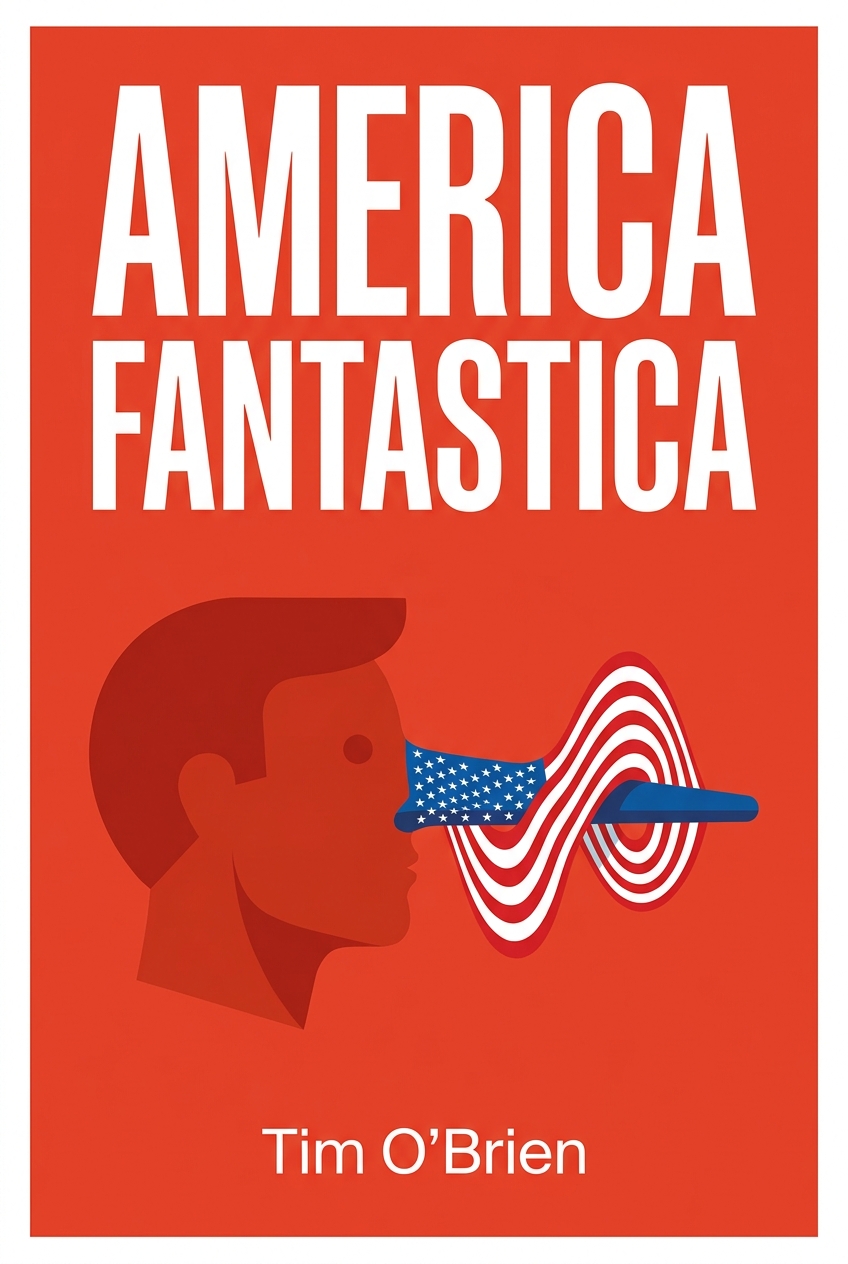
America Fantastica book cover

The Script

We think a lie is a weapon, a tool used to gain an advantage. But what if the most destructive lies are homes? What if they are elaborate, furnished structures we build around ourselves to make our own lives bearable? In this architecture of self-deception, the facts are simply irrelevant, like family photos left in a box in the attic of a house whose inhabitants have forgotten they even exist. This is about the quiet, personal lie that sustains a life. It's the lie that becomes more real than the truth it was built to conceal, a fiction so lived-in that the original reality feels like a rumor from a distant country. The real danger is that the lie will become so comfortable, so complete, that we will defend the house to the death, forgetting we built it ourselves.

That chilling proposition—that our most cherished fictions are foundations for our reality—is the disquieting territory explored by Tim O'Brien in "America Fantastica." Returning to fiction after two decades, O'Brien, the acclaimed author of "The Things They Carried," found himself compelled to build a story around this very idea. He noticed a landscape where the lines between grift and gospel, performance and personhood, had inverted. The book became his way of constructing a narrative funhouse to mirror this new American reality, one where a disgraced journalist's desperate lies create a vortex of absurdity, pulling everyone from conspiracy theorists to small-town sheriffs into a world built on what feels true.

Module 1: The Contagion of Lies

The novel opens with a vision of America infected by "mythomania," a compulsive need to lie. It’s a societal epidemic. O'Brien paints a picture where falsehoods spread like a virus, corrupting everything they touch. We see this through a barrage of absurd, yet unsettlingly familiar, examples. A false claim that a tax form causes cancer goes viral. Lobbyists declare handguns are "living human creatures." Talk radio hosts claim Alka-Seltzer is a Chinese weapon. These lies aren't random. They prey on our deepest fears and grievances.

This leads us to a core idea of the book. Falsehoods thrive by exploiting existing social distrust and disappointment. O'Brien shows the "contagion" finding its first victims among the "disappointed, the defeated, the disrespected." These are people who feel left behind. They are primed to believe narratives that validate their sense of grievance. We see this when a doctor distorts history to claim enslaved people had "privileged lifestyles." It's a lie designed to fuel a specific, racist ideology. It's about weaponizing falsehood for power.

From this foundation, the lies begin to tear society apart. The widespread acceptance of falsehoods erodes the shared reality necessary for a functioning society. The book describes "mythomaniacs" taking refuge in a world of their own construction. They operate from a completely different set of facts. This is a fundamental break in reality. When one group believes the German phrase "was not so bad" can apply to a presidential assassin, and another group doesn't, there's no common ground left for debate. The very foundation of civil society cracks.

And here's the thing. O'Brien suggests that this is a professionalized industry. Disinformation is an industrialized product created by cynical, amoral operators. He introduces us to "Truth Teller Seeds," creative teams whose job is to brainstorm and disseminate viral lies. They aren't true believers. They are marketers of outrage. They dismiss old conspiracies about political figures as "stale" and "done to death." Their goal is to create fresh, "sexy" content that captures attention. They are a dark mirror of a Silicon Valley startup, optimizing for engagement, but their product is social poison. This professionalization of lying is what makes the contagion so potent and so hard to stop.

Read More