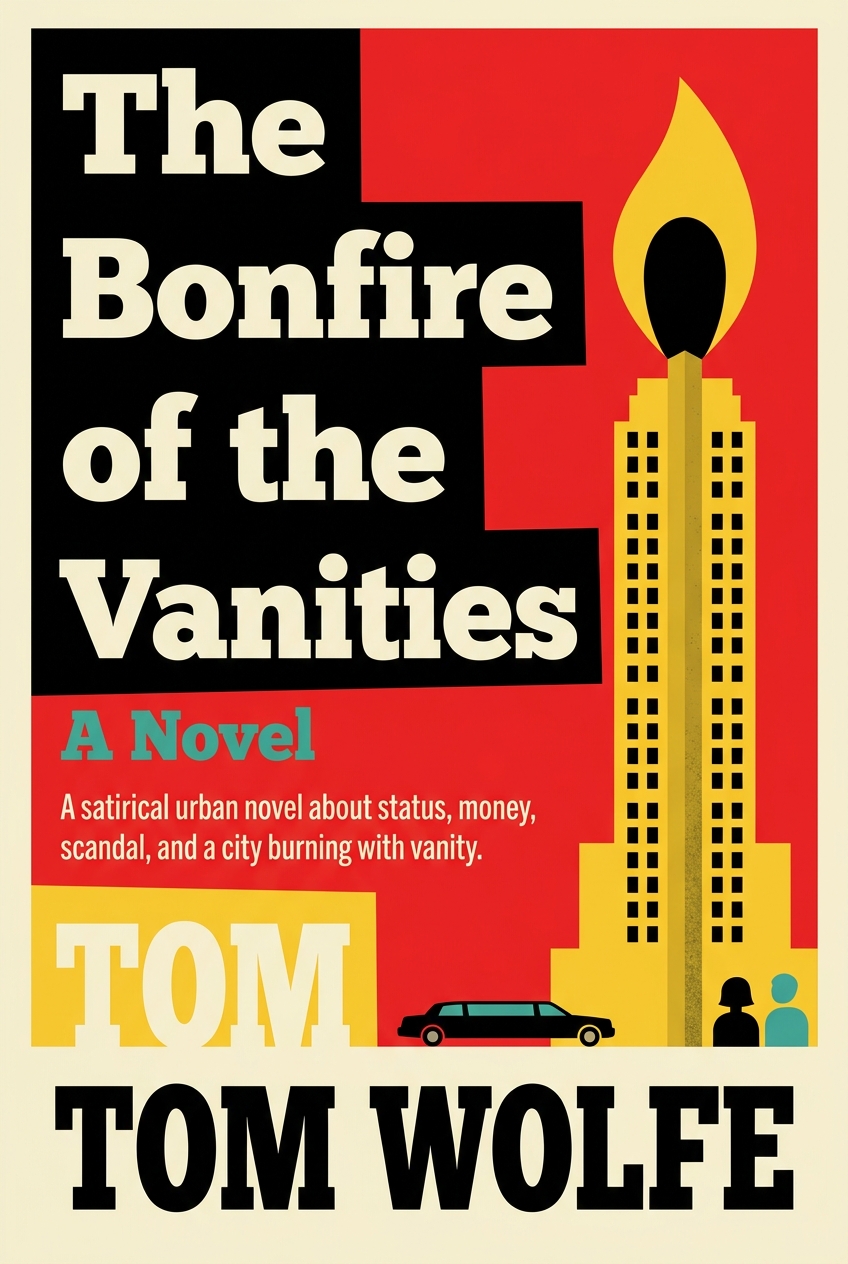
The Bonfire of the Vanities
A Novel
What's it about
Ever wonder what happens when a self-proclaimed "Master of the Universe" loses control? Discover the exhilarating downfall of Sherman McCoy, a Wall Street titan whose perfect life unravels after one disastrous wrong turn in the Bronx. This is your front-row seat to the collision of ambition, greed, and social class in 1980s New York. You'll follow Sherman's descent as his scandal ignites a media firestorm, manipulated by opportunistic politicians, tabloid journalists, and community leaders. This biting satire exposes the vanity, racial tensions, and brutal power dynamics hidden beneath the city's glamorous surface, revealing how quickly a life built on wealth and status can be reduced to ashes.
Meet the author
Hailed as the creator of "New Journalism," Tom Wolfe was a pioneering writer and cultural critic whose immersive reporting style changed the face of American literature. His background as a journalist for publications like the New York Herald Tribune gave him a unique, street-level view of the city's power dynamics and social strata. This firsthand experience allowed him to meticulously document the excesses and anxieties of 1980s New York, providing the rich, satirical detail that makes The Bonfire of the Vanities so compelling.
Opens the App Store to download Voxbrief

The Script
A man in a bespoke suit, who commands billions with a single phone call, stands on his Park Avenue terrace surveying the city that worships him. He feels invincible, a modern-day god perched atop his Olympus. He is a ‘Master of the Universe,’ a term coined for the financial titans of his era. But what happens when that god takes one wrong turn in his Mercedes, ends up in the Bronx, and his pristine world collides with one of desperation and simmering rage? Suddenly, the intricate web of power, money, and influence he so expertly navigates becomes a trap. The same media that built his legend now sharpens its knives. The prosecutors, politicians, and poverty pimps who circle the city’s fringes smell blood. His fall from grace is a public spectacle, a city-wide bonfire fueled by status, race, and ambition.
This exact scenario—the spectacular implosion of a Wall Street king—was a story that journalist and author Tom Wolfe felt compelled to tell. For years, he had been observing the seismic shifts in New York City's culture, from the stratospheric wealth of the financial district to the simmering tensions in its outer boroughs. He saw a city ripe for a grand, panoramic novel in the tradition of Dickens or Balzac, one that could capture the absurdity and tragedy of the 1980s. After embedding himself in the world of bond traders, criminal courts, and political dealmakers, Wolfe decided to serialize his story in Rolling Stone magazine, writing each installment against a relentless deadline. This forced, high-pressure process gave the novel its frantic energy, capturing the very essence of the city it portrayed—a chaotic, glorious, and unforgiving bonfire of human vanities.
Module 1: The Masters of the Universe and Their Paper-Thin Kingdom
We first meet Sherman McCoy. He’s a self-proclaimed "Master of the Universe." He's a bond trader at the fictional firm Pierce & Pierce, pulling in nearly a million dollars a year. He lives in a sprawling Park Avenue apartment that cost him millions. He has a socialite wife, a daughter at a prestigious school, and a mistress on the side. From his perch, he feels invincible. But Wolfe immediately shows us the cracks in this kingdom.
The central insight here is that extreme wealth creates an illusion of control, not genuine power. Sherman’s identity is built on external validation. He needs the admiring stares on Park Avenue. He needs the astronomical numbers on his trading screen. His sense of self-worth is tied to his $2.6 million apartment, a purchase that leaves him drowning in debt and guilt. He contrasts his lavish lifestyle with the quiet principles of his father, a legendary lawyer from a bygone era. The "Lion" McCoy took the subway as a matter of principle. Sherman, in contrast, seeks insulation. He takes a taxi down the FDR Drive to avoid the city's grit.
And here's the thing. This insulated world is incredibly fragile. We see this when Sherman tries to leave his apartment for a rendezvous with his mistress, Maria. He’s reduced to a comical figure, kneeling on his marble floor, struggling to leash his dog. His wife, Judy, effortlessly pins him down with guilt and logic. He wins the argument with a flash of temper, but it's a hollow victory. This "Master of the Universe" is powerless in his own home. So, what’s the lesson for us? Your professional title doesn’t immunize you from personal chaos. Sherman’s dominance on the trading floor is a performance. It's a role he plays in a specific arena. Outside that arena, he’s just as clumsy and vulnerable as anyone else. His power is contextual, not absolute.
This brings us to the social dynamics of his world. Wolfe introduces us to the "Social X-rays." These are the rail-thin, wealthy women in his wife's circle, obsessed with appearance and status. Their lives are a performance of leisure. Then there are the "Knickerbockers," the old-money establishment represented by his neighbor, Pollard Browning. Sherman, with his new money, constantly feels judged by this old guard. His anxiety reveals a critical truth: status is a relentless, competitive game, even at the top. You might think reaching the peak means you can relax. Wolfe argues the opposite. The peak is where the scrutiny is most intense. Every choice, from your suit to your dog, is a signal being judged by the tribe.
Module 2: The Two Cities and the Spark That Ignites the Fire
Now, let's turn to the event that changes everything. Sherman is driving his mistress, Maria, home from the airport. They take a wrong turn. Suddenly, their $48,000 Mercedes roadster is lost in the South Bronx. The landscape is a nightmare of urban decay. It's a "junkyard" of abandoned cars and rubble. This is the other city.
Here, Wolfe makes a powerful point: privilege creates blind spots that can be fatal. Sherman’s knowledge of New York is limited to his affluent bubble. Park Avenue, Wall Street, the Hamptons. In the Bronx, his social armor—the expensive car, the designer clothes—is useless. It makes him a target. They get stuck on an expressway ramp. Two young Black men approach. In the ensuing panic, Maria takes the wheel and their car strikes one of the youths. They speed away. Sherman thinks he hears a "thok." Did they hit him? Maria is adamant: "Two niggers tried to kill us, and we got away." She refuses to go to the police, fearing the scandal.
This is the pivotal moment. Sherman’s fear and guilt begin to consume him. But the incident also reveals something fascinating about the psychology of crisis. Afterward, Sherman and Maria are bonded by an adrenaline rush. They laugh, exhilarated by their survival. Sherman feels like a hero, her "protector." He has faced the "elemental enemy." This leads to a crucial insight: crisis can forge a powerful, but dangerously distorted, narrative of heroism. Sherman rationalizes his actions. He reframes a moment of panic and potential crime as a story of valor. He adopts Maria’s narrative: it was the "jungle." They were the survivors. This self-serving story allows them to avoid moral responsibility. For a little while.
But the other city doesn’t forget. The victim, a young man named Henry Lamb, is left in a coma. And this is where the machinery of 1980s New York kicks into gear. The incident is a public commodity.
Module 3: The Ecosystem of Outrage: Media, Politics, and the Law
The hit-and-run story lands on the desk of Peter Fallow. He’s a washed-up, alcoholic British journalist at a tabloid called The City Light. For Fallow, this is a career lifeline. He sees an angle: a poor Black "honor student" from the Bronx, run down by a rich driver in a Mercedes. The story is a sensation.
Building on that idea, the case is seized upon by Reverend Reginald Bacon. He's a charismatic community activist in Harlem. Bacon sees the incident as a perfect symbol of systemic injustice. He organizes protests. He holds press conferences. He frames the narrative as a clear-cut case of a wealthy white man getting away with harming a Black youth. But Wolfe shows us Bacon is also a master operator. He leverages the outrage for political power and, it’s hinted, personal gain. He understands that in the urban ecosystem, tragedy is a form of currency. It can be used to demand attention, mobilize communities, and pressure the establishment.
This pressure lands squarely on the Bronx District Attorney, Abe Weiss. Weiss is facing a tough reelection campaign in a borough that is 70% Black and Puerto Rican. He can’t afford to look soft on a case like this. He needs a "Great White Defendant." Sherman McCoy is the perfect target. So here's what that means for the justice system. Political survival can dictate prosecutorial strategy more than evidence. The pressure to make an arrest becomes immense. The D.A.’s office is managing a public relations crisis.
Enter Assistant District Attorney Larry Kramer. He's a young, ambitious prosecutor drowning in the thankless, anonymous work of the Bronx courts. The McCoy case is his golden ticket. It's a chance for fame, for recognition, for a way out. Kramer’s journey shows us how personal ambition fuels the machinery of public justice. He becomes obsessed with the case for what it can do for him. He fantasizes about the courtroom sketches on the evening news. He imagines the headlines with his name in them. The fate of Sherman McCoy and Henry Lamb becomes secondary to the drama of his own career.