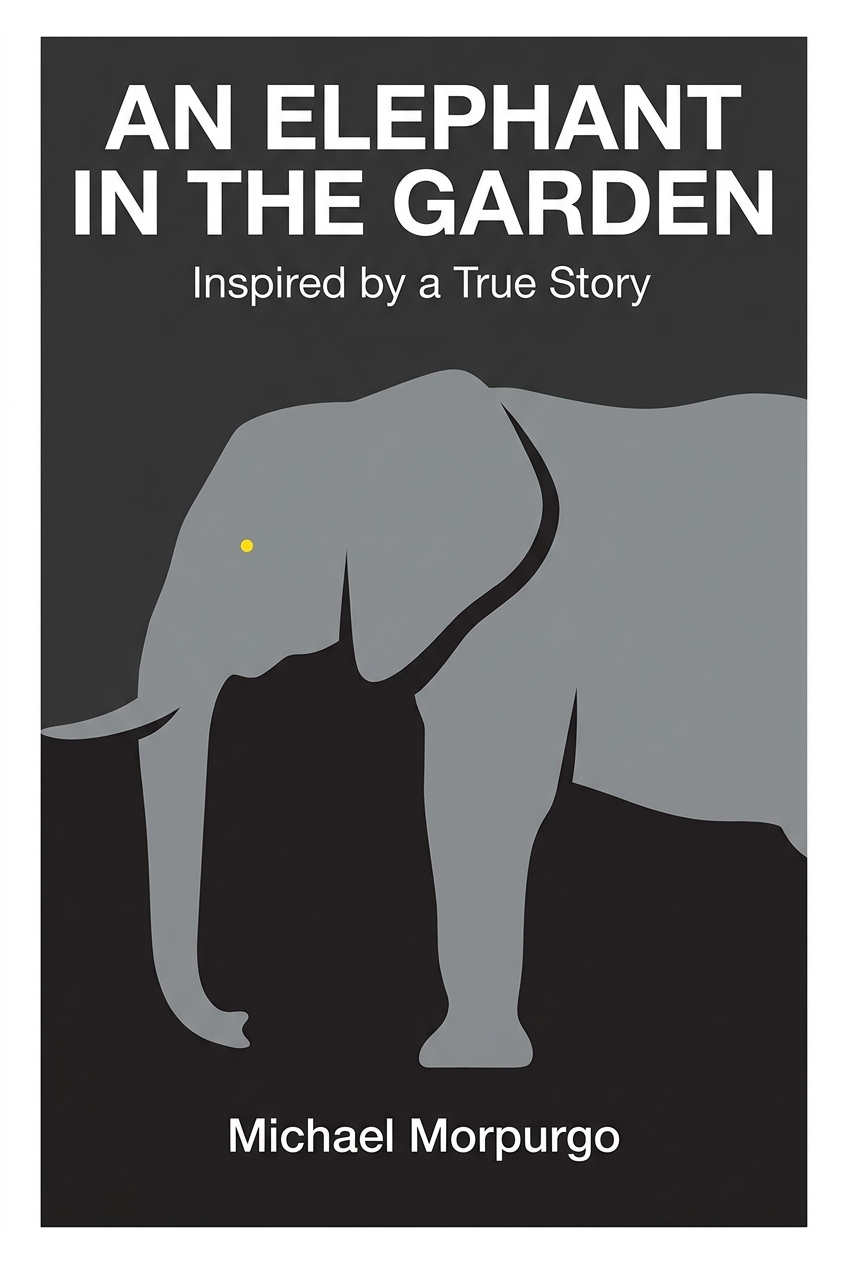
An Elephant in the Garden
Inspired by a True Story
What's it about
Ever wondered how an ordinary family’s love for an animal could help them survive the unthinkable? Discover a story of courage and hope that proves even in the darkest days of war, compassion can light the way forward and redefine what it truly means to be a family. Join young Lizzie, her mother, and an elephant named Marlene on a perilous journey as they flee the Allied bombings of Dresden. You'll learn how their unlikely bond becomes their greatest strength, teaching them invaluable lessons about resilience, loyalty, and finding humanity amidst the chaos of war.
Meet the author
Celebrated as the third British Children's Laureate and a master storyteller, Sir Michael Morpurgo has captivated millions with his poignant and historically rich novels for young readers. His deep empathy for the past, often inspired by real-life events and the unsung heroes of wartime, allows him to craft powerful narratives like An Elephant in the Garden. Through his work, Morpurgo illuminates the enduring strength of the human and animal spirit in the face of conflict.
Opens the App Store to download Voxbrief

The Script
Dresden, Germany, February 1945. A zookeeper’s daughter, Lizzie, listens to the whine of the air-raid sirens, a sound that has become the city’s grim heartbeat. She knows the protocol: shelter. But her mother, Mutti, a woman who understands the quiet, unspoken languages of the animal world better than the loud, chaotic one of humans, is making a different choice. While others run for the cellars, Mutti is unlocking cages. She is leading an elephant—a young, gentle giant named Marlene—out of the zoo and through the darkening streets. This is a desperate act of loyalty, a promise made to a creature who is as much a part of their family as any human.
Their home is no longer safe, but the world outside is a battlefield. With Marlene the elephant in tow, the small, unlikely family—Lizzie, her mother, and a resentful young refugee named Peter—flees the ruins of their city. They are walking into the heart of a war zone, armed only with a fierce, protective love for an animal that the world sees as either a curiosity or a liability. Their journey is a quiet testament to the idea that in the midst of humanity's greatest failures, our connection to the natural world, and our compassion for its creatures, can be the very thing that saves us.
This powerful story of survival was born from a quiet, haunting photograph. Michael Morpurgo, a celebrated author known for weaving history and heart together, once saw a picture of a real elephant being led from the rubble of a bombed German city. The image stuck with him, raising a profound question: What becomes of the innocent—both human and animal—when the world descends into chaos? Morpurgo, who co-founded the charity Farms for City Children with his wife, has dedicated his life to fostering the bond between children and animals. He wrote "An Elephant in the Garden" to explore that bond in its most extreme form, crafting a tale inspired by a true event to illuminate the resilience of the human spirit and the quiet dignity of the animals caught in our crossfire.
Module 1: The Erosion of Innocence
The story begins in a world of idyllic childhood. Lizzie, the narrator, recalls a life rich with simple pleasures. Her family home in Dresden is a sanctuary. It has a walled garden, a swing, and cooing pigeons. Her father, Papi, restores paintings and loves the music of Bach. Her mother, Mutti, adores Marlene Dietrich. They have "musical picnics" by the lake. This peaceful world is a bubble. Outside, the shadows of Nazi Germany are growing.
This leads us to the first core insight. Political turmoil seeps into daily life, slowly poisoning relationships and routines. Lizzie sees the injustice on the streets. She sees Jewish people forced to wear yellow stars. She sees their shops vandalized. Her family tries to create an "oasis" at home. They forbid political talk. But the outside world cannot be kept out forever. A bitter argument with their uncle, a fervent Hitler supporter, shatters the family. The holidays at his farm end. The ideological divide becomes a permanent rift. Then, the war becomes brutally personal. Papi comes home in a gray army uniform. He is being sent to the front. Lizzie describes this moment as "the beginning of our nightmare." The sanctuary is broken.
So, how do you cope when your world fractures? The family clings to rituals. Maintaining small, consistent acts of connection provides an emotional anchor in chaos. They hold "family moments" around the kitchen table. They hold hands. They think of Papi. His letters and photograph are placed on the mantelpiece. It’s almost like an altar. These rituals are a fragile defense against the growing emptiness. Lizzie, now a teenager, feels hollow and angry. The happiness is being stripped away from her, day by day. She becomes irritable, even with her beloved younger brother, Karli. The war is a thief, stealing her youth and her family's joy.
And here's the thing. In this bleak new reality, new bonds form in unexpected ways. Empathy for non-human life can become a powerful coping mechanism against feelings of helplessness. Mutti works at the local zoo. She develops a deep bond with a young elephant named Marlene, whose mother has died. She explains that elephants grieve just like people. She spends extra hours comforting the animal. Soon, Marlene's photo is on the mantelpiece right next to Papi's. The elephant has become part of the family. This creates friction. Lizzie grows jealous of the attention Mutti gives the elephant. "She is just an elephant!" she shouts. This outburst leads to a raw, honest conversation. Mutti confesses her fear and helplessness. She can't stop the war. But she can care for her children. And she can care for this grieving animal. It's in this shared vulnerability that Lizzie begins to see her mother as a person struggling to hold on.