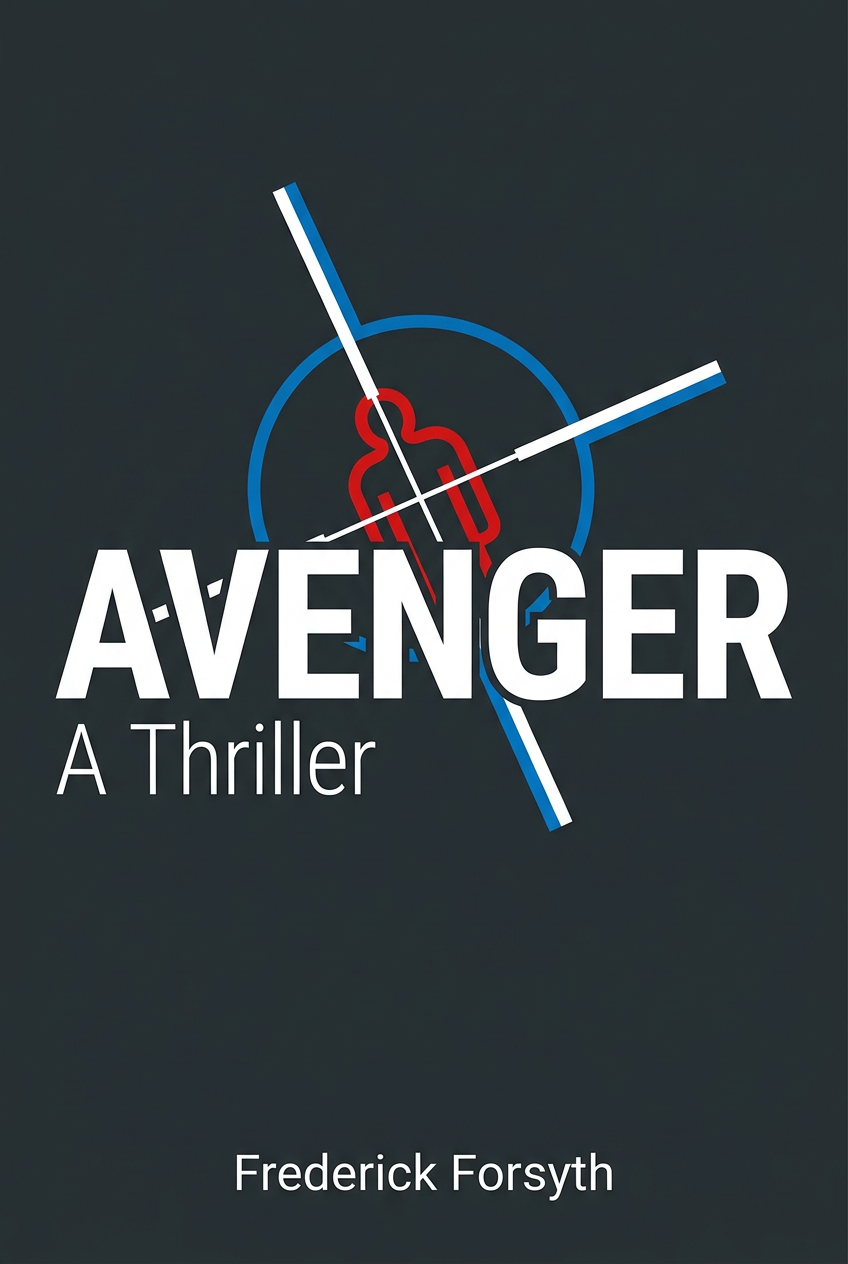
Avenger
A Thriller
What's it about
What if you could hunt down the world's most dangerous criminals when justice fails? Discover the story of a man who does just that, a former elite soldier turned lawyer who operates in the shadows, delivering his own brand of retribution to those who escape the law. Learn how this vigilante, known only as the Avenger, uses his vast resources and deadly skills to track a Serbian war criminal. You'll follow his high-stakes mission from the jungles of Vietnam to the dark corners of international crime, uncovering a web of deceit that reaches the highest levels of power.
Meet the author
As the youngest pilot in the Royal Air Force at nineteen and a former MI6 spy, Frederick Forsyth brings unmatched authenticity to the world of international espionage. His real-world experience as a covert operative and investigative journalist provides the backbone for his meticulously plotted thrillers, including the gripping narrative of Avenger. Forsyth's career, spanning decades of direct involvement in global intelligence, infuses his writing with a level of detail and suspense that only a true insider can deliver.
Opens the App Store to download Voxbrief

The Script
Imagine two identical shotguns. They leave the factory on the same day, stamped with consecutive serial numbers, their barrels bored from the same steel billet, their stocks carved from the same walnut tree. One is sold to a sportsman who cherishes it. He keeps it clean, oiled, and locked away, bringing it out for a few weekends of clay pigeon shooting each autumn. It fires maybe five hundred shells in its lifetime. Its action remains tight, its finish pristine. The other is sold to a backwoods poacher. It lives behind the seat of a pickup truck, rattling against a tire iron. It’s used to put food on the table, to settle disputes, to guard a moonshine still. It’s dropped in the mud, left out in the rain, and cleaned with a rag dipped in gasoline. It fires thousands of rounds, its stock is scarred, its barrel pitted. After twenty years, the sportsman’s gun is still a fine tool. The poacher’s gun is a dangerous, unpredictable weapon, its tolerances worn, its mechanisms loose. It has been shaped by the life it has lived.
A person can be like that second gun. A life of hard use—of combat, loss, and moral compromise—can wear down the soul, scarring it in ways that make it dangerously effective for one specific, terrible purpose. It can grind away the safeties and social conventions, leaving behind only a core of lethal capability, waiting for a single, compelling reason to be aimed and fired. The man at the center of this story is a product of such a life, a quiet lawyer whose placid surface conceals a past forged in the jungles of Vietnam and the shadowy world of clandestine operations. He is a weapon left leaning in a corner, seemingly retired, until the cry of an innocent victim provides a target.
This exploration of how experience shapes a person into an instrument of justice—or vengeance—comes from a mind intimately familiar with the hidden mechanisms of the world. Frederick Forsyth was a former RAF pilot and an investigative journalist for Reuters and the BBC. His reporting from behind the lines of the Nigerian Civil War and his work covering covert operations across Europe and Africa gave him a rare, ground-level view of conflict, espionage, and the kind of men who thrive in the gray spaces between law and lawlessness. Forsyth drew his characters from the real-world shadows he had navigated, writing Avenger to explore what happens when one of those highly skilled, deeply scarred individuals decides to balance the scales of justice on his own terms.
Module 1: The Forging of a Hunter
Before we meet the Avenger, we must first understand the man: Calvin Dexter. Forsyth spends significant time building Dexter’s backstory to establish the foundation for his later actions. His life is a series of crucibles, each one hardening him and honing a unique set of skills.
First, a brutal past creates profound resilience. Dexter’s childhood is one of poverty and instability. He grew up in a trailer, moving constantly between construction sites with his father. He attended nine different schools. This transient life denied him a formal education. But it gave him something else: street smarts and a relentless drive to escape his circumstances. He learned to be self-reliant. He learned to read people and situations quickly. This foundation of practical, hard-won survival skill is the bedrock of the man he becomes.
This drive leads him to the military. In the late 1960s, most young men were trying to get out of the Vietnam War. Dexter walks into a recruitment office and volunteers. He sees the army as his only viable escape route. It offers structure, education, and a purpose beyond a dead-end construction job. This decision reveals a core part of his character: he actively seeks out difficult paths for strategic gain. He doesn't just enlist; he insists on going to Vietnam. He runs toward the fire.
In Vietnam, his unique psychological makeup finds its purpose. He is recruited into one of the most dangerous and secretive units of the war: the Tunnel Rats. These were small, quiet men sent to navigate the Vietcong’s underground labyrinths. It was a form of warfare that was primal and terrifying. Here, Dexter learns that instinct and experience trump formal training in extreme environments. His officer, a man known as the Badger, defers to Dexter’s "sense for danger" inside the tunnels. They formed a bond of absolute trust, a partnership where each man’s life depended entirely on the other. This experience taught him to operate alone, in the dark, against a hidden enemy. It was the perfect training ground for an avenger.
Module 2: The Birth of the Avenger
Every superhero has an origin story. For the Avenger, it’s a tragedy. After the war, Dexter builds a life. He uses the GI Bill to go to law school. He becomes a public defender in New York, fighting for the downtrodden. He marries, has a daughter, Amanda, and finds a measure of peace. And then, it’s all taken away.
His daughter, a college student, is lured away by a gang recruiter. She is forced into prostitution, addicted to heroin, and brutally murdered. The official systems of justice fail him. The NYPD is overloaded. The FBI can only identify her body after the fact. The killer escapes to Panama, a country with no extradition treaty for this crime. The system can’t touch him.
So here’s what that means. When institutional justice fails, personal justice becomes a powerful, motivating force. Dexter’s grief and rage are channeled into a singular purpose. He is no longer just a lawyer. He becomes a hunter. He uses his life savings, his military skills, and his network to track his daughter’s killer. He adopts a disguise, infiltrates Panama, and executes the man responsible. He delivers his own brand of justice.
The act, however, breaks him. He can no longer be the man he was. He quits his job. He sells his apartment. His wife, unable to cope with the loss, takes her own life. This second tragedy completes his transformation. He has lost everything. This is a crucial point. Profound loss can catalyze a complete redefinition of one’s purpose. Dexter moves to a small town in New Jersey. He opens a quiet law practice. He creates a mundane facade to hide his new reality.
But underneath, a new identity has been forged. He takes up the brutal discipline of the triathlon, using physical pain to combat his emotional agony. And he creates a secret method for taking on new missions. He places a coded ad in Vintage Airplane magazine. The ad is simple: "AVENGER. Wanted. Serious offer. No price ceiling." This is how the wealthy and powerless can hire a ghost to hunt down those who have escaped justice. He will find them. He will capture them. And he will return them to face the law. The Avenger is born.
Module 3: The Target and The Mission
Now, let's turn to the central mission of the book. Years after Dexter has established his secret life, he receives a call. It’s from Stephen Edmond, a Canadian billionaire industrialist. Edmond’s grandson, Ricky Colenso, was a young American aid worker in Bosnia during the civil war in 1995. Ricky was brutally murdered by a Serbian paramilitary leader named Zoran Zilic.
The crime was horrific. Ricky was drowned in a cesspit. Six orphaned children under his care were executed. The murder was witnessed by a young Serbian law student, Milan Rajak, who was forced to participate. For years, Rajak was haunted by guilt and fear. He eventually becomes a monk and, facing a terminal illness, decides to confess. His sworn statement provides the first concrete evidence of what happened. But there's a problem. Zilic has vanished.
Here we see the core challenge of modern justice. Powerful criminals exploit a borderless world to evade accountability. Zilic is a master of adaptation. He partnered with the Milosevic regime, committed atrocities, and amassed a fortune. But unlike his peers, he saw the regime's collapse coming. He moved his money, erased his identity, and disappeared before he could be brought to The Hague. The world’s most powerful intelligence agencies—the CIA, FBI, and DIA—run a full search. They find nothing. Their files are 15 months out of date. Zilic is a ghost.
This is where the official systems hit a wall. Senator Peter Lucas, a powerful friend of the family, pulls every string in Washington. He gets the Attorney General and the Secretary of State involved. The U.S. government, empowered by laws like the Omnibus Antiterrorism Act of 1986, asserts its right to hunt down the killer of an American citizen anywhere in the world. But you can’t arrest a ghost.
Frustrated, the FBI gives Edmond one last, desperate lead. A rumor. A whisper of a freelance operative known only as "Avenger." So Edmond places the ad. Dexter answers the call. The mission is clear: find Zoran Zilic and bring him back to face American justice. The price? Ten million dollars. Dexter accepts.