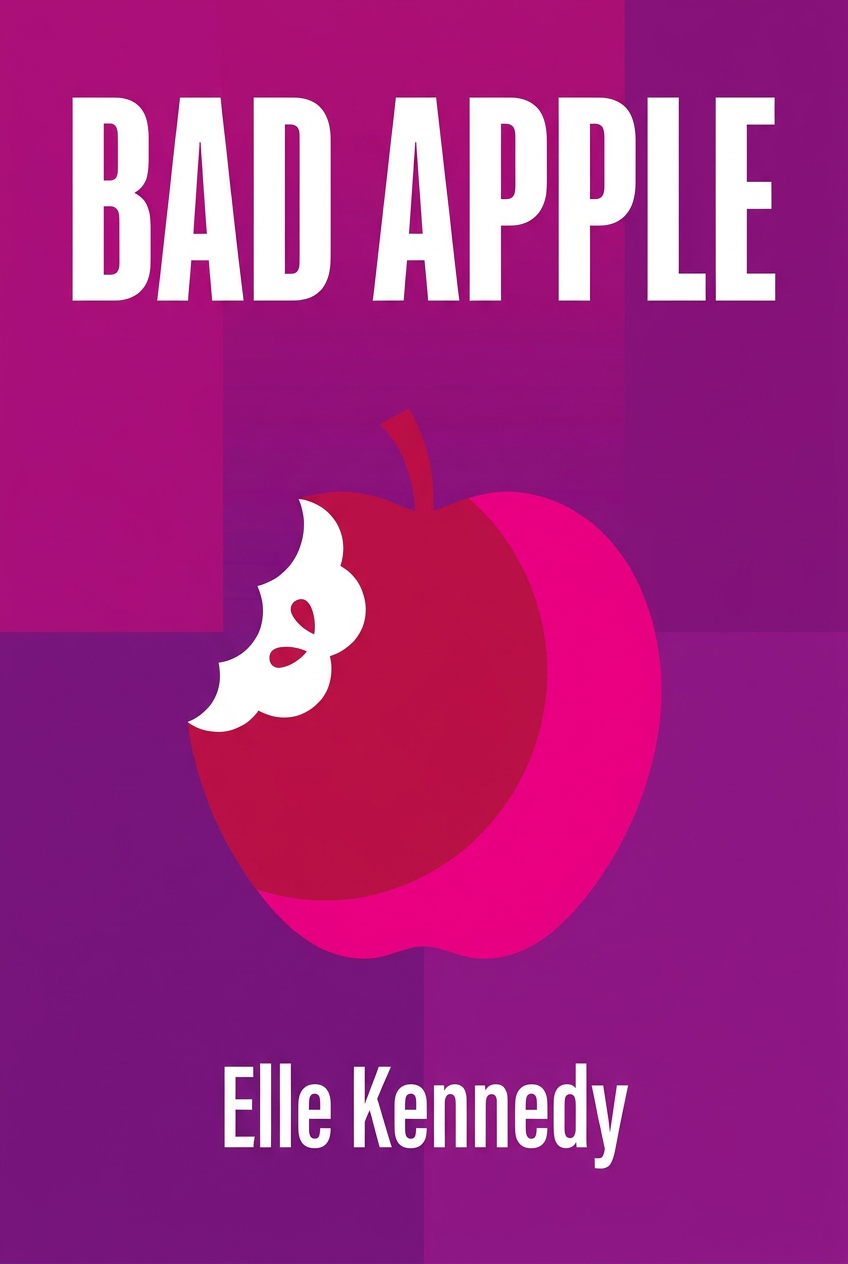
Bad Apple
What's it about
Ever wondered if you could find love with the one person you're supposed to hate? Get ready to explore the thrilling line between a bitter rivalry and undeniable passion, where every stolen glance and heated argument could lead to something more. This story plunges you into a fiery enemies-to-lovers romance. You'll discover how a decades-long family feud fuels the intense, forbidden connection between two stubborn rivals. Learn how they navigate secret desires and public expectations, turning a legacy of hate into a chance for an epic love affair against all odds.
Meet the author
Elle Kennedy is a New York Times, USA Today, and Wall Street Journal bestselling author who has sold over eight million copies of her books worldwide. A former RITA award winner, she has spent over a decade mastering the art of contemporary romance, creating beloved characters and addictive stories that resonate with a global audience. Her passion for exploring the complexities of relationships and crafting compelling narratives is at the heart of every novel, including the captivating world of Bad Apple.
Opens the App Store to download Voxbrief

The Script
Think of two childhood best friends who share everything. They have the same favorite movie, the same inside jokes, the same secret handshake. From the outside, they are two halves of a whole, their lives running on parallel tracks. But one day, a single event—a whispered accusation, a stolen glance, a moment of betrayal—acts like a railway switch. One friend’s track continues straight, following the expected path. The other’s is violently diverted, sent careening into a landscape of isolation and infamy. Now, years later, their paths are forced to cross again. The person who stayed on the rails sees the other as a cautionary tale, a life derailed. But the one who was diverted looks back and sees something else entirely: a survivor who learned to thrive in a harsher, more unforgiving wilderness, someone who built their own tracks where none existed.
This dynamic of two people shaped by a single, diverging event is the engine that drives so many of Elle Kennedy’s stories. As a New York Times and USA Today bestselling author, Kennedy has built a career exploring the intense, often messy connections that form in the charged environments of college campuses and small towns. For her, the 'bad boy' or 'bad girl' archetype is a starting point for asking deeper questions about reputation, loyalty, and the stories we tell ourselves about the people we once knew. In "Bad Apple," she pushes this exploration further, crafting a story born from her fascination with how a shared past can look so different from two opposing sides, and whether two tracks, once split, can ever truly merge again.
Module 1: The Accidental Encounter and the Allure of Anonymity
The story kicks off with a simple, high-stakes mistake. Maggie, a driven social work student, has her life scheduled down to the minute. Work, school, volunteering. That's it. She maintains a casual arrangement with a travel writer she sees a few times a year. It’s purely physical. No strings, no emotional drain. She believes relationships are a distraction she can't afford.
So, one night, she goes to a hotel to meet him. She enters the room, finds a man in the dark, and things get intimate. Fast. But it’s not him. It’s Ben Barrett, a Hollywood actor hiding from a media firestorm. He’s been labeled "Hollywood's most notorious bad boy." Paparazzi are camped outside his home. He can't sleep. He can't think. He's desperate for a moment of peace. So he checks into a nondescript hotel under a fake name, seeking total anonymity.
This accidental meeting reveals a powerful truth. Authentic connection thrives where status is irrelevant. Ben is immediately intrigued by Maggie for one reason. She has no idea who he is. For the first time in ages, someone treats him like a normal person, not a celebrity commodity. She’s just a mortified woman who walked into the wrong room. This authenticity is a breath of fresh air for him.
From this foundation, we see how their initial dynamic is shaped by their personal histories. Maggie is deeply embarrassed, assuming Ben thinks she’s a "nutcase." Her life is built on control and responsibility. This mistake is a chaotic anomaly. Ben, on the other hand, is conditioned by fame. His first thought is that she’s a plant from the tabloids. His world is full of people with ulterior motives.
And here’s the thing. Humor becomes the bridge over awkwardness and suspicion. After the initial shock, both characters find the situation absurdly funny. Maggie laughs hysterically on her way home. Ben can’t stop chuckling at the memory of this beautiful stranger kissing him and then offering free drinks as an apology. This shared sense of the ridiculous diffuses the tension. It creates a small, humanizing link between them before they even know each other’s names.
Ultimately, this first module establishes a critical theme. Public personas are often a prison, and anonymity is the key to freedom. Ben’s "bad boy" image is a media creation that bears little resemblance to his private self. He’s looking for sleep. He’s exhausted by the performance of being "Ben Barrett." Maggie, by being completely oblivious to his fame, offers him something priceless. She offers him a moment of being just a man in a hotel room. This is the hook that pulls him in, setting the stage for everything that follows.
Module 2: The Negotiation of Space and Desire
Now, let's turn to their second meeting. It happens by chance at the bar where Maggie works. She’s shocked to see him. He’s relieved to find a place where no one is bothering him. The encounter is charged with a mix of embarrassment, attraction, and wariness. Maggie is a fortress of self-control. She’s spent years building a life that leaves no room for complications. And Ben, with his cobalt blue eyes and celebrity baggage, is the definition of a complication.
This leads to a fascinating negotiation. Ben needs a place to hide from the press. He can’t go to another hotel. He can’t trust his friends not to leak his location. So he makes a bold, direct proposition. He asks to stay at her apartment. This is where we get a core insight. In moments of crisis, personal needs and physical desires often merge. Ben’s request is about wanting to be near the one person who sees him as human. He’s drawn to her authenticity. He wants more of it.
Maggie’s reaction is pure self-preservation. Her entire life is a testament to her work ethic. She grew up poor, spent years in the foster system, and has fought for every single thing she has. Her social work degree is her identity. It’s her way of ensuring other kids don't feel as alone as she did. So, her first instinct is to say no. A man like Ben is a threat to her carefully managed focus.
But flip the coin. Intense physical chemistry can dismantle the most logical defenses. Despite her resistance, Maggie is undeniably attracted to Ben. She tries to convince herself she’s immune to his charm, but her body betrays her. This internal battle is central to their dynamic. Her mind says "danger," but her physical response says "more." Ben sees this conflict in her. He knows she’s attracted to him, and he uses that knowledge to press his case. He doesn't back down.
This power struggle reveals another key principle. Ego and vulnerability are in constant tension during courtship. Ben is used to getting what he wants. He tells her, "Women don’t say no to me." It’s an arrogant statement, born from years of fame. Maggie immediately calls him on it. She refuses to be just another woman who falls at his feet. Yet, Ben also shows vulnerability. He shares a story about a childhood friend who betrayed him for money, hinting at a life devoid of real, trustworthy connections. This glimpse of his own loneliness softens Maggie’s resolve.
So here's what that means in practice. She agrees to let him stay, but only after laying down strict ground rules. He can’t interfere with her job. He can’t interrupt her studying. It’s her attempt to contain the chaos he represents. But the deal is sealed with a kiss that proves their chemistry is too powerful to be contained by any set of rules.
Module 3: The Price of Fame and the Burden of the Past
We've covered their meeting. Next up: the reality of their arrangement. Ben moves in, and their two worlds collide spectacularly. Maggie is a workaholic. Her life is a rigid schedule of classes, volunteering, and waitressing shifts. Ben, used to a life of unstructured downtime between films, is a force of spontaneous disruption. He cooks breakfast shirtless while singing the Beach Boys. He tries to get her to relax, to watch a movie, to take a walk. To her, this feels like an attack on her discipline.
This friction highlights a crucial point. Extreme workaholism often serves as an emotional shield. Maggie’s constant busyness is a defense mechanism. She tells Ben that "doing nothing makes me anxious." Ben, having seen burnout in his own industry, recognizes the pattern. He sees her relentless schedule as a way to avoid introspection and intimacy. He correctly guesses that her non-existent love life is a direct result of her need to always be doing something. Her focus on her career is so absolute that when he asks about her life goals beyond that, she admits she's never thought about it.
Building on that idea, the story shows how past trauma shapes present-day defenses. We learn the devastating truth of Maggie’s childhood. Her mother abandoned her at a gas station when she was five. She then spent thirteen years in sixteen different foster homes. This experience taught her a brutal lesson: Lasting connections are unreliable, so you must rely only on yourself. Her career in social work is her anchor. It’s the one thing that gives her a sense of purpose and stability. She sees her goals as non-negotiable because they are the foundation of her entire identity.
In contrast, Ben’s burden is different but just as heavy. He’s trapped by a false public narrative. The media portrays him as a playboy who had an affair with a wealthy, married older woman named Gretchen Goodrich. She recently died and left him twenty million dollars. The truth is far more painful. Gretchen was the woman his father secretly married while still married to Ben’s mother. The inheritance was a gesture of guilt. But Ben can’t tell the world the truth. Why? Protecting loved ones from pain can be a heavier burden than enduring a false reputation. He chooses to let the world think he’s a sleazebag to shield his mother from having her deepest wound splashed across the tabloids.
This module culminates in a trip to the Bahamas. Ben, seeing how overworked Maggie is, arranges a getaway. It’s here, away from their normal lives, that their guards finally come down. But the escape is short-lived. A supermodel publicly humiliates Maggie for being a "waitress," calling her out for "slumming it" with Ben. The incident is a brutal reminder of the class divide between them. The fragile intimacy they’ve built shatters.