All Books
Self-Growth
Business & Career
Health & Wellness
Society & Culture
Money & Finance
Relationships
Science & Tech
Fiction
Topics
Blog
Download on the App Store

Beasts of a Little Land

A Novel

16 minJuhea Kim

What's it about

Have you ever wondered how love, ambition, and survival intertwine during a nation's most turbulent times? This epic historical novel plunges you into early 20th-century Korea, following the intertwined destinies of a young girl and a penniless hunter as they navigate a world torn apart by war. You'll discover the resilience of the human spirit as their lives intersect with courtesans, freedom fighters, and soldiers against the backdrop of Japanese occupation. Witness a sweeping saga of forbidden love, heartbreaking loss, and the fierce struggle for independence, all while exploring Korea’s rich culture and history.

Meet the author

Juhea Kim is the founder of Peaceful Dumpling, an online magazine for sustainable living, and a contributor to publications including the Times of London and The Independent. Her lifelong fascination with Korean history and its traditional arts, combined with her advocacy for environmentalism, culminates in her epic debut novel. Kim’s extensive research and deep personal connection to the subject matter bring the tumultuous world of early 20th-century Korea to life with profound authenticity and heart.
Listen Now

Opens the App Store to download Voxbrief

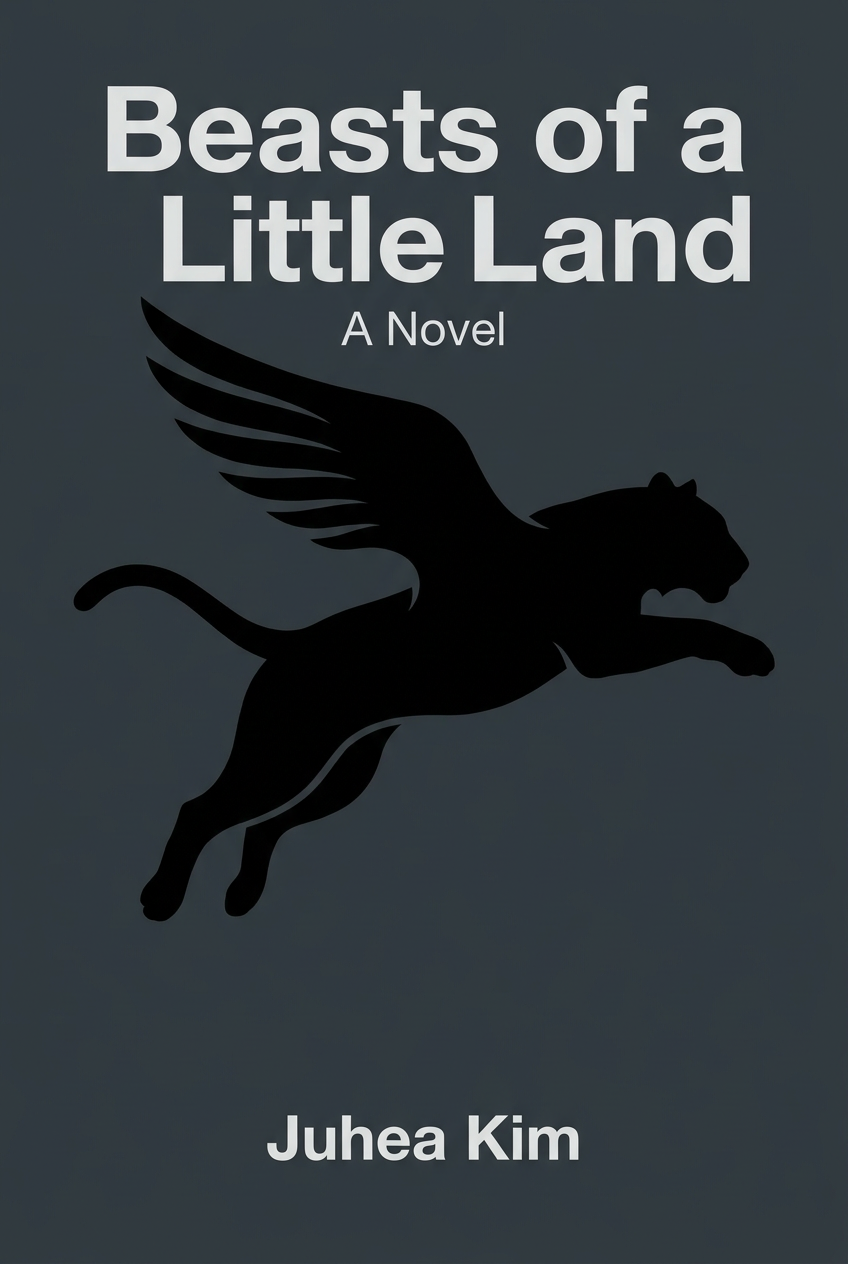
Beasts of a Little Land book cover

The Script

In a hunter’s cabin, deep in the mountains, a young boy is given a choice. He can learn to read the forest by its official language—the names of trees, the classifications of animals, the established trails. This is the language of maps and masters, a knowledge that can be taught and tested. Or, he can learn the forest’s private tongue, a language spoken in the subtle shift of a pine needle underfoot, the specific silence that follows a predator’s passage, the way a shadow’s edge tells the time of year, not just the time of day. One path offers the security of known facts. The other offers a deeper, more dangerous connection—a way of belonging to the land itself, not just moving through it.

This choice, between a life of prescribed roles and one of intuitive survival, animates the world of Beasts of a Little Land. Author Juhea Kim felt a profound disconnect from her own Korean heritage, a history often told through grand, impersonal narratives of war and occupation. She wanted to find the private tongue of her ancestors’ world—the stories of individuals whose lives were shaped by choices both small and seismic. A former contributing editor for an online literary magazine, Kim spent years researching the era, but she was searching for the human pulse beneath the historical record, weaving together the lives of courtesans, hunters, and revolutionaries to tell a story of Korea as a living, breathing land of beasts, both animal and human.

Module 1: The Rules of the Hunt—Survival, Power, and Honor

The novel opens in the harsh, snow-covered mountains of 1918 Korea. A starving hunter, Nam, stalks a leopard. This initial scene sets the stage for the core themes of the entire book. It’s a world where survival is a primal contest. And it’s here we see our first key insight.

The author shows us that in a world of scarcity, survival depends on a deep, almost spiritual respect for the rules of nature and power. Nam isn’t just a killer; he’s a participant in the mountain’s ecosystem. He understands its rhythms. He respects its most powerful creatures. His father taught him never to hunt a tiger unless it attacks first. This is a practical rule for survival. You don't challenge a power you can't defeat. This principle echoes throughout the book, from the mountains to the city streets to the halls of political power.

This brings us to the introduction of a new kind of beast: the Japanese colonial officers. They are on a tiger hunt, and they embody a starkly different relationship with power. While the hunter respects nature, the officers seek to dominate it. Major Hayashi executes a Korean guide for a simple mistake. He treats the man's life as worthless. Captain Yamada, a man of privilege, openly challenges his superior. He knows his social standing protects him.

This is where the second insight clicks into place. Colonial power operates with arbitrary brutality, reducing human lives to commodities. The Japanese officers see Korea and its people as resources to be exploited. Tigers are hunted for their skins and for the misguided belief that eating their flesh grants valor. Koreans are seen as "Josenjing," a derogatory term for an inferior people. They are tools, obstacles, or inconveniences. Their lives can be taken or spared based on the whim of a powerful officer.

But then, something unexpected happens. After the hunter saves the officers from a tiger, Captain Yamada, the arrogant officer, intervenes to save the hunter’s life. He does it from a complex, transactional sense of honor. He can’t be indebted to an "inferior." This leads to a surprising alliance.

Here’s the thing: Even in the most oppressive systems, unexpected moments of compassion and honor can forge alliances across divides. Yamada gives the hunter a silver cigarette case, a token that will become a crucial link in the story. This single act of conflicted honor sets in motion a chain of events that will ripple through generations. It’s a powerful reminder that even in a world governed by brutal systems, individual choices matter. The hunter, the officers, the tiger—they are all beasts on this little land, each following their own code of survival.

Now, let's follow the story as it moves from the desolate mountains to the complex, hidden world of the city. We're moving to our second module.

Module 2: The Gilded Cage—Art, Resistance, and Female Agency

The narrative shifts from the rugged masculinity of the hunt to the refined, yet equally dangerous, world of a giseng house in Pyongyang. These houses trained courtesans in the arts of song, dance, and poetry. Here, a young girl named Jade is sold by her impoverished family. Her story reveals a world where beauty and talent are both a currency and a cage.

We see immediately that in a rigid society, women must navigate a complex web of economic necessity and social stigma to survive. Jade’s mother resists selling her daughter, viewing the life of a courtesan as beneath their class. But Jade, ever pragmatic, calculates the financial benefit. Fifty won could save her family from starvation. This is the brutal calculus of survival for women with limited options. The courtesan house, run by the formidable Silver, is a business. It’s a place where girls are trained, polished, and valued for their ability to please powerful men.

Once inside, Jade discovers that this is no simple finishing school. The training is rigorous. The girls learn dance, music, painting, poetry, and even practical subjects like Japanese and arithmetic. This training was about cultural preservation and intellectual discipline.

And this brings us to a deeper insight. Art and education can become powerful tools for both liberation and control. For Jade, literacy is a secret refuge. She finds solace in the poetry of Hwang Jini, feeling a connection that transcends her confined reality. Yet, this same education is designed to make her a more valuable commodity. The school is a place of immense cultural richness, preserving traditions that are being threatened by colonial rule. But it’s also a system designed to produce women who are, as the book notes, "past their prime by twenty-five and geriatric by thirty."

So what happens next? Beneath this polished surface of art and culture, a dangerous secret is brewing. Silver, the madam of the house, is a key player in the Korean independence movement. She uses her network and her wealth, earned from "pouring drinks and lying with men," to fund the resistance.

This reveals a critical layer of the story: Seemingly apolitical spaces can harbor covert acts of resistance, driven by hidden loyalties. The giseng house, a place dedicated to entertaining the ruling class, including Japanese officers, is simultaneously a hub for rebellion. Merchants transport secret letters and funds. Courtesans risk their lives to support fighters in Siberia. This duality is at the core of the novel. It shows how marginalized people, especially women, find ways to exert agency and fight for a cause that is bigger than themselves, often in the very places where they seem most powerless.

From these hidden worlds of hunters and courtesans, the story expands, and we see how these individual lives begin to intersect on a much larger stage. Next up, we’ll explore the collision of personal dreams and political upheaval.

Read More