All Books
Self-Growth
Business & Career
Health & Wellness
Society & Culture
Money & Finance
Relationships
Science & Tech
Fiction
Topics
Blog
Download on the App Store

Big Dumb Eyes

Stories from a Simpler Mind

14 minNate Bargatze

What's it about

Ever wonder if you're overthinking everything? What if the secret to a happier, less stressful life is to just... stop? Discover how embracing a simpler perspective can help you find humor and clarity in the chaos of modern life, turning everyday frustrations into your greatest punchlines. You’ll learn from comedian Nate Bargatze’s hilarious real-life stories how to navigate awkward social encounters, family quirks, and your own anxieties with a refreshing dose of uncomplicated logic. Get ready to laugh, relate, and find the brilliant simplicity in seeing the world through big, dumb eyes.

Meet the author

Grammy-nominated comedian Nate Bargatze, hailed as "The Nicest Man in Stand-Up," is celebrated for his clean, relatable, and hilariously deadpan observations on everyday life. His unique perspective was shaped by a childhood spent alongside his father, a former clown turned world-class magician, providing a backstage pass to the absurd. This upbringing taught him to find profound humor in the wonderfully simple and mundane, a skill that defines his insightful and universally appealing comedy.
Listen Now
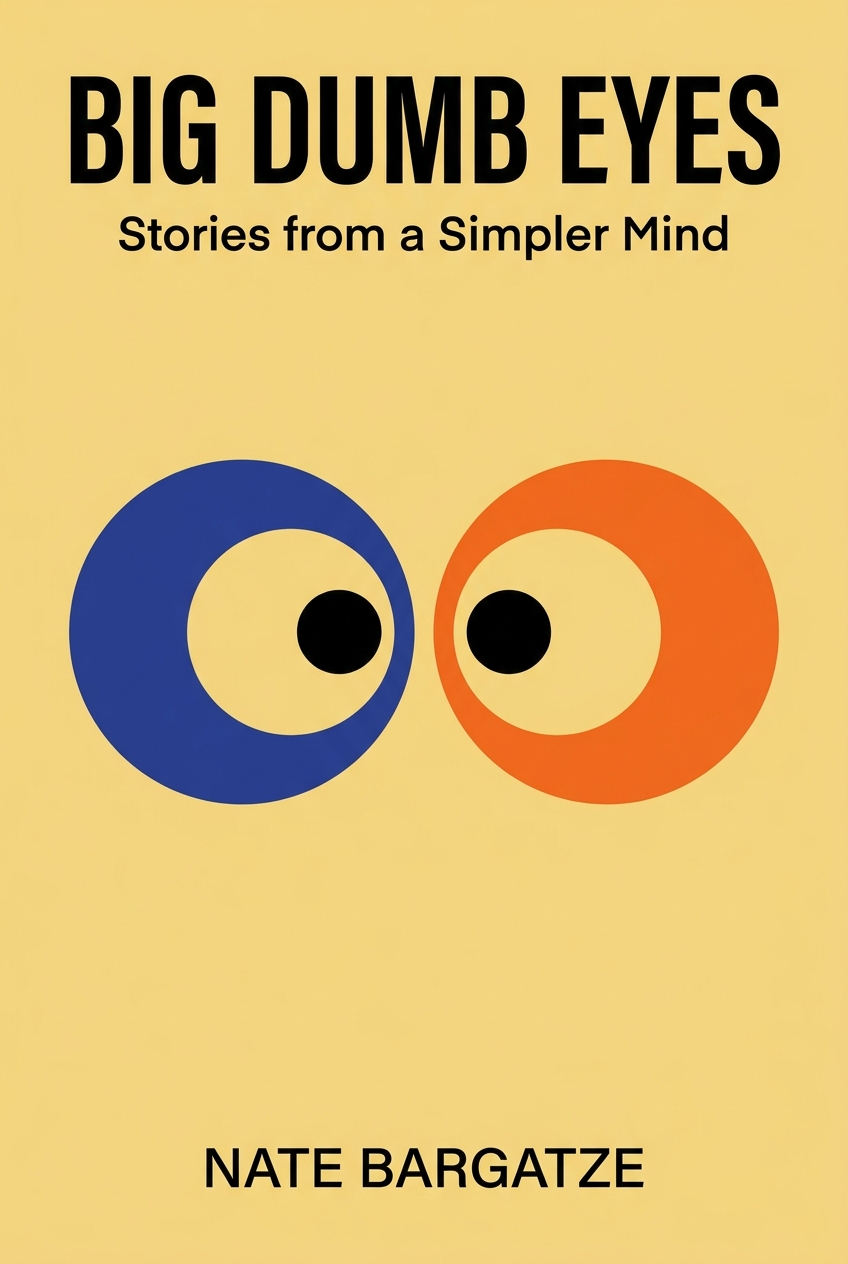
Big Dumb Eyes book cover

The Script

At the grand opening of a new candy store, the owner proudly displays two enormous, identical glass jars of jelly beans. They’re the centerpiece. He tasks his two newest employees—both earnest, both eager to please—with a simple job: guess the number of jelly beans in each jar. The first employee, a math whiz, spends an hour meticulously measuring the jar's volume, calculating the average jelly bean's displacement, and running formulas. He presents his answer with decimal-point precision. The second employee just squints, tilts his head, and says, “A whole bunch?” When the owner finally reveals the true count, the second employee’s guess is closer. The first employee is baffled, demanding a recount, convinced there’s a flaw in the physics of the jar. The second one just shrugs, happy to be right, and even happier that the whole ordeal is over.

This is the world seen through the 'big dumb eyes' of comedian Nate Bargatze. For years, Bargatze has been building a career on the kind of gentle, bewildered observations that feel both absurdly specific and universally true. He’s the guy who looks at a world full of people trying to outsmart every problem and wonders if just squinting and shrugging isn't a more effective strategy. This book is an extension of his stand-up, a collection of stories born from a lifetime of choosing the simplest, most straightforward, and often most hilarious path through life’s ridiculous complexities. Bargatze wrote it as a response to the constant overthinking he sees everywhere, offering a perspective where the most logical solution is often the one that makes the least sense on paper.

Module 1: The Bargatze Way of Life

At the heart of Bargatze's world is a philosophy he calls "The Bargatze Way." It’s a specific brand of logic that often defies common sense, especially when it comes to money and effort. It’s a mindset passed down through his family, where good intentions frequently lead to comically disastrous outcomes.

The core principle is that counterproductive frugality often costs more than it saves. Bargatze’s parents are masters of this. To save money on movers, they hired unqualified men who dragged their brand-new refrigerator on its back, completely ruining it. The cost of a new fridge far exceeded what they would have spent on professionals. This is a recurring pattern in their lives. His wife, Laura, spent over a year researching lawn chairs, getting seven different estimates, all to save a grand total of eighty dollars. Bargatze argues the "cost" of a year without chairs and the time invested made the savings irrational. The Bargatze Way values the idea of saving money more than the actual outcome.

This leads to another key insight. Growing up with financial insecurity creates lasting and often contradictory behaviors. Bargatze’s family was so poor they didn't have bedrooms. They would just "move" between the den and the dining room. This experience shaped their relationship with money in strange ways. For instance, despite their poverty, his parents bought an expensive new car just because it had cup holders, a luxury they craved. This small status symbol was more important than practical needs, a decision that led to more financial strain. This mindset shows how deprivation can warp priorities, making small luxuries feel like essential victories.

So how do you escape this cycle? The book suggests that breaking free from ingrained family patterns requires a conscious and deliberate struggle. Bargatze tries. He vows to hire a professional lawn service without obsessing over price. He decides to call a single, reliable service for porch repairs instead of seeking endless, cheap estimates. He is actively trying to reject the family method. But it’s a constant battle. When he hires the lawn service, Laura cancels it and starts mowing the lawn herself, seeing it as a "side hustle." The Bargatze Way is resilient. It’s a powerful force that resists logical, efficient solutions, making every attempt at change a new, funny struggle.

Read More