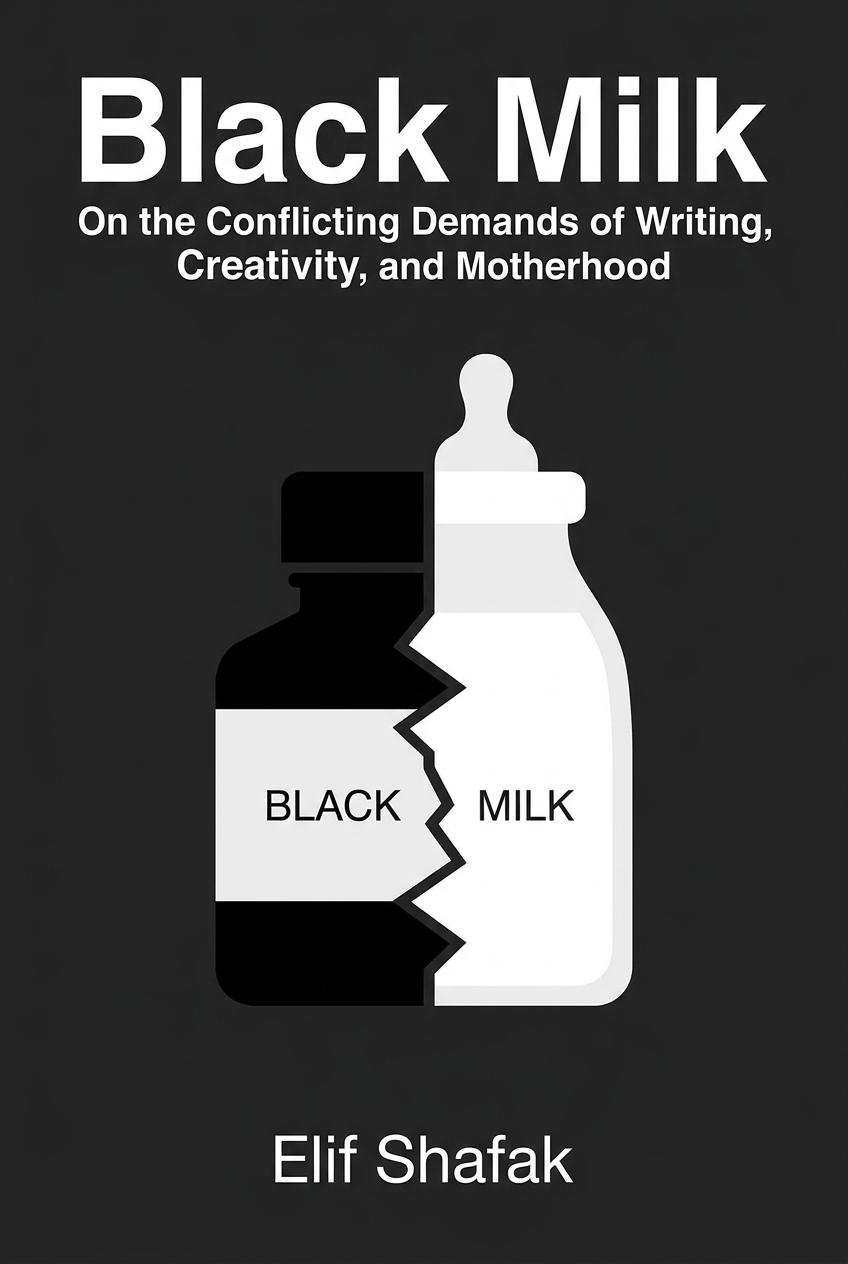
Black Milk
On the Conflicting Demands of Writing, Creativity, and Motherhood
What's it about
Ever wondered if you have to choose between your creative passions and motherhood? Elif Shafak’s powerful memoir explores the intense pressure on women to be perfect mothers, often at the expense of their own identities, and shows you how to navigate this difficult crossroads. Discover how Shafak confronted her postpartum depression and writer's block by personifying her conflicting inner voices as a "harem of women." You'll learn how to embrace your own internal conflicts, finding a powerful new way to integrate your creative ambitions with the profound journey of motherhood.
Meet the author
Elif Shafak is an award-winning British-Turkish novelist and the most widely read female author in Turkey, celebrated for her powerful storytelling and advocacy for women's rights. Drawing from her own experience with postpartum depression, she penned Black Milk as a deeply personal and intellectual exploration of the tensions between creativity and motherhood. Her unique perspective as a global intellectual, academic, and mother provides a profound and honest guide to navigating the complex identities of the modern woman.
Opens the App Store to download Voxbrief

The Script
Inside every creative person, a silent tea party is being held. Seated around the table are all the different women she could be. There’s the Mystic, who believes in intuition and whispers from the universe. Across from her sits the Pragmatist, who keeps a meticulous schedule and believes only in what she can measure. Next to them, the Ambitious Careerist taps her nails, impatient to get back to work, while the Nurturing Homemaker wants to make sure everyone has enough to eat. They are all versions of the same person, yet they rarely agree on anything. Each one wants to be the hostess, to set the rules, to be the loudest voice in the room. For an artist, a writer, this inner committee is essential for creation. But what happens when a new, unexpected guest arrives at the party—a guest who threatens to overturn the table and silence all the other voices? What happens when the Mother arrives?
This is the very dilemma that paralyzed author Elif Shafak after the birth of her first child. A celebrated and prolific novelist, Shafak suddenly found herself unable to write, plunged into a profound postpartum depression that felt like a betrayal of her own identity. The inner harem of voices that had fueled her creativity—the intellectual, the spiritualist, the traveler, the cynic—was suddenly drowned out by the overwhelming, singular identity of 'mother.' She felt split in two, believing she had to choose between the pen and the cradle. "Black Milk" is the raw, unflinching chronicle of that crisis. It is an exploration of how Shafak fought to bring all her disparate selves back to the table, to convince them to collaborate, and ultimately, to write again.
Module 1: The Inner Harem and the Quest for Democracy
Shafak introduces a powerful metaphor for our inner world. She suggests we all contain a "mini harem" or a "Choir of Discordant Voices." These are the multiple, often conflicting, personas that make up who we are. Before motherhood, Shafak’s identity was a clear hierarchy. She was a writer, a nomad, a cosmopolite, a lover of Sufism, a pacifist, and a woman—in that order. This was her internal oligarchy, where some selves ruled over others. But after giving birth, this structure collapsed. Her postpartum depression shattered her personality, forcing her to meet six distinct inner "finger-women."
This leads to the first major insight: You must acknowledge the full spectrum of your inner selves. We often suppress aspects of our personalities to conform to an ideal image. We might silence the part of us that craves stability to project an image of adventurousness. Or we might hide our ambition to appear more collaborative. Shafak argues this creates an internal despotism. The crisis of her depression was a chance to finally listen to the voices she had ignored. Each "finger-woman" had a different take on her new life. The writer panicked. The spiritual self sought surrender. The pragmatist wanted a plan.
So what happens next? Instead of letting one voice dominate, the goal is to build an inner democracy. This is about creating harmony from internal conflict. Shafak draws on Sufi philosophy, which sees every human as a walking microcosm, an orchestra of conflicting emotions. The challenge is to conduct them into a symphony. An inner democracy means giving each self a voice and a vote. It’s a shift from a rigid hierarchy to a dynamic, balanced system. This allows for a more whole and resilient identity, one that can adapt to life’s inevitable earthquakes without shattering. A professional in a demanding field can apply this by consciously checking in with their different "selves." The ambitious project leader, the exhausted parent, the curious learner—each needs to be heard, not suppressed.
Module 2: The Two-Sided Coin of Creativity and Motherhood
For many creative professionals, there’s a deep-seated fear. Will starting a family mean the end of my ambition? Shafak confronts this question head-on, exploring the perceived battle between the creative self and the maternal self. She describes writers as "asocial creatures" who thrive on solitude and self-absorption. Her own pre-motherhood life was defined by constant travel and cherished isolation. Writing was the "invisible glue" holding her identity together.
When she became a mother, that glue dissolved. She was hit with a paralyzing writer's block. The silence of the blank page was terrifying. This brings us to a crucial point: The roles of creator and nurturer exist in a state of profound tension. Shafak explores this through the lives of other women writers. For some, like J.K. Rowling, motherhood became a source of inspiration. For others, like Sylvia Plath, the attempt to be the "perfect Poet-Mother" became an unbearable pressure that contributed to her breakdown. Muriel Spark’s writing flourished, but her relationship with her son was permanently fractured. There is no single story.
And it doesn't stop there. Shafak realized that motherhood is a slow, difficult learning process. Society often pushes the narrative that a woman becomes a mother the moment she gives birth, equipped with a magical maternal instinct. Shafak calls this a myth. For her, and for many others, it was a slow, difficult learning process. She felt like an impostor, alienated from the seemingly effortless femininity she saw in other mothers. This feeling is common, but rarely discussed. She critiques the modern pressure to be "successful, strong and always perfect," which silences conversations about maternal struggle.
Ultimately, her path back to writing came from a powerful realization. You can transform your darkest experiences into your greatest assets. The turning point was the idea that she could turn her "blackened milk into ink." Instead of seeing her depression and her new maternal role as obstacles to her creativity, she made them the very subject of her work. This act of writing Black Milk was her recovery. It was how she stitched the writer and the mother back together into a new, more complex and resilient identity. This approach is powerful for any professional facing a setback. Your greatest challenge can become the source of your most profound growth and insight, if you have the courage to face it and integrate it into your story.