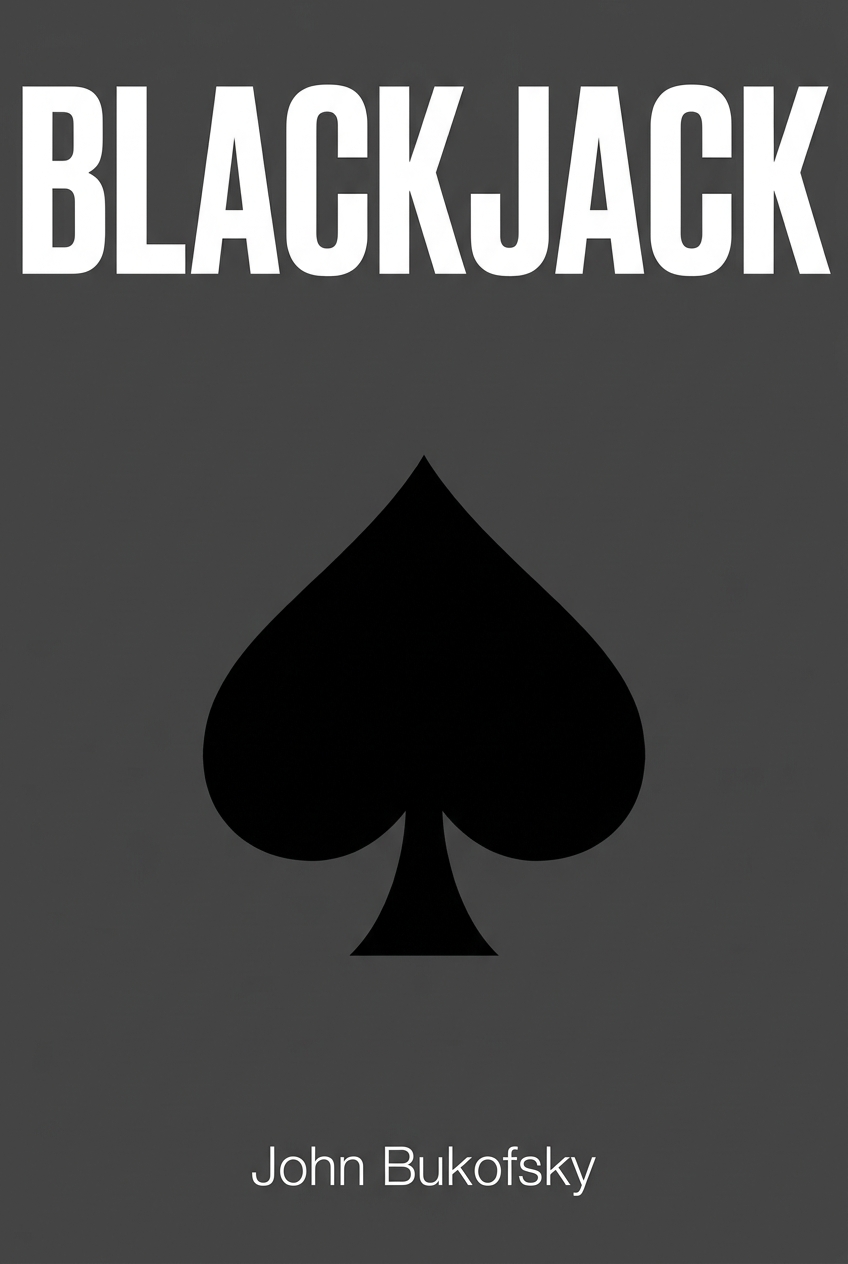
Blackjack
Play Like The Pros: A Complete Guide to BLACKJACK, Including Card Counting
What's it about
Tired of leaving the casino with empty pockets? What if you could turn the tables on the house and consistently walk away a winner? This guide reveals the professional strategies that transform blackjack from a game of chance into a game of skill you can master. You'll learn everything from basic strategy to the art of card counting, discovering how to manage your bankroll, read the table, and make the mathematically correct move every single time. Stop guessing and start playing with the confidence and knowledge of a true professional.
Meet the author
For over two decades, John Bukofsky has been a professional blackjack player and consultant, successfully beating casinos from Las Vegas to Monte Carlo with his proven strategies. His journey began as a mathematics prodigy at MIT, where he first developed and tested the card counting systems that would form the foundation of his career. Bukofsky now dedicates his time to teaching others how to master the game, transforming complex theory into practical, winning techniques for players of all levels.
Opens the App Store to download Voxbrief

The Script
We believe luck is a wild, unpredictable force, a cosmic lottery that randomly blesses or curses our lives. We speak of lucky breaks and unlucky streaks as if we are passive observers in a game run by invisible gods. But this entire conception of luck is a profound misunderstanding. The truth is that luck is an engineered outcome. It has a structure, a logic, and a set of rules that can be learned and exploited. The person who consistently finds themselves in the right place at the right time is operating by a different set of principles, turning the chaos of chance into a predictable system of advantage.
This is the secret that casinos never want you to learn. It’s the principle that allows a professional card player to treat the blackjack table as an office where they go to work. For John Bukofsky, this was a way of life. As a former professional blackjack player who spent over a decade making his living by calculating odds the house tried to hide, he saw firsthand how what looks like luck to the amateur is simple physics to the professional. He wrote Blackjack after realizing that the very same strategies he used to systematically beat the dealer—identifying unseen patterns, managing risk, and exploiting hidden advantages—could be applied to the much larger game of life, business, and personal achievement.
Module 1: The Foundation — It’s Not a Game of Luck
Most people see blackjack as a game of chance. You get good cards or you don't. This is fundamentally wrong. Bukofsky's first major insight is that blackjack is a game of conditional probability. This is the key that unlocks everything. Games like roulette have fixed odds. Every spin is an independent event. The past has no bearing on the future. The house edge is constant and unbeatable.
Blackjack is different. The odds change with every card that leaves the deck. If the first four cards dealt are all aces, the probability of anyone getting a blackjack on the next hand drops to zero. This dynamic environment creates temporary windows of opportunity. The entire science of professional blackjack is about identifying and exploiting these fleeting moments when the odds shift in your favor.
To do this, you first need to understand the battlefield. Rule variations dramatically impact your advantage. A casino is a unique environment. A game in Las Vegas plays differently from a game in Atlantic City. Does the dealer hit on a soft 17? Can you double down after splitting pairs? Is surrender an option? Each of these rules has a precise mathematical effect on your expected return. For example, a rule forcing the dealer to hit on a soft 17 gives the house a small but meaningful gain. A professional player must assess these rules instantly. They walk into a casino, scan the tables, and know within minutes which games are playable and which are a waste of time.
This leads to a crucial point about game selection. More decks always favor the house. A single-deck game is the most favorable for a player. As casinos add more decks—two, four, six, even eight—the player's advantage steadily declines. Why? It dilutes the impact of card removal. In a single-deck game, removing a few small cards significantly increases the ratio of high cards left. This is good for the player. In a six-deck game, removing those same few cards is just a drop in the ocean. The effect is muted. Casinos moved to multiple-deck games to blunt the effectiveness of skilled players.
Finally, you must master the fundamentals before you can do anything else. Bukofsky is adamant about this. Basic Strategy is the non-negotiable price of entry. Basic Strategy is the mathematically optimal way to play any hand against any dealer up-card, assuming you know nothing about the remaining cards. It was first calculated by hand and later verified by supercomputers at IBM and MIT. Playing with perfect Basic Strategy reduces the house edge to nearly zero. In some single-deck games, it can even give the player a tiny advantage.
But here's the catch. Most people don't play it perfectly. They play with gut feelings and superstitions. They stand on 16 against a dealer's 7 because they "feel" the dealer will bust. This is a losing play. Bukofsky estimates it takes 15 hours of intense study to truly master Basic Strategy. You have to know it so well that your decisions are automatic and error-free. Any mistake, no matter how small, erodes your edge. And when your total advantage is only 1-2%, there is no room for error.