All Books
Self-Growth
Business & Career
Health & Wellness
Society & Culture
Money & Finance
Relationships
Science & Tech
Fiction
Topics
Blog
Download on the App Store

Brainwashed

How Universities Indoctrinate America's Youth

13 minBen Shapiro

What's it about

Ever wonder what's really being taught in America's top universities? Get ready to uncover the hidden political agendas that shape higher education. This summary reveals how liberal professors might be influencing students far beyond the syllabus, turning lecture halls into platforms for ideological indoctrination. You'll discover the specific tactics used to silence conservative viewpoints and promote a one-sided narrative on campus. Learn how to identify bias, challenge prevailing groupthink, and understand the true intellectual landscape your kids are facing in college today. This is your guide to what's happening behind the ivy-covered walls.

Meet the author

A graduate of UCLA and Harvard Law School, Ben Shapiro is one of America's most prominent conservative political commentators, columnists, and media hosts. He wrote Brainwashed at the age of seventeen, drawing from his own experiences as a young, outspoken conservative navigating the university system. This early start provided the foundation for a career dedicated to challenging prevailing campus orthodoxies and advocating for intellectual diversity and free speech, making him a leading voice for a generation of young conservatives.
Listen Now

Opens the App Store to download Voxbrief

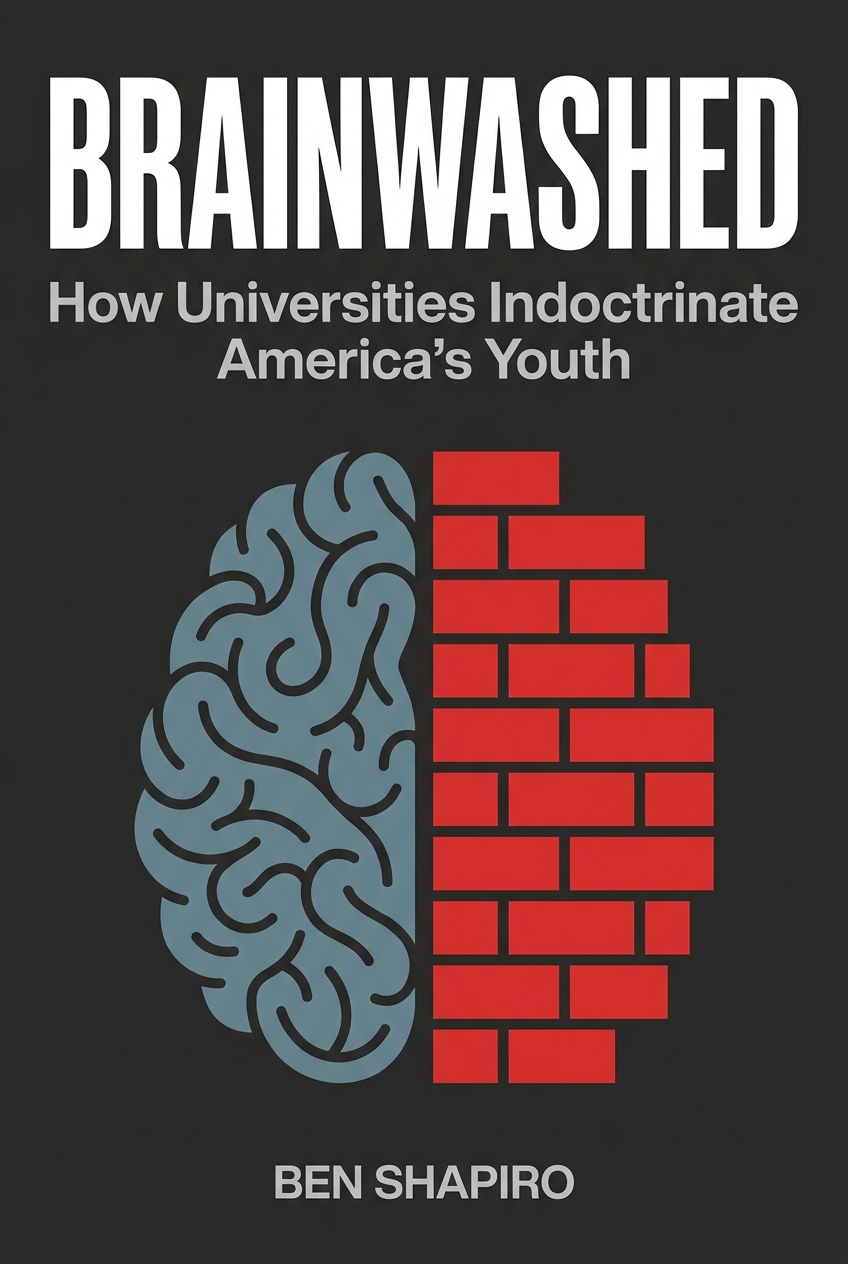
Brainwashed book cover

The Script

The most secure prison is the one whose inmates believe they are free. It’s a place where the walls are built from comforting ideas, the guards are respected authorities, and the daily routine feels like an intellectual adventure. In this environment, conformity is celebrated as enlightenment. The most effective indoctrination feels like a lively, open-ended discussion where all the 'right' conclusions are reached voluntarily. This process is so subtle that its participants will fiercely defend the very architecture of their confinement, mistaking the echo of their instructors' beliefs for the sound of their own independent thought.

This is the university experience that Ben Shapiro witnessed firsthand. As a student at UCLA, he was struck by the stark contrast between the university's promise of open inquiry and the reality of a pervasive, one-sided ideological pressure. He saw how dissent was often treated as a moral failing. At just seventeen years old, Shapiro began documenting this phenomenon, interviewing students and professors to understand how an institution dedicated to knowledge could become a powerful engine for ideological conformity. The result, written while he was still an undergraduate, became Brainwashed—a direct report from inside a system he believed was shaping minds in a way few students, parents, or taxpayers truly understood.

Module 1: The Myth of Neutrality and the Rise of Moral Relativism

One of the first things students encounter in the modern university is the idea that there's no such thing as objective truth. Shapiro argues this is a foundational strategy. Professors actively teach that morality is relative and truth is a social construct. This idea, often called postmodernism, suggests that what's right or wrong depends entirely on your culture or personal values. There are no absolutes.

Shapiro provides stark examples. He quotes UCLA Professor Joshua Muldavin, who told his class there is no capital-T Truth. He also points to a 2002 Zogby poll. It found that 73% of college seniors reported their professors taught that right and wrong depend on individual values. Only 25% said they were taught clear, uniform moral standards. This is an issue with real consequences. When you remove the guardrails of objective morality, you create a vacuum.

So what happens next? Once students are taught that nothing is definitively right or wrong, it becomes much easier to introduce new, radical ideas. This rejection of moral absolutes creates an intellectual vacuum that is then filled with a specific political ideology. Shapiro argues this is the core of the brainwashing process. He gives the example of Princeton professor Peter Singer. Singer famously argued for the morality of killing disabled newborns, equating their moral status to that of a pig or cow. In a world without objective moral lines, such an argument can be presented as a legitimate academic position, rather than an abhorrent one. It desensitizes students. It makes them question foundational ethics they once took for granted. The goal is to dismantle their existing moral framework to make way for a new one.

Module 2: The Ideological Monopoly in the Classroom

Now, let's move to the second part of the process. The university classroom is supposed to be a marketplace of ideas. But what happens when only one type of idea is sold? Shapiro presents a mountain of evidence to argue that a specific political viewpoint dominates academia. Universities are staffed by an overwhelming majority of left-leaning professors who openly use their classrooms for political advocacy.

The numbers are striking. Shapiro cites a poll showing 84% of Ivy League professors in the humanities and social sciences voted for Al Gore in 2000, with only 9% voting for George W. Bush. At the University of Colorado, the English, History, and Philosophy departments had 68 registered Democrats and zero Republicans. This is about what gets taught. Some professors don't even hide it. Shapiro quotes a provost at the University of California, San Diego, who bluntly asked, "Why should I teach a point of view I don't agree with?"

This leads to a classroom experience where one perspective is presented as fact. For instance, after the 2000 election, professors across the country depicted George W. Bush as an illegitimate president. A UCLA English professor wrote an article urging people to protest his inauguration by burning slips of paper labeled "Democracy" and "Truth." In one of Shapiro's own classes, a professor asked for a show of hands. Nearly all 300 students believed the election was unfair because their candidate lost. They had been taught that the system is only legitimate when it produces their desired outcome.

And here's the thing. This bias isn't limited to politics. It extends to economics, where capitalism is frequently vilified. Professors consistently frame capitalism as an inherently exploitative system and profit as an immoral motive. Courses at top universities are titled "Taking Marx Seriously." Professors describe socialism as a "great idea" and Mao Tse-Tung as a "great leader," often ignoring the catastrophic human cost of their ideologies. The profit motive is blamed for everything from obesity to public health crises. This creates a generation of students who are trained to be suspicious of free markets and receptive to government control, all without ever hearing a robust defense of the system that fuels the global economy.

Read More