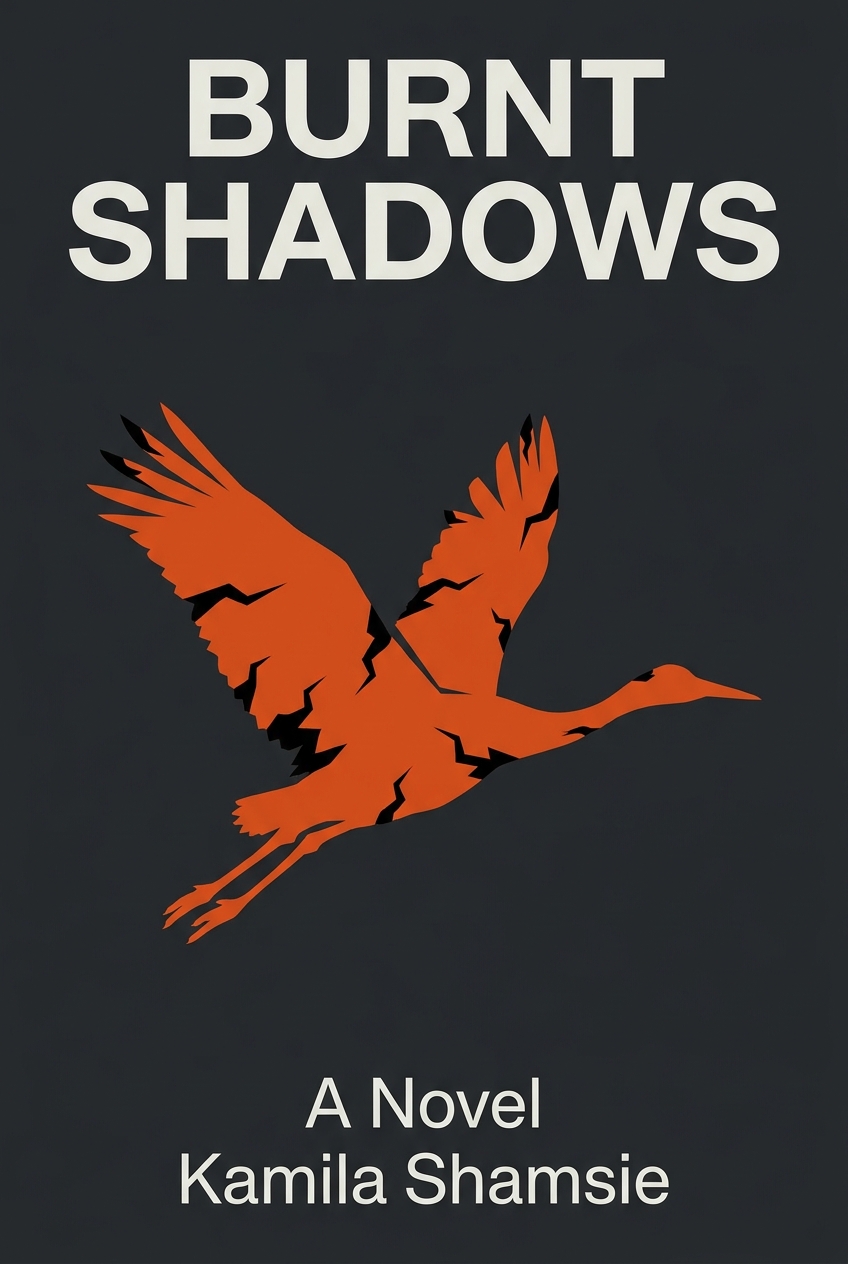
Burnt Shadows
A Novel
What's it about
Have you ever wondered how a single moment can ripple through generations, connecting seemingly unrelated lives across the globe? Discover a story that reveals how personal destinies are irrevocably intertwined with the grand, often tragic, sweep of modern history, from Nagasaki to post-9/11 New York. This epic tale follows two families whose paths cross in the atomic blast's aftermath. You'll trace their journey through the partition of India, the conflicts in Pakistan and Afghanistan, and the paranoia of the modern world. Uncover how love, betrayal, and the search for belonging are shaped by the long shadows of war, challenging your own understanding of identity and connection.
Meet the author
Kamila Shamsie is an award-winning British-Pakistani novelist whose work masterfully explores themes of identity, war, and globalization, earning her a place on the Booker Prize shortlist. Born in Karachi into a family of writers, her personal history straddles continents, providing a rich, authentic foundation for the sweeping, interconnected narratives found in her novels. This unique perspective allows her to illuminate the profound human impact of historical events with unparalleled empathy and insight, as powerfully demonstrated in Burnt Shadows.
Opens the App Store to download Voxbrief

The Script
Think of an old, intricate tapestry. From one side, the threads form a coherent picture: a bird in flight, a ship at sea. But turn it over, and you see something else entirely. You see the knots, the cut threads, the chaotic web of connections that hold the beautiful image together. You see where one color abruptly ends and another begins, where a weaver changed their mind, where a thread, once prominent, vanishes completely. This is the unseen history, the messy, intersecting reality beneath the finished story.
What happens when a single, violent event sends a thread shooting from one tapestry into another, tangling them together forever? In the aftermath of the atomic bomb in Nagasaki, a young woman named Hiroko Tanaka is left with only a few searing memories and three black birds burned into her back, a permanent, ghostly pattern on her skin. Her life, once woven into the fabric of her Japanese family and fiancé, is violently re-routed. She becomes a thread that travels across the world, from Japan to India, from Pakistan to New York and Afghanistan, weaving herself into the lives of another family across generations. The story traces how this single, catastrophic event redirects a life, creating new, unforeseen patterns of love, loyalty, and betrayal that ripple across half a century and two very different cultures.
Kamila Shamsie was moved to write this story by a profound question: how do we live with the historical cataclysms that we inherit? As a Pakistani novelist living in a post-9/11 world, she felt the weight of history being written and rewritten, often with little regard for the intricate, personal tapestries it tore apart. She wanted to move beyond the headlines and political justifications to explore the deeply human consequences of global conflict as a continuous, interconnected story passed down through families. Burnt Shadows became her way of tracing those hidden threads, showing how the shockwaves of a single moment in 1945 could continue to shape the loyalties and identities of people decades later, an entire world away.
Module 1: The First Shadow — Trauma and Reinvention
The novel opens with a devastating act. It's August 9, 1945, in Nagasaki. A young woman named Hiroko Tanaka is standing on a balcony, engaged to a German man named Konrad Weiss. She wears a beautiful silk kimono patterned with three black cranes. In a flash, the world is incinerated by the atomic bomb. The blast fuses the kimono’s pattern onto her back, leaving her with three bird-shaped scars. This is the first "burnt shadow." It’s a physical scar, but it’s also a psychological one. It marks her forever as a hibakusha, a survivor of the bomb.
From this foundation, the first core insight emerges. Historical trauma becomes a part of personal identity, forcing constant reinvention. Hiroko’s life is defined by this moment. The bomb takes her home, her city, and her fiancé. She flees Japan, seeking refuge from the label of hibakusha. She hates the word. It reduces her entire being to a single catastrophic event. Her journey is a desperate search for a place where she is not just a victim.
This leads her to Delhi, India. She finds Konrad’s half-sister, Elizabeth Burton, and her husband, James. Here, Hiroko tries to build a new life. But she remains an outsider, a Japanese woman in the final days of the British Raj. Her scars are a secret she carries. They are a constant reminder of what she lost. And they dictate her future. She believes the scars make her unlovable, a warning to any man who might get close.
So what happens next? She meets Sajjad Ashraf, an employee of the Burtons. He is a thoughtful man from Old Delhi, struggling with his own identity in a changing India. Their connection is quiet but profound. Hiroko reveals her scars to him, a monumental act of trust. She tells him, "This is just one more thing the bomb took away from me." She believes marriage is no longer possible for her. This brings us to a critical point. True connection requires revealing the deepest scars, both visible and invisible. Sajjad doesn't see a warning. He sees her. He sees the woman who has endured the unimaginable. Their bond transcends the trauma. They decide to marry, a defiant act of creating a future out of the ashes of the past.
Module 2: The Second Shadow — Displacement and Partition
Hiroko and Sajjad's marriage is a fragile new beginning. It happens on the eve of the Partition of India in 1947. The British are leaving. The subcontinent is being violently cleaved into two nations: India and Pakistan. This political upheaval casts the second great shadow over their lives. Their personal story once again becomes entangled with global events.
The Burtons, acting out of a sense of protection, convince the newlyweds to leave Delhi. They argue it’s too dangerous for a Muslim man and his foreign wife. They arrange a "honeymoon" in Istanbul, promising a safe return once the violence subsides. This well-intentioned act has catastrophic consequences. And here's the thing: Acts of protection from those in power can lead to devastating, unintended outcomes.
While they are in Istanbul, Partition is finalized. Sajjad, a man whose family has lived in Delhi for generations, tries to return home. He is stopped at the Indian Consulate. A bureaucrat informs him that because he is a Muslim who left India during that period, he is now classified as having "chosen" to leave. The decision is irreversible. He is permanently barred from his home. The news crushes him. His beloved "Dilli" is lost forever.
This forced displacement defines the next phase of their lives. They become migrants, settling in Karachi, Pakistan. They must build a life from scratch in a new country. This module reveals a powerful truth about identity. Home is a political status that can be stripped away by bureaucratic decisions. Sajjad’s identity is fractured. He is a muhajir, a migrant in a new land, forever mourning the city he lost.
Through this, Hiroko and Sajjad’s bond deepens. They have both lost their worlds. She lost Nagasaki to a bomb. He lost Delhi to a border. Their shared experience of loss becomes the foundation of their life together. They have a son, Raza. Sajjad channels all his hopes into him. He wants Raza to become a lawyer, to achieve the professional life he himself was denied. But this places a heavy burden on their son. It shows how the dreams of one generation, born from trauma, can become the pressures of the next.