All Books
Self-Growth
Business & Career
Health & Wellness
Society & Culture
Money & Finance
Relationships
Science & Tech
Fiction
Topics
Blog
Download on the App Store

Cooking with My Sisters

One Hundred Years of Family Recipes, from Italy to Big Stone Gap

11 minAdriana Trigiani, Mary Yolanda Trigiani

What's it about

Tired of complicated recipes that lack soul? Discover how to transform everyday cooking into a cherished celebration of family and flavor. This isn't just a cookbook; it's your invitation to a century-old Italian kitchen, where simple ingredients create unforgettable meals and lasting memories. You'll learn the Trigiani sisters' secrets for perfecting everything from hearty pasta dishes to delicate desserts, all passed down through generations. Uncover the timeless techniques and heartwarming stories that turn cooking into an act of love, connecting you to the rich traditions of Italian-American home life.

Meet the author

Adriana Trigiani is the beloved New York Times bestselling author of twenty books in fiction and nonfiction, celebrated for her heartwarming tales of family, faith, and food. She and her sister Mary Yolanda Trigiani, a culinary expert and painter, learned the art of Italian cooking at the elbows of their grandmothers. This book is their tribute to those matriarchs, preserving cherished family recipes and stories that have traveled from the mountains of Italy to the heart of Appalachia, meant to be shared for generations to come.
Listen Now

Opens the App Store to download Voxbrief

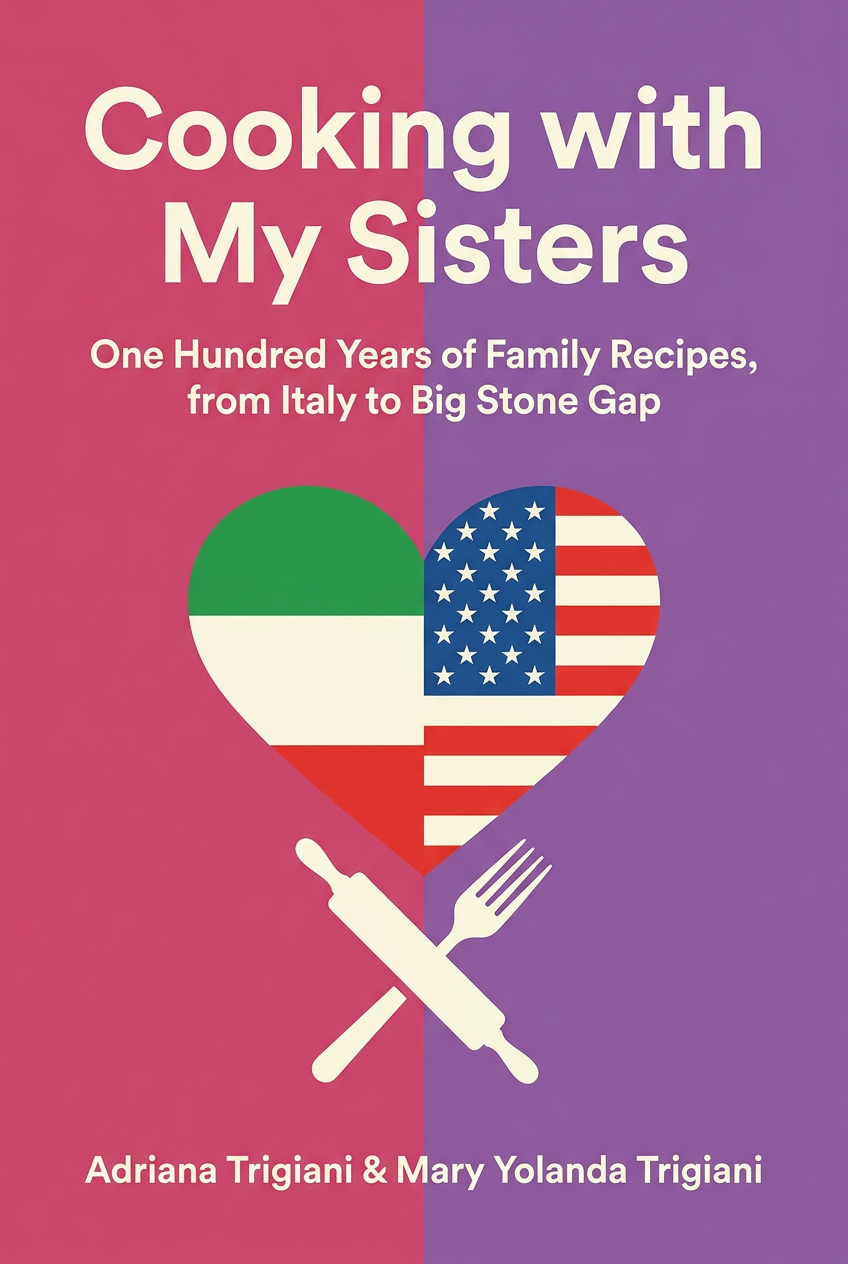
Cooking with My Sisters book cover

The Script

Think of the last time you followed a recipe. You measured, whisked, and heated, your eyes darting between the printed instructions and the ingredients on the counter. The result was perfectly fine, a faithful recreation of what the author intended. But now, think of a dish you make without any recipe at all—the one you know by heart, the one your grandmother taught you not with cups and teaspoons, but with a pinch of this and a handful of that. The ingredients are the same, but the process is different. It’s a conversation. The feel of the dough tells you if it needs more flour; the sizzle in the pan tells you when it’s time to flip. One is an act of assembly; the other is an act of connection.

This kind of cooking—the kind that holds memory, identity, and love within its very process—is a living thing. It’s a story passed from one generation to the next through shared experience in the kitchen. It’s this exact feeling that novelist Adriana Trigiani and her sister Mary Yolanda wanted to capture. Growing up in a sprawling Italian-American family, they realized their family’s history wasn’t written in journals; it was baked into their mother's wedding cake, simmered in the Sunday gravy, and folded into the Christmas ravioli. They wrote Cooking with My Sisters to preserve these edible heirlooms, translating the intuitive, sensory knowledge of their grandmothers and mother into a collection that is as much a family memoir as it is a guide to delicious food.

Module 1: The Kitchen Table as the Center of Gravity

The book opens with a powerful premise. The kitchen table is the emotional and social anchor of family life. It’s a stage where life unfolds. The authors argue that in Italian culture, la tavola—the table—says who you are without a single word. It's where you learn your place, share your stories, and reinforce your identity.

This is about intention. The authors describe their mother, Ida, making the table beautiful with simple, handmade centerpieces. She used an old wine flask and melted crayons to create a candle holder. This small act was an expression of love. It was a physical welcome. So the first key insight is that you must treat your gathering space as a deliberate act of creation. It’s a place to connect. The ambiance you build, even with the simplest things, sends a powerful message. It tells people they are seen. It tells them they are valued.

Building on that idea, the book shows how the table becomes a classroom for life. The Trigiani family used dinnertime to transmit culture. The father told stories of their Italian heritage. He corrected his children's accents to help them retain their identity in a new environment. Their mother used report card nights to teach "deportment," or good manners. This leads to a second powerful principle: Use shared meals to actively transmit your values. Don't just eat together. Talk together. Tell stories. Share what matters. The dinner table is a rare moment in modern life where you have a captive audience. Use that time to reinforce the culture you want to build, whether in your family or your team.

And here's the thing. This doesn't have to be a formal, multi-course affair. The Trigiani family adapted traditional Italian dining for a busy American life. They streamlined the process. But they never sacrificed the core principles. The food was always hearty, balanced, and plentiful. This philosophy was captured in a single word: Abbondanza. Abundance. The rule was simple. If you leave our house hungry, it’s your own fault. This was about generosity. Embrace a mindset of abundance in your hospitality. Always make more than enough. This signals generosity and care. It removes any anxiety for your guests and makes them feel truly welcome. It’s a simple shift that transforms the dynamic from transactional to relational.

Module 2: Recipes as Historical and Emotional Archives

Now, let's turn to the recipes themselves. In this book, a recipe is a story. It's a tangible link to the past. The authors treat recipes as treasured heirlooms, some over 150 years old. They describe finding their grandmother's hidden recipe scraps, written in code, like discovering lost treasure. This reframes how we should think about our own family dishes. A handwritten recipe card from a grandparent is a direct connection to their life, their hands, their kitchen.

This brings us to a crucial insight. Every dish is a narrative of migration and adaptation. The Trigiani family’s cooking tells the story of their ancestors' journey from different regions of Italy—Lombardy, Veneto, Puglia—to a small town in Virginia. Their grandmothers brought distinct culinary styles. One favored the lighter, polenta-based cuisine of the north. The other mastered the robust, tomato-heavy sauces of the south. In America, these traditions collided and merged. They even blended with local Southern food, like white gravy made from flour and pork fat. This fusion created something entirely new. It was Italian-American. It was their food. Your own family's "weird" dishes probably tell a similar story of compromise and creativity.

From this foundation, we see how food becomes a powerful trigger for memory. The scent of grapes in a barrel room instantly transports one sister back to her grandfather making wine in the basement. Unopened jars of their grandmother's canned tomatoes are kept as precious heirlooms, physical reminders of her legacy. Food becomes an emotional archive, storing memories that words can't capture. This is something you can apply immediately. Think about a dish that connects you to a person or a time in your life. Making that dish is an act of remembrance. It’s a way to keep a part of your history alive and share it with others.

But flip the coin. What about the recipes you hated as a kid? The authors share stories of dishes they dreaded, like a stew called spezzatino. As children, they’d pick out the meat and leave the rest. Today, they love and serve it. They understand its cultural context and flavor complexity. This highlights a fascinating point. Your childhood dislikes can evolve into adult appreciations. Our tastes change as we gain new perspectives. Revisit a food you once disliked. Try to understand its history or preparation. You might unlock a new appreciation for it and for the person who used to make it for you. It’s a simple way to reconnect with your own story.

Read More