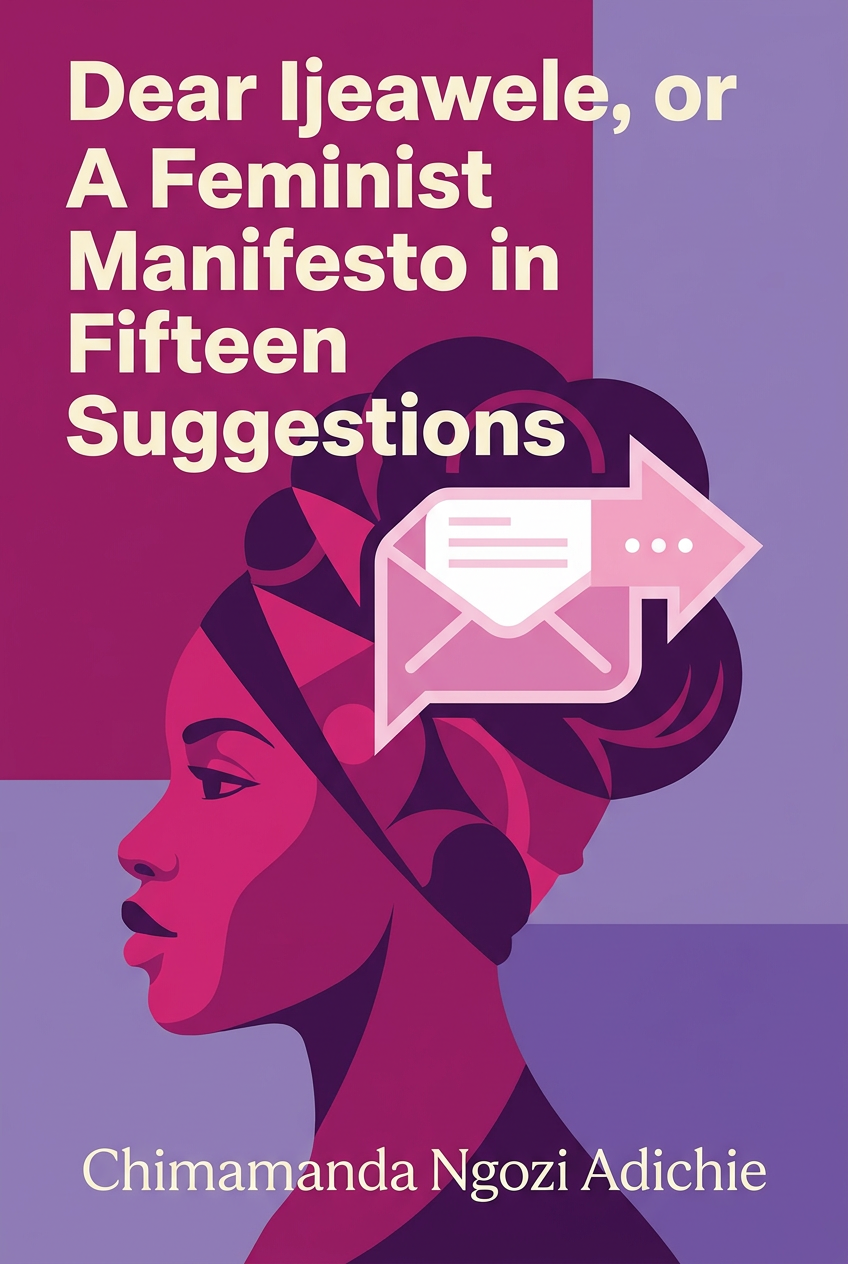
Dear Ijeawele, or A Feminist Manifesto in Fifteen Suggestions
What's it about
Want to raise a daughter who is confident, independent, and empowered? This manifesto offers fifteen actionable suggestions for equipping the next generation of women to navigate a complex world, reject limiting stereotypes, and truly own their power. You don't have to be a parent to benefit. Discover how to talk about everything from clothing and makeup to career ambitions and relationships. Adichie provides a clear, modern roadmap for fostering a feminist mindset in everyday life, helping you challenge unconscious biases and champion equality for yourself and those you love.
Meet the author
Chimamanda Ngozi Adichie is a globally acclaimed, MacArthur Genius Grant-winning author whose work powerfully explores feminism, identity, and the intricate tapestry of Nigerian culture. Dear Ijeawele began as a personal letter to a friend who asked how to raise her daughter a feminist, capturing Adichie’s heartfelt and practical wisdom on the subject. Her insights are drawn from her own experiences as a woman, a daughter, and a mother, offering an accessible and essential guide for a new generation.
Opens the App Store to download Voxbrief

The Script
Think of the first time you held a newborn. The weight of them, so small yet so profound, settles into your arms. In that moment, an entire universe of unspoken questions arrives. How do you protect this tiny being from the world's sharp edges? How do you raise them to be kind, confident, and whole? For many, the instinct is to build a fortress, to shield them from every possible harm, every confusing message, every inequality. But another path exists, one that hands the child the tools to navigate the world as it is.
This second path offers a conversation. It’s the difference between giving a child a list of pre-approved, ‘safe’ books and teaching them how to read critically, to question the stories they encounter and find their own voice within them. It’s about raising a person who doesn't need a fortress because they carry their own sense of self, their own solid ground, wherever they go. The goal is to cultivate a resilient, thoughtful human being capable of creating their own environment.
This very challenge landed in the inbox of celebrated Nigerian author Chimamanda Ngozi Adichie. When a childhood friend, Ijeawele, asked for advice on how to raise her newborn daughter as a feminist, Adichie didn't just send a quick reply. She responded with a long, heartfelt letter, which grew into fifteen thoughtful suggestions. This letter, born from a personal exchange between friends, became the foundation for Dear Ijeawele. It's a practical, loving, and direct guide rooted in the real-world questions that arise the moment you hold that new life in your arms.
Module 1: The Feminist Toolkit
Before we can teach, we have to understand the core principles ourselves. Adichie provides a foundational toolkit for feminist thinking. It’s simple, powerful, and immediately applicable.
The first principle is the premise of feminism itself. Your feminism should be built on the unconditional belief that you matter equally. It’s not "I matter if..." or "I matter as long as..." It's simply "I matter. Full stop." This is about rejecting any narrative that places your worth below someone else's. It's the firm foundation from which all other feminist ideas grow.
From this foundation, Adichie introduces a practical tool for spotting inequality. To test for gender bias, ask yourself: "Can I reverse the roles and get the same result?" This simple question cuts through social conditioning. For example, if a husband cheats, society might offer the excuse, "men will be men." But flip the coin. If the wife cheats, would she receive the same forgiveness? If the answer is no, you've uncovered a gendered double standard. This reversal test works everywhere. It reveals the hidden assumptions that prop up inequality in relationships, at work, and in our daily lives.
And here's the thing. This self-worth must extend beyond any single role, especially motherhood. You must be a full person beyond being a mother. Society often pressures women to shrink their identities once they have children. Adichie argues that this is a loss for both the mother and the child. A child benefits immensely from a mother who has her own passions, career, and sense of self. The journalist Marlene Sanders put it perfectly: "Never apologize for working. You love what you do, and loving what you do is a great gift to give your child." This is not a modern, Western idea. Adichie points to her own Igbo heritage, where women have always been traders and farmers. Working mothers are a part of tradition, not a deviation from it.
Module 2: Deconstructing Gender Roles at Home
We've established the core ideas. Now we move into the home, where gender conditioning begins. Adichie argues that true partnership and conscious parenting are essential to breaking these cycles.
The most critical shift starts with how we view parental duties. Fathers are parents, not "helpers." The language we use matters. When a father cares for his own child, he isn't "babysitting." He is parenting. The idea that a father is "helping" the mother implies that childcare is fundamentally her responsibility. This is a subtle but damaging assumption. A father might not change a diaper perfectly at first. That's okay. The child benefits from being cared for by both parents. It builds a bond and establishes a true partnership from day one.
Building on that idea, we must challenge the very concept of gender roles. Reject "because you are a girl" as a reason for anything. These roles are nonsensical, arbitrary, and limiting. Adichie recalls being told as a child to "bend down properly while sweeping, like a girl." The instruction should have been about sweeping effectively, not performing gender. This conditioning starts almost at birth. In toy stores, boys get active toys like cars and trains. Girls get passive toys like dolls. A girl who might have become a brilliant engineer is subtly steered away from her potential. Parents also unconsciously restrain girls more, telling them "be nice" or "don't touch." Meanwhile, boys are encouraged to explore. We are teaching girls to be passive and boys to be active from their first moments.
But flip the coin. There's a subtle trap we need to avoid: "Feminism Lite." This is the idea of conditional female equality. It sounds progressive, but it's not. Beware of "Feminism Lite," which grants equality with conditions. It uses language that implies male benevolence or authority. Think of phrases like "he is the head and you are the neck." This suggests male dominance disguised as partnership. Another example is praising a husband for "allowing" his wife to succeed. The very word "allow" implies he holds the power. True equality doesn't need permission. It just is. This watered-down version of feminism is dangerous because it maintains the core structure of patriarchy while pretending to be fair.