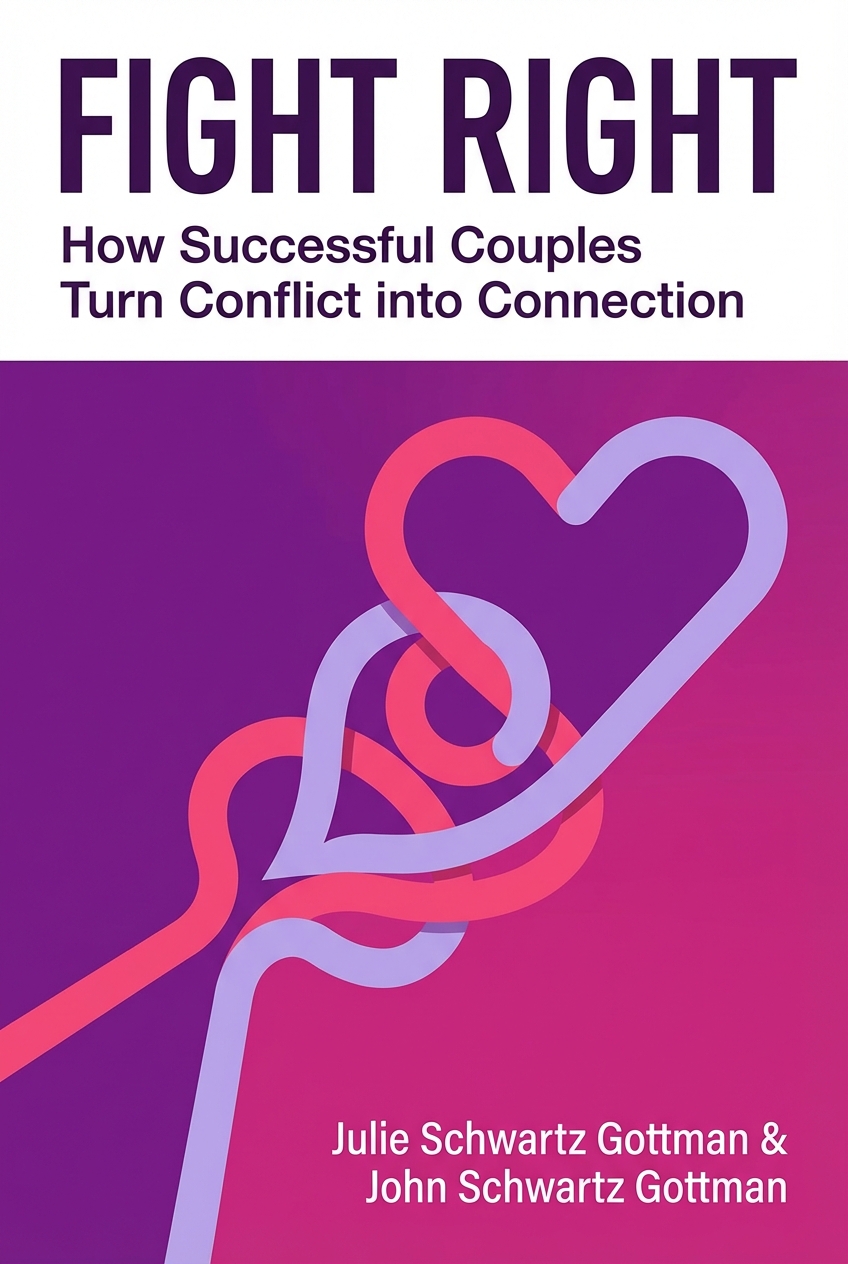
Fight Right
How Successful Couples Turn Conflict into Connection
What's it about
Tired of arguments that go nowhere and leave you feeling disconnected? What if you could turn every disagreement into an opportunity to strengthen your relationship? Learn how to transform conflict from a relationship-killer into a powerful tool for building intimacy, trust, and a deeper connection with your partner. Discover the six essential skills that successful couples use to navigate disagreements constructively. You'll get practical, science-backed techniques from world-renowned relationship experts to help you understand your partner's perspective, de-escalate tension, and find common ground, ensuring your fights end with you feeling closer than ever before.
Meet the author
Drs. John and Julie Gottman are the world-renowned psychologists and co-founders of The Gottman Institute, celebrated for their four decades of breakthrough research with thousands of couples. Their life's work, conducted in their famous "Love Lab," scientifically analyzes what makes relationships succeed or fail. This unparalleled research provides the foundation for their proven, practical advice, empowering couples to transform conflict into a powerful tool for building deeper connection, intimacy, and lasting love.
The Script
Within a single generation, the likelihood that an American will live alone has nearly doubled, rising from 17% in 1970 to 29% today. While solitude can be restorative, a landmark 85-year study from Harvard University tracking thousands of individuals from their teens to old age reached an unequivocal conclusion: warm, high-quality relationships are the single greatest predictor of long-term health and happiness. Yet, for many couples, the path to maintaining that quality is fraught with conflict. A separate analysis of over 40,000 couples found that nearly 60% report significant distress stemming from how they handle disagreements, a figure that has held remarkably steady for decades. This persistent struggle is a sign that the fundamental skills for navigating conflict are often missing, leaving partners feeling stuck in damaging cycles of attack and retreat.
This gap between the deep human need for connection and the widespread struggle with conflict is precisely what drove decades of research by Drs. Julie and John Gottman. From their renowned 'Love Lab,' they have observed and analyzed the interactions of thousands of couples, identifying the precise, measurable behaviors that separate relational 'masters' from 'disasters.' Their work was a mission to decode the mechanics of healthy arguments. In "Fight Right," they distill these complex findings into a clear, actionable approach, demonstrating that conflict is a powerful opportunity to deepen understanding and strengthen a partnership when handled correctly.
Module 1: The Anatomy of a Fight
Most of us think conflict is a sign that something is wrong. The Gottmans argue the opposite. Conflict is not only inevitable; it’s necessary for a healthy, growing relationship. It’s the friction that helps you understand your partner on a deeper level. But to make it productive, you first have to understand what you’re really fighting about.
The first major insight is that most arguments are about deeper, hidden needs. A fight over loading the dishwasher is often a proxy for needs for respect, appreciation, or control. The Gottmans found that a staggering 69% of all relationship conflicts are "perpetual problems." These are fundamental differences in your personalities or values that will never be fully solved. An introvert and an extrovert will always have to negotiate their social lives. A spender and a saver will always see money differently. The goal is to manage these issues.
And here's the thing. When you fail to manage them, you get "gridlock." This is when a perpetual problem becomes a source of constant pain. You have the same conversation again and again. You feel rejected and misunderstood. Nothing ever moves forward. The Gottmans discovered that gridlocked conflicts are almost always fueled by unfulfilled dreams. A fight about moving for a new job might be about one partner’s dream of career achievement clashing with the other's dream of community and stability. Until you uncover and honor those underlying dreams, you will stay stuck.
So what separates the couples who manage this well from those who don't? It comes down to a few key behaviors. The Gottmans identified four communication patterns so toxic they called them "The Four Horsemen of the Apocalypse." These are Criticism, Contempt, Defensiveness, and Stonewalling.
- Criticism attacks your partner's character. Instead of saying, "I'm upset you didn't take out the trash," you say, "You're so lazy."
- Contempt is criticism with a dose of superiority. Think sarcasm, mockery, and eye-rolling. It’s the single greatest predictor of divorce.
- Defensiveness is a natural response to criticism, but it just escalates the conflict. It's making excuses or playing the victim.
- Stonewalling is shutting down. The listener withdraws, goes silent, and emotionally exits the conversation. It often happens when someone feels physiologically overwhelmed.
This leads us to a crucial point. The success of a relationship depends on a 5-to-1 ratio of positive to negative interactions during conflict. For every one "Four Horsemen" moment, you need five positive ones to balance it out. These can be small things. A nod, a smile, a touch, or saying "that’s a good point." The masters of relationships maintain this ratio. The disasters don't. This emotional bank account is what keeps conflict from becoming corrosive.