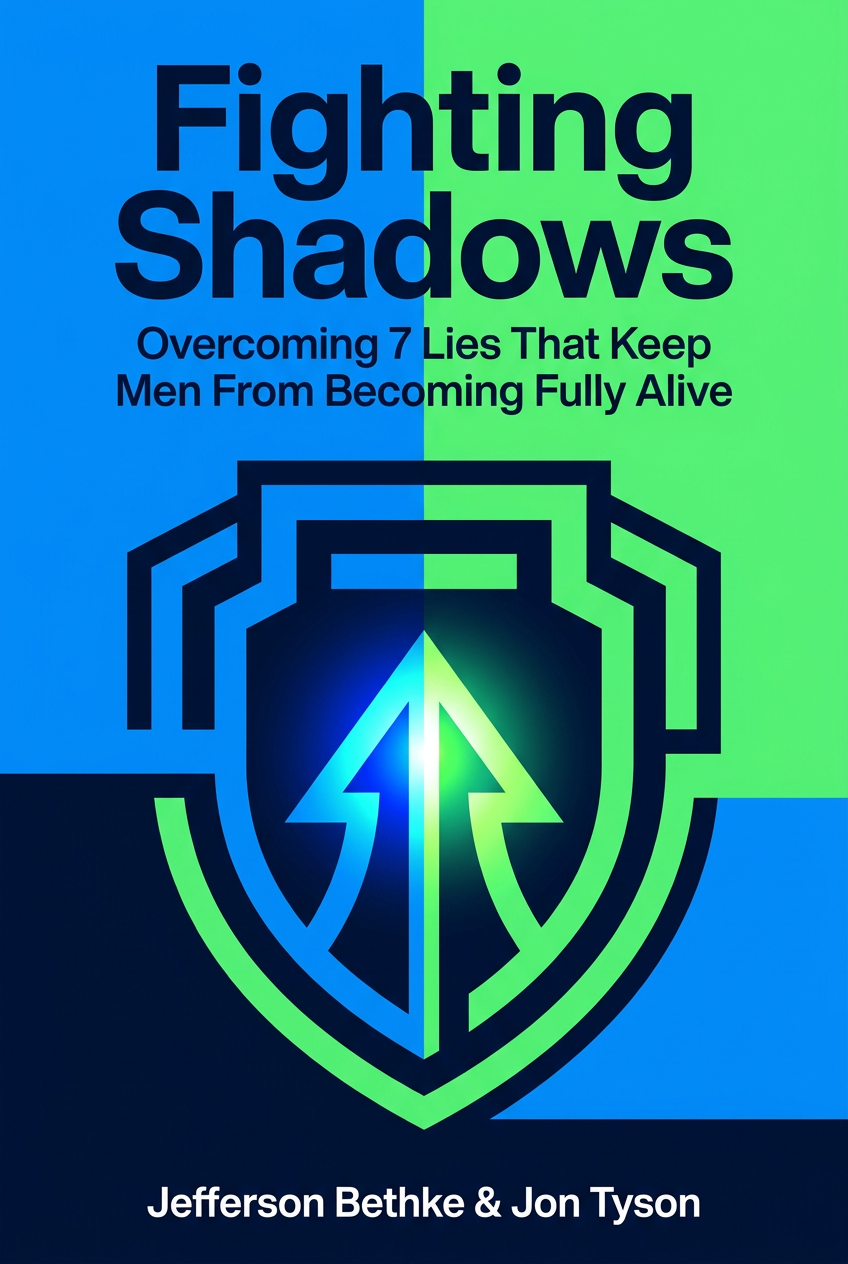
Fighting Shadows
Overcoming 7 Lies That Keep Men From Becoming Fully Alive
What's it about
Are you living up to your full potential, or are you held back by unspoken rules about what it means to be a man? This summary offers a powerful path to break free from the invisible lies that drain your energy, steal your joy, and keep you from true masculinity. Discover how to stop fighting for a life you don't want and start fighting for the one you were made for. You'll learn to identify the seven core deceptions holding you captive—from passivity to power-hungry ambition—and replace them with a life-giving vision of strength, purpose, and authentic connection.
Meet the author
Jon Tyson is a renowned pastor and church planter in New York City, and Jefferson Bethke is a New York Times bestselling author and speaker. Together, they founded the Primal Path, a community dedicated to helping men navigate the challenges of modern masculinity. Their combined experience in ministry, mentorship, and honest self-exploration provides a powerful framework for men seeking to overcome internal struggles and live with authentic purpose, as explored in their book, Fighting Shadows.
Opens the App Store to download Voxbrief

The Script
Every family has a set of holiday ornaments. There’s the box, the one brought down from the attic each year. Inside, some ornaments are pristine, maybe even still in their original packaging—shiny glass balls and perfect, store-bought angels. These are the public-facing decorations, the ones that tell a story of togetherness, tradition, and polished celebration. But somewhere else, perhaps in a smaller, more worn box, are the other ornaments. The lopsided clay handprint from kindergarten, a faded felt star with too much glue, a fragile paper snowflake that’s barely holding together. These aren’t for public display. They represent the messier, more complicated, and often more meaningful parts of the family’s real life—the private story, full of imperfections and honest memories.
This tension between a family’s polished, public story and its private, messier reality is something Jefferson Bethke and Jon Tyson know intimately. As pastors, speakers, and fathers, they have spent years in countless living rooms, counseling offices, and church pews, witnessing the damage done when men are only handed the 'shiny ornament' version of masculinity—a story that leaves no room for the messy, contradictory, and broken parts of their own lives. They wrote Fighting Shadows to open the other box—the one containing the honest, difficult, and ultimately more healing stories of what it means to be a man, a husband, and a father in a world that often demands we hide our true selves.
Module 1: The Core Problem—The Spiritual Eclipse
The central idea of the book is what the authors call a spiritual eclipse. This is Satan's primary strategy. He positions something between you and God. This object—a fear, a temptation, a wound—blocks the light of God's presence and truth. The light is still there. God hasn't gone anywhere. But your perception of reality becomes distorted. You are left in a shadow.
And here’s the thing. This shadow has real, debilitating consequences. It breeds fear. It leads to poor decisions. It often sends men back to old, broken patterns. The authors use the biblical story of Peter as a prime example. Jesus tells Peter that Satan wants to "sift" him, a process designed to make him fail. Jesus prays that Peter's faith won't get eclipsed. Yet, under the pressure of fear, Peter denies Jesus three times. The shadow of his failure was so profound that he abandoned his calling and returned to his old life as a fisherman. He retreated.
This brings us to a critical insight. You must get the diagnosis right before you can find the cure. The authors share a personal story of a mysterious illness that lasted 18 months. Countless doctors offered incorrect diagnoses and ineffective treatments, leading to deep discouragement. Only when a specialist correctly identified the problem did relief come almost instantly. The same is true for the struggles men face. Culture offers flawed diagnoses. It might blame "outdated" values or label masculinity itself as the problem. But the authors argue these explanations fail because they ignore our fundamental design. Healing only begins with the right diagnosis. The problem is the shadows eclipsing your masculinity.
So what's the correct response? The book points to the Spartans in the movie 300. When told the enemy's arrows would "blot out the sun," they replied, "Then we will fight in the shade." This is the mindset required. You must resolve to fight, even when you are in the dark. The goal is to develop the grit to resist the forces of darkness, even when your vision is obscured. This defiant courage is the first step toward reclaiming your life from the shadows.
Module 2: The Battleground of the Mind—Despair vs. Hope
Now, let's move to the first shadow the book tackles: despair. This is a battle fought over your view of the future. The authors make a powerful distinction. Hope is a confident expectation based on a promise, whereas optimism is mere wishful thinking.
To illustrate this, they offer a thought experiment. Two men do the same grueling manual labor for one year. One expects a payment of $10,000. The other expects $10 million. The man with the $10 million expectation will work with joy and grit. His present suffering is dwarfed by the certainty of his future reward. This is the power of expectation. Hope is an expectation of a promised future that transforms your present reality. Without it, life feels like it's just happening to you. This is the root of despair.
In fact, the authors argue that many men suffer from misplaced hope. They set their ultimate aim, their telos, on the wrong things. Maybe your chief aim is to become wealthy. Or to get married. Or to achieve a certain level of career success. These are not bad things, but if they are your ultimate source of hope, you are setting yourself up for despair. When those goals are frustrated, your world collapses. You must align your ultimate hope with God's indestructible promise. The book points to the biblical promise of God's plan to renew all things. Partnering with that cosmic restoration project gives you a purpose that no earthly failure can derail.
Building on that idea, the authors identify several false hopes that need to be dismantled. One is the false hope in a life without suffering. Life is full of hardship. True hope trusts that God is present within suffering and is working for a greater good. Another is the false hope in total control. Men, especially, can fall into the trap of believing that with enough effort, they can control every outcome. This is an illusion. True hope requires surrendering the illusion of control and trusting in God's sovereignty. This shift from control to trust is fundamental. It allows you to live as what the authors call a "man from the future"—someone who lives boldly in the present because you are confident about where history is headed.