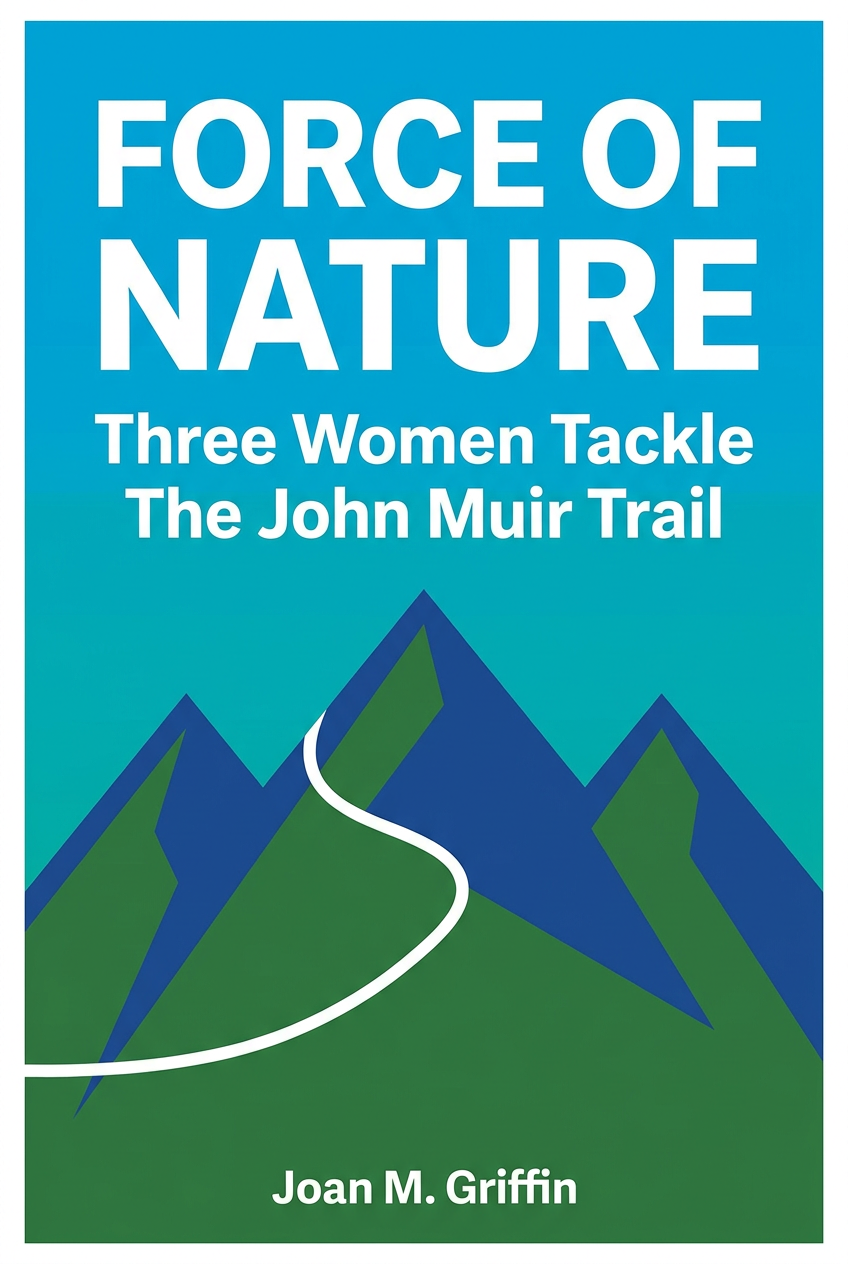
Force of Nature
Three Women Tackle The John Muir Trail
What's it about
Ever wondered if you have the grit to conquer a life-changing challenge? Discover the power of perseverance and friendship as three women, all over fifty, take on one of America's most demanding hikes, proving that your greatest adventures can still be ahead of you. This summary of Force of Nature reveals the practical and mental strategies these women used to tackle the grueling 211-mile John Muir Trail. You'll learn how they navigated treacherous terrain, personal doubts, and group dynamics to not only survive but thrive, offering you a roadmap for your own epic journey.
Meet the author
Joan M. Griffin is an award-winning journalist and editor whose work has appeared in numerous national publications, including the San Francisco Chronicle and Outside magazine. After a career spent telling other people's stories, she decided to tackle her own epic adventure: hiking the 221-mile John Muir Trail at age sixty. This transformative experience, undertaken with two close friends, gave her a profound new perspective on nature, friendship, and the surprising strength found later in life.
Opens the App Store to download Voxbrief

The Script
Two people are given identical, state-of-the-art bicycles. One is a seasoned professional cyclist, the other a weekend enthusiast. The professional immediately gets to work, meticulously disassembling the bike, tuning the derailleurs, adjusting the brake tension, and swapping the factory saddle for one molded to their body. Every screw is checked, every component optimized for a specific purpose. For them, the bike is an instrument, a collection of discrete parts to be perfected for maximum output. The enthusiast, meanwhile, simply hops on and starts riding. They feel the wind, the rhythm of the pedals, the way the frame flexes on a tight corner. They don't know the precise torque settings, but they know the feel of the bike as a single, living thing. When the professional’s hyper-tuned machine suffers a catastrophic failure from an over-tightened bolt, the enthusiast is miles down the road, enjoying the ride.
This gap—between dissecting the parts and feeling the whole—is the force that drove Joan M. Griffin to write this book. After a successful career as a systems engineer, where she excelled at breaking down complex problems into their smallest components, she found herself facing a personal crisis that couldn't be solved with a spreadsheet. The analytical tools that had brought her professional success were useless in navigating the messy, interconnected reality of her own life. Griffin embarked on a decade-long journey as an observer of natural systems, from forest ecosystems to the intuitive flow of a master chef's kitchen. She discovered that the most resilient and powerful forces emerge from the holistic, often un-analyzable, relationships between the parts.
Module 1: The Wilderness as Both Healer and Adversary
The central premise of the book is that nature is a powerful dual force. It can be a source of profound healing. But it can also be a formidable adversary that demands respect and immediate, decisive action.
Griffin’s journey begins as a direct response to grief. She seeks solace in the wilderness, believing a long-distance hike will restore her spirit. And in many ways, it does. She describes moments of transcendent beauty, like watching the first light hit a high mountain pass or lying in a meadow filled with wildflowers. Immersion in nature provides a powerful psychological and emotional balm for trauma. She finds that the sheer scale of the Sierra Nevada mountains puts her own problems into perspective. The rhythmic act of walking becomes a form of meditation, quieting the anxious inner voice that had plagued her. This is the healing power she sought.
However, the wilderness is not a gentle therapist. On just the second day, Griffin and her companions are caught in a violent lightning storm at 11,000 feet on Donohue Pass. They are forced to dump their packs, remove anything metal, and huddle in a shallow depression as lightning cracks around them. The experience is terrifying. It’s a stark reminder that the wilderness presents immediate, life-threatening dangers that require quick, decisive action. The trail disappears in boulder fields. Rivers swell to become dangerous crossings. Freezing rain and unexpected snowstorms test their endurance and gear. Griffin learns that survival in this environment is about adapting to its power.
This duality is where the real transformation happens. The physical challenges force a level of presence and focus that leaves no room for despair. When you’re navigating a steep, icy snowfield, you can’t afford to be lost in thought. You must be fully present. Confronting extreme physical challenges triggers a profound inner journey. The external mountains she climbs become a metaphor for her internal mountains of grief and self-doubt. By facing the real-world dangers, she builds the mental fortitude to face her inner demons.
Module 2: The Power of Preparation and the Inevitability of Chaos
In Silicon Valley, we live by sprints, roadmaps, and meticulous planning. Griffin’s journey proves that while preparation is essential, you must also be ready for your plan to completely fall apart.
Before ever stepping on the trail, Griffin becomes obsessive about preparation. She spends a year planning every detail. She devours books and maps. She spends hours researching the lightest gear. She dehydrates and meticulously packs her food into resupply buckets. Her physical training is equally rigorous, involving a personal trainer, weighted backpack hikes, and even wearing ankle weights while teaching. Meticulous preparation is the foundation for confidence and success in any major undertaking. This exhaustive planning gives her the mental confidence to even begin the journey, especially after her original hiking partner drops out.
But here’s the thing. No amount of planning can account for the chaos of reality. On the very first day, her forty-pound pack feels "frighteningly heavy," sparking immediate self-doubt. Soon after, she trips on a tree root, spraining her ankle. This single, simple accident creates a cascade of problems. The ankle wrap she uses causes painful blisters, which then become a source of constant pain and worry for days. Idealized expectations will always collide with unglamorous physical realities. This is a powerful lesson for any project manager or founder. Your Gantt chart is a beautiful theory. Reality is a sprained ankle on day one.
The real skill, Griffin shows, is in adapting when the plan fails. When a sudden storm hits, the women must improvise safety measures on the spot. When a crucial food resupply box goes missing, they have to rely on the generosity of other hikers. When a trail legend about a dangerous river crossing proves to be overblown, they learn to trust their own judgment over hearsay. True resilience is measured by your ability to adapt and problem-solve in real time. The plan gets you to the starting line. Adaptability gets you to the finish.