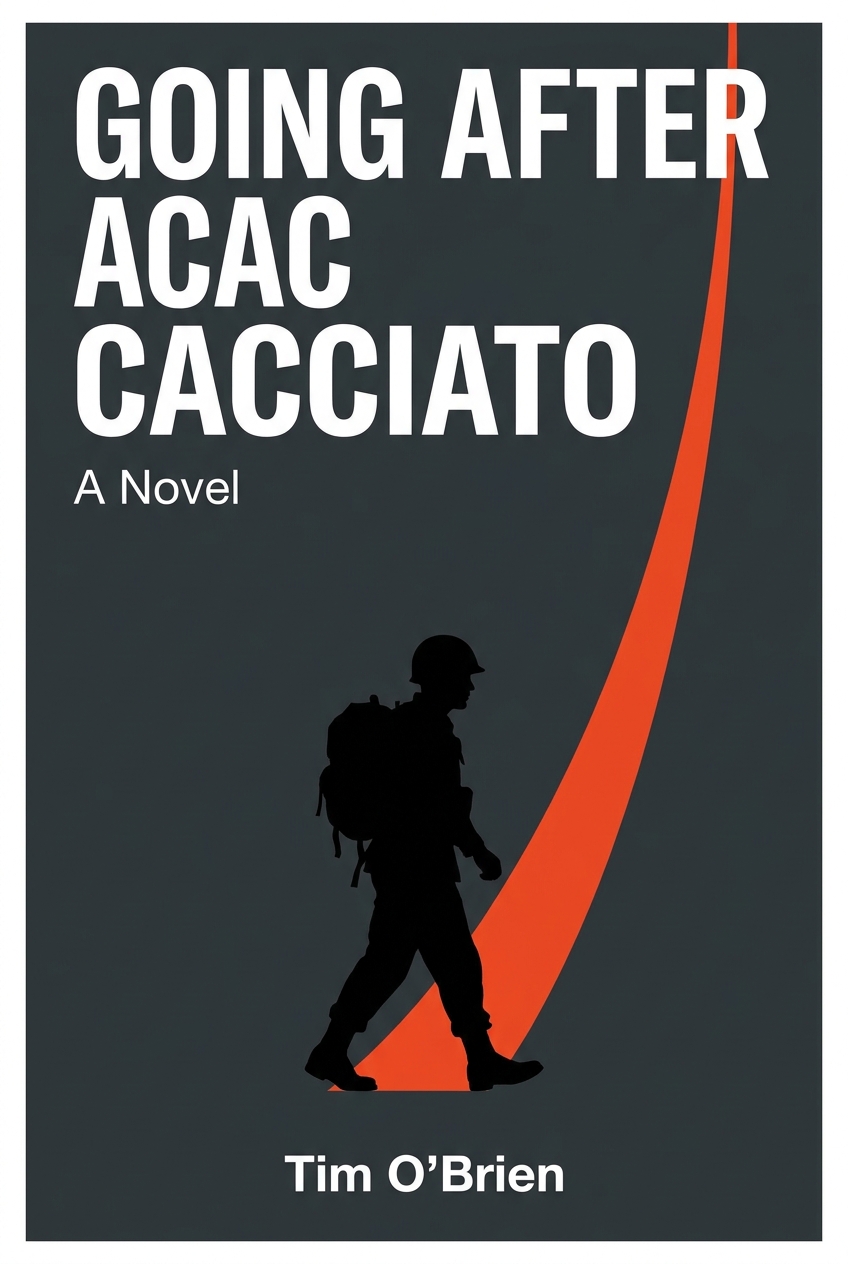
Going After Cacciato
A Novel
What's it about
What if the only way to survive the madness of war was to embrace an even greater madness? Journey into the surreal landscape of the Vietnam War, where one soldier's bizarre desertion sparks an unforgettable, mind-bending pursuit that blurs the line between reality and imagination. This isn't just a war story; it's a profound exploration of fear, courage, and the stories we tell ourselves to endure the unthinkable. You'll follow a platoon on a surreal trek from the jungles of Vietnam to the streets of Paris, questioning what's real and what’s simply a desperate dream of escape. Discover how the human mind can bend the world to find hope in the most hopeless of places.
Meet the author
A decorated veteran of the Vietnam War, Tim O'Brien is one of America's most acclaimed authors on conflict, earning the National Book Award for this very novel. His firsthand experience as an infantryman, or "grunt," in the jungles of Vietnam provides the searing authenticity and psychological depth that define his work. O'Brien masterfully blurs the line between reality and imagination, exploring the profound ways war reshapes memory, morality, and the stories soldiers tell themselves to survive.
Opens the App Store to download Voxbrief

The Script
The most logical response to an absurd reality is to become even more absurd. We often think of escape as a straight line—a desperate, linear flight from danger to safety. But what if the only true way out isn't a line at all, but a spiral? What if, in a world where following orders leads to madness and death, the sanest act is to invent an impossible journey, a private quest so ludicrous it bends the very fabric of war-torn reality around it? This is about creating a parallel, more powerful fact through sheer force of imagination. It suggests that the stories we tell ourselves to survive are tangible forces capable of charting a course through the unimaginable.
This profound exploration of imagination as a survival tool was forged in the crucible of Tim O'Brien's own experience. As a young soldier drafted into the U.S. Army and sent to Vietnam, he was confronted daily by the surreal horror and moral chaos of the war. He witnessed the thin line between reality and delusion, between staying alive and losing one's mind. Haunted by these experiences and the stories that soldiers told each other—stories that were part fact, part fever dream—O'Brien began to write. "Going After Cacciato" was an attempt to capture the war's psychological essence, exploring the powerful, often bizarre, ways the human mind rebels against an intolerable present by inventing an impossible future.
Module 1: The Two Wars: Reality vs. Imagination
The entire novel operates on a split screen. On one side, you have the brutal, static reality of the Vietnam War. On the other, a fantastical, impossible journey. O'Brien forces us to live in both worlds simultaneously.
The story centers on Specialist Paul Berlin. He's on watch in a tower, looking out at the South China Sea. To cope with his terror, he begins to imagine a story. The story is that a fellow soldier, Cacciato, has decided to just walk away from the war. He's heading for Paris. An absurd, 8,600-mile journey. Berlin then imagines his squad is sent to chase him. This chase becomes the novel's central plot.
This structure reveals a critical insight. Imagination is a primary tool for psychological survival. For Berlin, the "road to Paris" is a structured mental project. It's a way to impose a narrative, with a beginning, a middle, and a destination, onto the senseless chaos of war. While his body is stuck in a watchtower, his mind is on an epic adventure. This mental escape is what keeps him sane. It's a deliberate act of "pretending" to manage overwhelming fear. The squad's medic, Doc Peret, even offers a pseudo-scientific diagnosis. He claims Berlin's vivid fantasies are caused by an excess of "fear biles" flooding his system.
But here's the thing. This mental escape is constantly punctured by the sharp edges of reality. The fantastical journey to Paris is repeatedly interrupted by visceral, fragmented memories of combat. One moment, the squad is debating their route through Iran. The next, Berlin is reliving the horrific death of a fellow soldier. Traumatic memory operates in a non-linear, intrusive loop. O'Brien mirrors this by using repetitive chapter titles like "The Observation Post." He brings us back, again and again, to the same static, terrifying present. This structure is a simulation of post-traumatic stress. The past is a recurring, vivid nightmare that invades the present without warning.
This brings us to the core tension of the book. While imagination is a powerful shield, it's not a perfect one. Berlin tries to control his "pretending," to think through the story of Cacciato logically. He wants to explore the possibilities of escape and duty. But the story keeps getting away from him. The boundary between coping fantasy and delusional reality is dangerously thin. The imagined journey becomes just as perilous as the real war. The squad faces capture, moral decay, and betrayal within the fantasy itself. This shows that you can't simply imagine your way out of trauma. The war's poison seeps into the dream. The very act of imagining an escape is shaped and tainted by the horrors you are trying to flee.