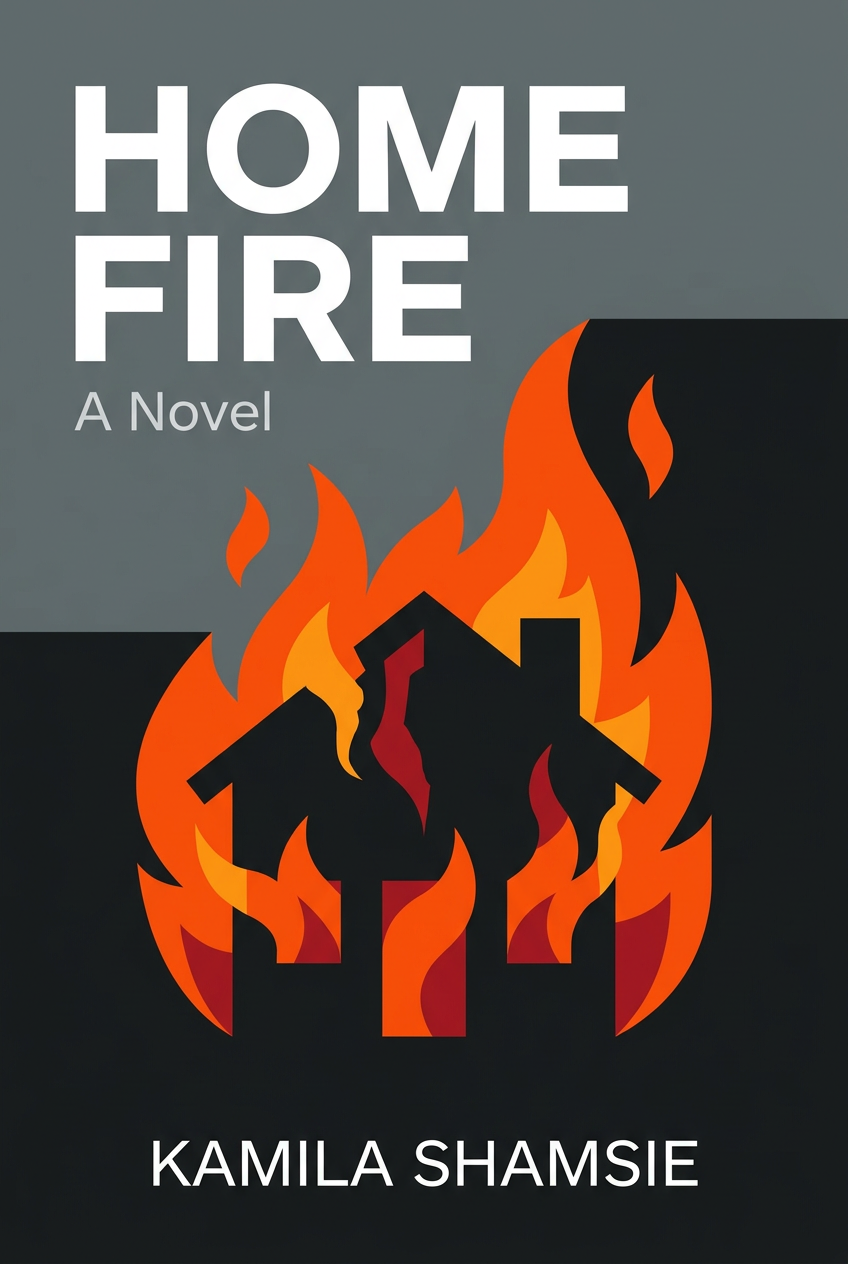
Home Fire
A Novel
What's it about
What happens when your loyalty to your family clashes with your duty to your country? Dive into a modern tragedy that explores the devastating choices one family must make when a brother they love is recruited by a terrorist organization, forcing his sisters to navigate a world of political intrigue and personal betrayal. You'll discover how love can be weaponized and how personal sacrifices can have explosive public consequences. This gripping story challenges you to question the true meaning of home, belonging, and the impossible price of radicalization, forcing you to confront the conflict between the heart and the state.
Meet the author
Kamila Shamsie is a Booker Prize-longlisted and Women's Prize-winning author whose work masterfully explores themes of identity, conflict, and belonging in a globalized world. Born in Pakistan to a family of writers, her background provides a rich, nuanced perspective on the complex interplay between family loyalty and state allegiance that is central to her acclaimed novel, Home Fire. Her storytelling bridges cultures, offering profound insight into the human cost of political turmoil and the search for home.
Opens the App Store to download Voxbrief

The Script
At the passport control line in a London airport, an official asks a young woman in a headscarf a series of questions. Is she British? Yes. Where was she born? London. Where is she traveling from? Amherst, Massachusetts. The questions continue, each one a small, sharp stone thrown at the window of her identity. They are about loyalty. 'Do you consider yourself British?' 'Do you feel loyal to the Queen?' The questions become more absurd, more invasive. 'What’s your favorite football team?' 'What do you think of the burkini ban?' The line is a stage, and she is performing a role she never auditioned for: the good citizen. She must prove not just her legal right to be there, but her cultural and emotional allegiance. Every answer is a potential trap door, every hesitation a mark against her. For Isma, and for so many others, this is the mundane, exhausting reality of crossing a border that is both geographical and psychological, a border she must navigate perfectly, every single time.
This is the world that British-Pakistani novelist Kamila Shamsie wanted to illuminate. She saw the ancient story of Antigone—a woman torn between the laws of the state and the laws of her family—playing out in the headlines of the 21st century. The story of children from immigrant families, whose love and loyalty are questioned, whose identities are fractured by the very nations they call home. Shamsie, who herself holds three passports and has lived between London, Karachi, and the United States, felt a deep, personal connection to this modern-day tragedy. She took Sophocles's 2,500-year-old play and set it alight, recasting it in the heat of contemporary London, Raqqa, and Massachusetts. In doing so, she was holding up a mirror to the devastating choices forced upon families caught in the crossfire of love, faith, and national identity.
Module 1: The Weight of Identity and the Performance of Belonging
Our story begins with Isma Pasha, a young British Muslim woman. She's at an airport, on her way to America to finally start her PhD. But first, she faces a security interrogation. This scene sets the stage for the entire novel. It's about the constant, exhausting performance required of those perceived as "other."
The first crucial insight is that marginalized individuals must strategically curate their public identity to survive scrutiny. Isma has meticulously prepared. No Quran. No controversial books. She even practices neutral, non-inflammatory answers to political questions with her sister. The interrogator judges the quality of her clothes, implying she can't afford a nice jacket. This is a judgment on her class, her race, and her right to belong. Isma's experience shows that for many, identity isn't just who you are. It's a role you must play carefully to avoid suspicion.
This leads us to the next point. Visible symbols of faith become targets for misinterpretation and prejudice. Isma wears a hijab. Later in America, a new acquaintance, Eamonn, asks if her head covering is a "style thing or a Muslim thing." He hesitates to shake her hand, making an assumption based on a stereotype. But when Isma is asked if it's difficult to be Muslim today, her response is firm: "I'd find it more difficult to not be Muslim." Her faith is an integral part of her identity, regardless of how others perceive it.
And here's the thing. This pressure to assimilate comes from the very top. Eamonn's father is Karamat Lone, a powerful British politician from a Muslim background who has built his career on a platform of assimilation. He gives speeches telling British Muslims to stop setting themselves apart in how they dress and think. His message is clear: to be accepted as British, you must shed visible markers of difference. So, when Aneeka, Isma's sister, is spat on for wearing a hijab after one of Lone's speeches, the connection is direct. The rhetoric of assimilation from those in power often fuels hostility on the ground. It creates a dangerous climate where personal choices about identity are seen as political statements, inviting aggression.
Module 2: The Tangled Web of Family, Secrets, and Betrayal
At the heart of Home Fire are two families: the Pashas and the Lones. Their lives are intertwined by a dark history, and the novel masterfully shows how family secrets can poison the present.
The story hinges on a devastating secret. The Pasha siblings—Isma, Aneeka, and their twin brother Parvaiz—are the children of a jihadist who died en route to Guantánamo Bay. For years, they hid this truth, fearing state harassment and community backlash. This secret has shaped their lives, forcing Isma to become a surrogate parent and delaying her own ambitions. This reveals a profound truth: family secrets born from political trauma create a legacy of silence and sacrifice. The weight of their father's actions falls squarely on the children, dictating their choices and limiting their freedom.
From this foundation, we see how these secrets fracture the family itself. Parvaiz, the gentle twin who loves recording sounds, feels lost and disconnected from a father he never knew. He becomes vulnerable to a recruiter, Farooq, who feeds him a heroic, romanticized narrative of his father as a noble warrior. Farooq exploits Parvaiz's search for identity and belonging. He promises a utopian caliphate in Syria, a place of dignity and purpose. This is a critical point: radicalization often preys on a search for identity, not just ideology. Parvaiz is drawn to a story that gives his life meaning and connects him to his absent father.
So what happens next? Isma, terrified for her family's safety, makes an impossible choice. She reports her brother to the authorities. For her, it's an act of protection. For her sister Aneeka, it's the ultimate betrayal. Aneeka's bond with her twin is primal, physical. They used to synchronize their heartbeats as children. Her rage at Isma is a visceral reaction to a severed connection. This explosive conflict illustrates that when family loyalty clashes with state loyalty, the fallout is devastating and deeply personal. There is no clean choice, only tragic consequences that tear at the fabric of the family.