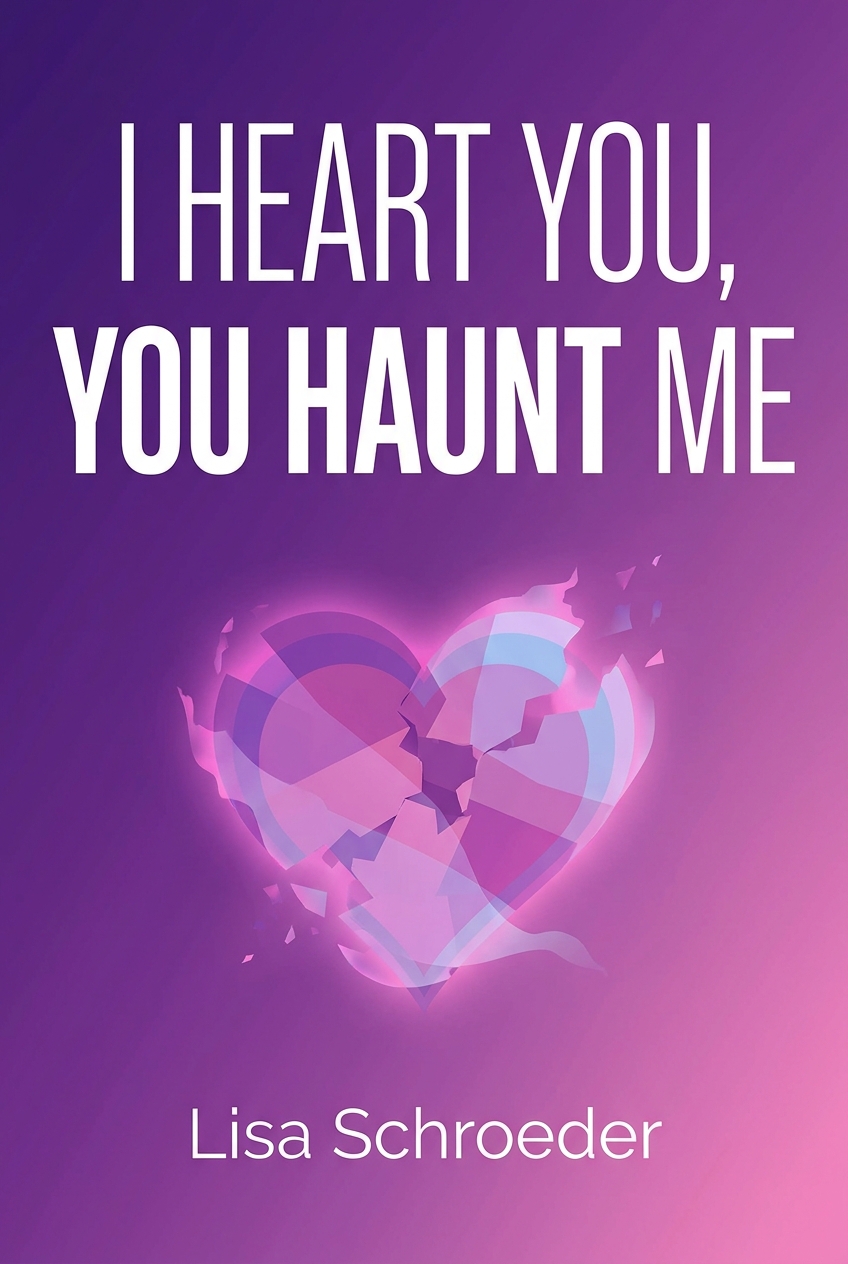
I Heart You, You Haunt Me
What's it about
Have you ever loved someone so much that you can't let them go, even after they're gone? What if your first love came back to you, not as a memory, but as a ghost you can't see, touch, or hold ever again? This is Ava's new reality. A year after her boyfriend Jackson's sudden death, his ghost reappears, and she's the only one who can see him. Explore her journey through unimaginable grief and undying love as she navigates a relationship that exists between two worlds. You'll discover how to find hope and healing when moving on feels impossible.
Meet the author
Lisa Schroeder is an acclaimed author of over twenty books for young adults and a former Oregon Book Award finalist, celebrated for her pioneering work in verse novels. Having always been drawn to stories that explore deep emotions and complex relationships, she wrote I Heart You, You Haunt Me to give voice to the overwhelming power of first love and loss. Her background as a voracious reader and lifelong writer allows her to connect with teens on a profoundly empathetic level.
Opens the App Store to download Voxbrief

The Script
Think of the last song you truly loved. Not just liked, but felt in your bones—the kind you put on repeat until the world outside melts away. Each time you listen, you notice something new: a subtle harmony, a lyric that hits differently, a drumbeat that syncs with your own heart. Now, imagine that song is a person. The one person you built a whole world around. And then, one day, the music stops. The silence is absolute, a crushing weight where a melody used to live. All you have are the echoes, the phantom notes playing in the back of your mind.
What do you do when the ghost of a song is the only thing you have left? Do you try to forget the tune, to force the silence to become normal? Or do you lean in, listening so closely to the memory that it starts to feel real again, the ghost of the melody taking shape in the empty air around you? This is the space where grief and love become indistinguishable, where the longing for one more verse is so powerful it might just be able to conjure it.
This very question of love surviving the ultimate silence is what compelled Lisa Schroeder to write. As a poet and novelist for young adults, she noticed that stories often treated grief as a final chapter, an ending to be overcome. She wanted to explore what happens when love is so strong it refuses to end, when it lingers like a powerful, persistent echo. Schroeder chose to write the story in verse—short, sharp poems that feel like fragments of memory, flashes of feeling, and the haunting, rhythmic quality of a song you can’t get out of your head.
Module 1: The Anatomy of a Haunting
The story begins in the immediate aftermath of a tragedy. Ava's boyfriend, Jackson, is dead. But for Ava, he's not entirely gone. This leads to the book's central exploration.
First, grief manifests as a physical, sensory haunting. This is about reality itself becoming distorted by loss. For Ava, Jackson’s presence is tangible. She feels a sudden drop in air temperature. She smells his specific sandalwood shaving cream. She sees his face for a split second in the mirror. These are sensory experiences she interprets as direct communication from his ghost. This illustrates a profound truth about deep grief. The brain, desperate to maintain a connection, can translate emotional pain into physical phenomena. The haunting is an internal state projected onto the world.
From this foundation, we see how guilt acts as the anchor for the haunting. Jackson's ghost is a constant reminder of Ava's role in his death. She's trapped in a loop of self-blame, replaying the moment she dared him to make the fatal jump. She tells her mother, "It was my fault... He did it for me." This guilt is a debt she feels she can never repay. Consequently, Jackson's ghost tells her he can only leave if she gives him her guilt. The haunting is a self-inflicted prison built from her own unresolved emotions. She is chained by her responsibility for his memory.
Building on that idea, the haunting becomes a form of connection that isolates Ava from the living. She actively chooses the company of a ghost over her friends and family. She rejects social invitations to stay home, hoping for a sign from Jackson. When her friends try to connect, she feels they can't possibly understand. One friend, Jessa, tells her, "You're not the dead one, you know." The comment is meant to be a reality check, but it only deepens Ava's isolation. She thinks, "You guys just don't have a clue what I'm going through." This is the paradox of her situation. The more she clings to the ghost of her past love, the more she severs her ties to the living people who could help her heal. Her supernatural connection becomes a barrier to human connection.