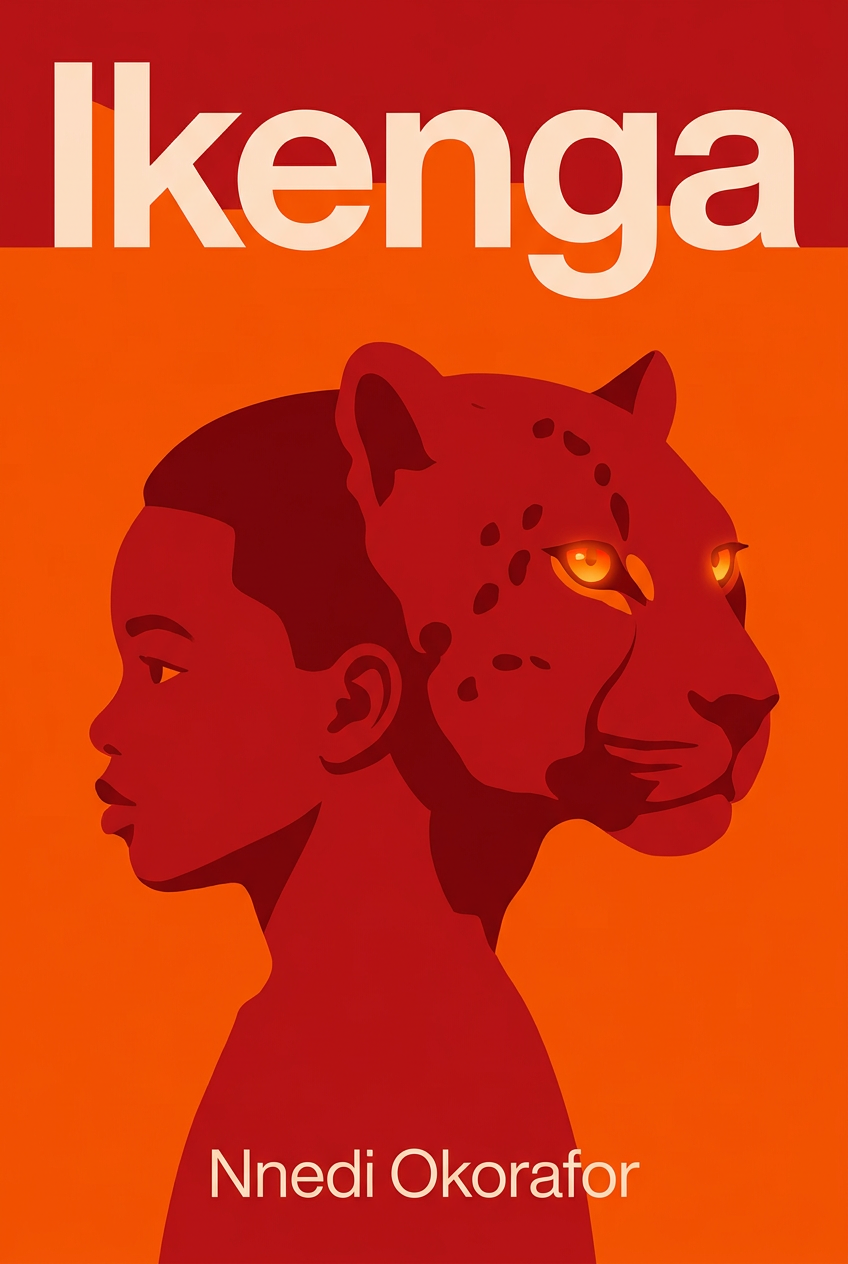
Ikenga
What's it about
What if you could gain superpowers to avenge your family and protect your town? In Kaleria, Nigeria, 12-year-old Nnamdi is gifted a mysterious Ikenga statue. It grants him incredible strength and abilities, but he must learn to control the rage that comes with them. Discover how Nnamdi secretly transforms into a hulking, shadowy hero to hunt down his father's killer. You'll follow his journey as he grapples with the immense power of the Ikenga, struggles to keep his identity hidden, and learns that true strength isn't just about fighting monsters.
Meet the author
Nnedi Okorafor is an international award-winning novelist of African-based science fiction, fantasy, and magical realism for both children and adults, including the World Fantasy Award-winning novel Who Fears Death. A first-generation Nigerian-American, she draws upon her heritage to weave Igbo cosmology and Nigerian culture into her vibrant, imaginative stories. Her unique perspective, which she calls "Africanfuturism," challenges and expands the boundaries of genre, creating unforgettable worlds and characters rooted in a rich cultural landscape, as seen in Ikenga.
Opens the App Store to download Voxbrief

The Script
A boy finds his father's old toolbox in the garage. Inside, there's a hammer for building and a pry bar for taking things apart. He spends a summer learning to use both, fixing a wobbly chair with the hammer, then using the pry bar to pull up old, rotten floorboards. One day, he finds a third tool, tucked away in a felt-lined compartment he’d never noticed before. It looks like a hammer, but it’s heavier, strangely balanced, and hums with a low energy he can feel in his teeth. He tries to use it on a nail, but it smashes the wood. He tries to use it like a pry bar, but it shatters the board into splinters. The tool doesn't seem to be for building or for demolition. It feels like it’s for something else entirely—something ancient and transformative, a tool that doesn’t just change the wood, but changes the person holding it.
This question of inheriting a power that has no clear instructions, a legacy that is both a gift and a terrifying responsibility, is at the heart of Nnedi Okorafor’s work. Okorafor, an award-winning Nigerian-American author, grew up on a steady diet of science fiction and fantasy, but rarely saw her own heritage reflected in those worlds. She began writing the stories she wanted to read, blending the technological futures of sci-fi with the deep, spiritual magic of Igbo mythology. Ikenga was born from this space, a direct answer to her son’s request for a superhero who looked like him. It was her way of crafting that third tool—a tool for showing a new generation how to wield the unique, powerful magic of their own identity.
Module 1: The Weight of Grief and Corruption
The story opens with a scene that is all too common. A good man is murdered, and his community is left reeling. Nnamdi, a twelve-year-old boy, has just lost his father. His father was the chief of police in the town of Kaleria, a man who stood for integrity. Now, at the funeral, Nnamdi watches as the man everyone believes is responsible for the murder, the "Chief of Chiefs," waltzes in. He shows no fear. He shows no remorse. He even offers Nnamdi’s grieving mother a fat envelope of money. This is a display of power. It's a message: I am untouchable.
This act sets the stage for the book's core conflict. Grief becomes a catalyst for a desire for justice. Nnamdi’s personal sorrow quickly mixes with a burning anger. He sees his mother, once the respected wife of the police chief, now forced to sell cheap tapioca in the market to survive. He sees his father's beautiful garden, once a symbol of order and care, now overrun with weeds. The personal decay of his family mirrors the social decay of his town. Kaleria is plagued by criminals with names like Bad Market and Mama Go-Slow. They operate in broad daylight. Fear paralyzes the community.
So what happens next? Nnamdi makes a vow. He vows that his father's killers will be in jail or dead within a year. But a small voice in his head mocks him. What can a twelve-year-old boy do against a system so thoroughly corrupt? This brings us to the second core insight. Powerlessness fuels a desperate search for agency. Nnamdi feels intense shame over his inability to protect his mother or honor his father's legacy. He wishes he were a grown man, someone who could stand up to the bullies and criminals. He is trapped between a child's vulnerability and an adult's burden. It’s this intense internal pressure that makes him receptive to the impossible.
Module 2: The Gift and the Burden of the Ikenga
A year after his father's death, at the memorial ceremony, something extraordinary happens. Nnamdi is visited by his father's ghost. The spirit doesn't offer comfort or easy answers. Instead, it presents him with a gift. It’s a small, ebony statue of a horned figure holding a machete. It is an Ikenga. His father explains it is a place of strength, an ancient object passed down through generations. He instructs Nnamdi to take it only with his right hand, his aka ikenga. This moment is pivotal. It introduces the book's central mechanic. Supernatural power emerges from cultural heritage.
The Ikenga is not just a symbol. It’s a key. The first time Nnamdi is filled with righteous anger while holding it, the transformation happens. He becomes "the Man," a seven-foot-tall shadowy figure of immense strength. He moves with impossible speed and sees in the dark. His first act is to stop a notorious carjacker, Three Days' Journey, saving a woman in the process. The power is exhilarating. It's also terrifying. He doesn't understand it. He can't fully control it.
And here's the thing. This newfound ability doesn't solve his problems. In fact, it complicates them. Possessing a secret power creates profound isolation. Nnamdi can't tell anyone, not even his best friend, Chioma. He lies about his strange disappearances and unexplained injuries. This secrecy creates a rift between them. Chioma knows he's hiding something, and it strains their friendship. The power that gives him agency in the world simultaneously cuts him off from his most important relationship.
Furthermore, the power itself is morally ambiguous. Nnamdi's transformations are triggered by anger. But what happens when that anger isn't righteous? What happens when it's just raw, unchecked rage? After a fight with a school bully, Nnamdi feels the Man stir within him, his voice deepening, his vision turning red. He begins to fear the power. Is it a tool for justice, or is it a poison that is corrupting him from the inside? This leads to the book's most critical theme. Heroism requires control and moral clarity. Nnamdi must learn that wielding the Ikenga is about mastering his anger.