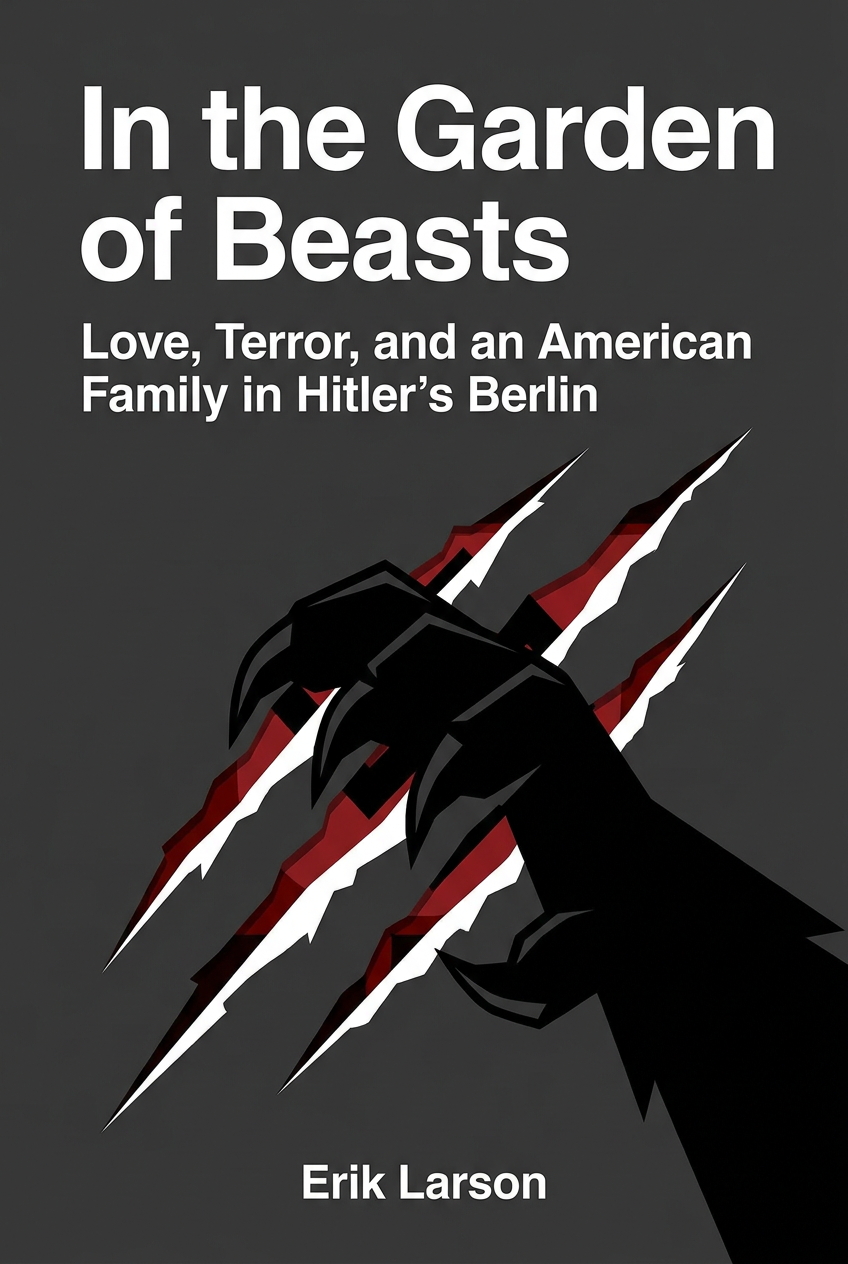
In the Garden of Beasts
Love, Terror, and an American Family in Hitler's Berlin
What's it about
What if you could witness the chilling rise of Nazi Germany through the eyes of an American family? Step into 1933 Berlin with the U.S. ambassador and his socialite daughter, and experience the city's glamorous allure as it descends into a nightmare of terror. This summary unpacks how an unsuspecting diplomat slowly recognized the horrifying truth of Hitler's regime. You'll discover the stark contrast between lavish parties and the brutal reality of escalating violence, learning how one family’s initial naivety gave way to a desperate attempt to warn an indifferent world.
Meet the author
Erik Larson is a master of narrative nonfiction and the 1 New York Times bestselling author of eight books, including the National Book Award finalist, The Devil in the White City. He excels at transforming meticulous historical research into gripping, suspenseful narratives that read like fiction. For In the Garden of Beasts, Larson drew from the personal letters and diaries of Ambassador William E. Dodd and his daughter, Martha, to bring their harrowing experience in 1930s Berlin vividly to life.
Opens the App Store to download Voxbrief

The Script
The air in a new country can feel different in your lungs. It’s the small things at first. A customs agent’s gaze lingers a moment too long, his smile not quite reaching his eyes. A parade marches down the street, but the cheers sound more like a command than a celebration. The polite laughter at a dinner party feels brittle, like thin ice over a dark, rushing current. You find yourself adjusting your own behavior in subtle ways—speaking a little more quietly, avoiding certain topics, offering a strained smile in return. You tell yourself it’s just cultural adjustment, the normal disorientation of being an outsider. You dismiss the unease as paranoia, a failure to adapt. But what if it’s not paranoia? What if you’re a canary in a coal mine, and the air really is turning to poison around you, so gradually that no one else seems to notice?
This creeping sense of normalcy dissolving into menace is the atmosphere Erik Larson sought to capture. He stumbled upon the story of William E. Dodd, America's first ambassador to Nazi Germany, and his family, and was immediately captivated by a specific, unsettling question: how could they have not seen what was coming? As a master of narrative nonfiction, known for bringing historical moments to life with the tension of a thriller, Larson found his answer in the quiet, day-to-day seduction of a society sleepwalking into catastrophe. He dove into the family's letters and diaries to reconstruct their experience from the inside, showing how the unbelievable becomes ordinary, one polite dinner party at a time.
Module 1: The Seductive Illusion of Normalcy
We've covered the book's premise. Now let's explore the first major theme: the deceptive allure of early Nazi Germany.
When Ambassador William Dodd and his family arrived in Berlin in 1933, they expected to find a city in turmoil. News reports painted a grim picture. But what they found was startlingly different. The city was vibrant. Cafes were full. Music spilled into the streets. This contrast between perception and reality is the first crucial insight. The surface of a society can mask deep, underlying terror. Martha Dodd, the ambassador's daughter, was immediately captivated. She saw Berlin as "youthful, carefree, romantic, and wonderful." She dismissed the warnings of violence as media exaggerations. Even the writer Christopher Isherwood, who knew friends had been imprisoned, admitted the beautiful weather and daily routines could trick him into feeling everything was fine.
This illusion was no accident. It was a carefully cultivated part of the Nazi strategy. Beneath the surface, a swift and brutal revolution was underway. The Nazis called it Gleichschaltung, or "Coordination." It was a campaign to align every aspect of German life with Nazi ideology. This brings us to a second key point. Systemic oppression can advance almost invisibly, through bureaucratic means and voluntary compliance. Many Germans willingly conformed without direct orders. This "self-coordination" created a rapid, pervasive change that shocked those who had been away. The infamous Secret State Police, the Gestapo, gained a reputation for being all-knowing. Its power came largely from ordinary citizens. A study found that many denunciations arose from petty personal disputes. A grocery clerk reporting a customer over a few cents. This created an atmosphere of pervasive fear and suspicion.
And here's the thing. This didn't look like a revolution to an outsider. The "Aryan clause," a law banning Jews from government jobs, had a devastating impact. Yet it was barely visible to a visitor. Jews made up only about 1% of the population. They were concentrated in neighborhoods most tourists never saw. This leads to the module's core lesson. Gradual erosion of rights is harder to recognize than sudden violence. The initial, overt violence against Jews had mostly subsided by the time the Dodds arrived. It was replaced by something more insidious. A slow, bureaucratic strangling of economic and social life. This "eerie calm," as one writer called it, was far more dangerous than open street brawls. It allowed outsiders, and even many Germans, to believe the worst was over. They mistook a change in tactics for a change of heart. But the terror had just gone underground.
Module 2: The Diplomat and the Dictator
We've seen how Berlin’s veneer of normalcy could deceive. Now, let's turn to the man sent to navigate this treacherous landscape: Ambassador William E. Dodd.
Dodd was a history professor from Chicago. He was a man of modest means and strong Jeffersonian principles. He believed in reason, logic, and the power of dialogue. This background shaped his entire approach. Dodd initially believed he could moderate the Nazi regime through rational engagement. He thought he could appeal to the "sober-minded" officials he met, like Foreign Minister Konstantin von Neurath. He hoped to reason with Hitler himself. He told a friend he would rather resign than be a mere "social figurehead." He wanted to have substantive, principled conversations.
This idealistic approach immediately clashed with the reality of Nazi Germany. Dodd's personal frugality became a point of friction. He shipped his old Chevrolet to Berlin. He insisted on walking to meetings. He found the lavish parties of the diplomatic corps appalling during a global depression. This brings us to a critical observation. In a system built on performative power, modesty can be mistaken for weakness. Embassy counselor George Gordon warned Dodd that his simple lifestyle would be a barrier. The Nazi government, Gordon argued, only respected displays of strength and status. Hitler's officials drove giant black touring cars. Dodd's Chevy was a symbol of a different world, one the Nazis held in contempt.
From this foundation, Dodd's mission became a study in frustration. He met with Hitler, hoping for a breakthrough. He found the dictator unimpressive in person. His features were "indistinct and unimpressive, as if begun in clay but never fired." Yet during their meeting, Dodd witnessed Hitler's ability to transform. When angered, he became a vessel of pure rage, railing against the Treaty of Versailles. Still, Dodd left the meeting with a flicker of hope. He cabled Washington that Hitler seemed sincere about wanting peace. This reveals the final insight of this module. Even seasoned observers can be manipulated by a charismatic leader's performance of sincerity.
Consul General George Messersmith, a career diplomat in Berlin, saw the danger immediately. He sent a blistering, 18-page letter to Washington. He warned that Dodd's optimism was a mistake. Hitler's assurances, he wrote, were "too good to be true." He described the Nazi government as a "madhouse" run by fanatics. Messersmith understood what Dodd, the historian, could not yet fully grasp. He was dealing with a new political species, one driven by an ideology that reason could not penetrate.