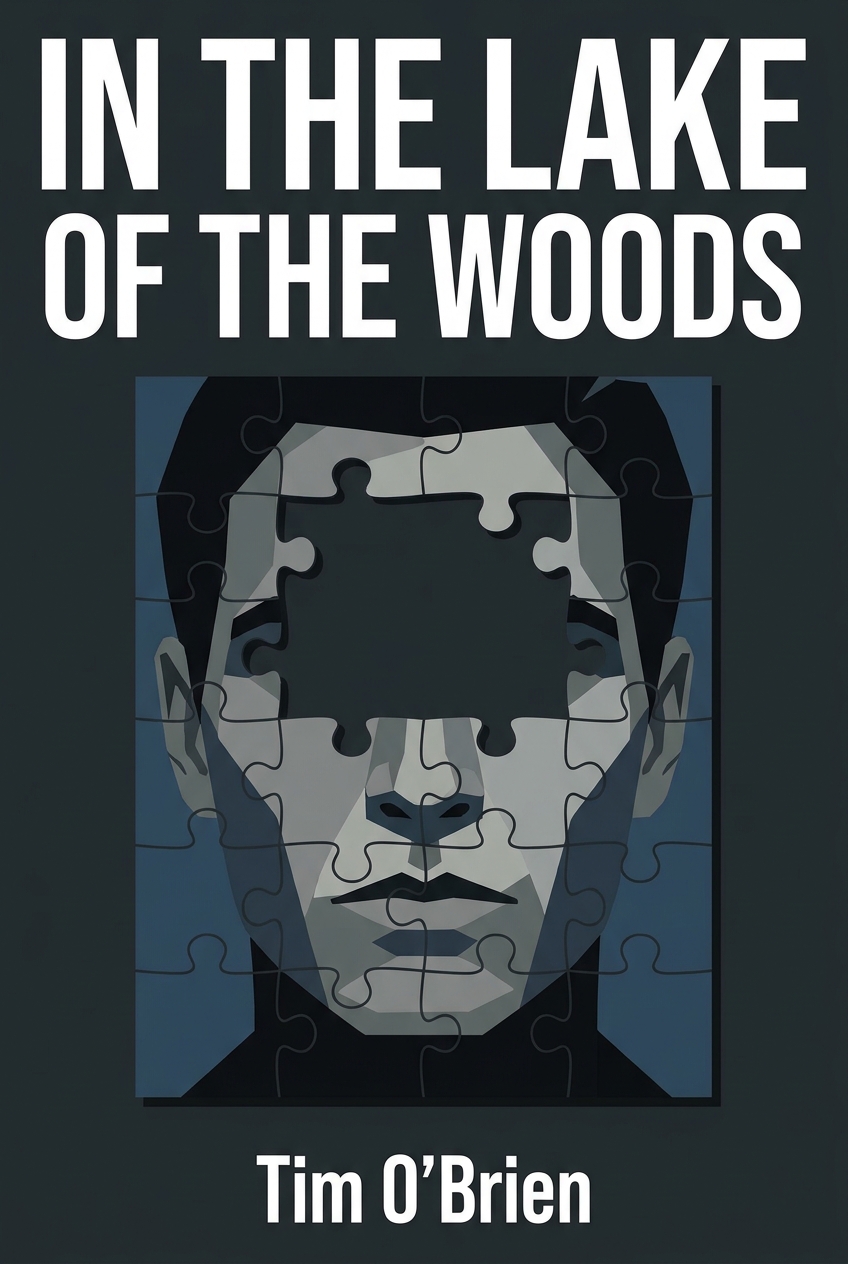
In the Lake of the Woods
What's it about
Have you ever wondered what secrets lurk beneath the surface of a seemingly perfect life? This summary explores the dark past of a politician whose carefully constructed world shatters when his wife mysteriously vanishes after his devastating electoral loss. You'll uncover the chilling connections between his hidden war crimes in Vietnam and his wife's disappearance. Delve into a fractured narrative of memory, love, and deceit to confront the terrifying possibility that the person you know best might be a complete stranger.
Meet the author
A National Book Award winner and decorated Vietnam War veteran, Tim O'Brien is celebrated as one of America’s most essential voices on war and its psychological aftermath. Drawing from his own infantry experience in the Quảng Ngãi province, the setting of the My Lai Massacre, O'Brien masterfully blurs the line between fact and fiction. This unique perspective allows him to explore the haunting ambiguities of memory, guilt, and the hidden stories soldiers carry home long after the fighting stops.
Opens the App Store to download Voxbrief

The Script
Two archivists are given identical cardboard boxes, salvaged from the same attic. The boxes contain the effects of a single man: a few medals, a stack of letters tied with string, a child's drawing, and a single, out-of-focus photograph of a woman smiling on a boat. The first archivist begins to catalog. He dates the letters, identifies the military honors, cross-references the locations mentioned, and builds a timeline. His goal is to assemble the fragments into a coherent, factual narrative—a definitive history of the man's life. He labels the box: 'Evidence.'
The second archivist looks at the same materials and sees something else entirely. He sees the gaps. He notes the letters that are clearly missing, the way the handwriting changes under pressure, the story the child’s drawing tells that the official commendations hide. He wonders about the photographer, not the subject. He sees the life as a space defined by its missing pieces, its deliberate omissions, and its irreconcilable contradictions. He labels the box: 'Mystery.' For him, the truth is found in the chasms of uncertainty that lie between the facts themselves.
This very tension between evidence and mystery is what drove Tim O’Brien to write In the Lake of the Woods. As a veteran of the Vietnam War, he lived in a world where official histories and battlefield realities were two entirely different languages. He saw how the stories soldiers told, and the secrets they kept, could create impenetrable walls within a person's soul. Troubled by the unknowability of the past and the ghosts of his own wartime experiences—including the My Lai massacre, which his unit was involved in—O’Brien uses fiction to explore the profound and often terrifying depths of what we can never truly know about others, or even about ourselves.
Module 1: The Sorcerer's Apprentice — Magic as a Coping Mechanism
The first thing to understand about John Wade is that he’s a magician. Literally. From childhood, he earns the nickname "Sorcerer." He uses illusion to manage an unbearable reality. This is a crucial insight into his character. Magic is Wade's primary tool for control and escape.
As a boy, John was ridiculed by his alcoholic father for being overweight. So he retreated to the basement. He practiced sleight of hand for hours. He learned to make things disappear. He learned to transform one object into another. This was a way to create a world where he had sovereignty. A world where he could control the outcome. After his father’s suicide, John used mental magic to cope. He would imagine a blue door opening, and his father would step through for a conversation. He was, in effect, performing a resurrection trick in his own mind.
This pattern continues into his adult life. In Vietnam, performing magic tricks for his fellow soldiers in Charlie Company earns him respect and a place in the group. It becomes his identity. But it's also a way to process the horror. The book suggests that after participating in a horrific massacre, he frames it as a grand illusion. He made a village "disappear." Later, to escape the guilt, he performs his ultimate trick: he forges military records, erases his name from the company roster, and effectively vanishes his own past. The lesson here is profound. When faced with trauma, some people develop coping mechanisms. Wade’s mechanism is to treat reality itself as a trick to be manipulated. It’s how he survives, but it also means he never truly lives in the real world.