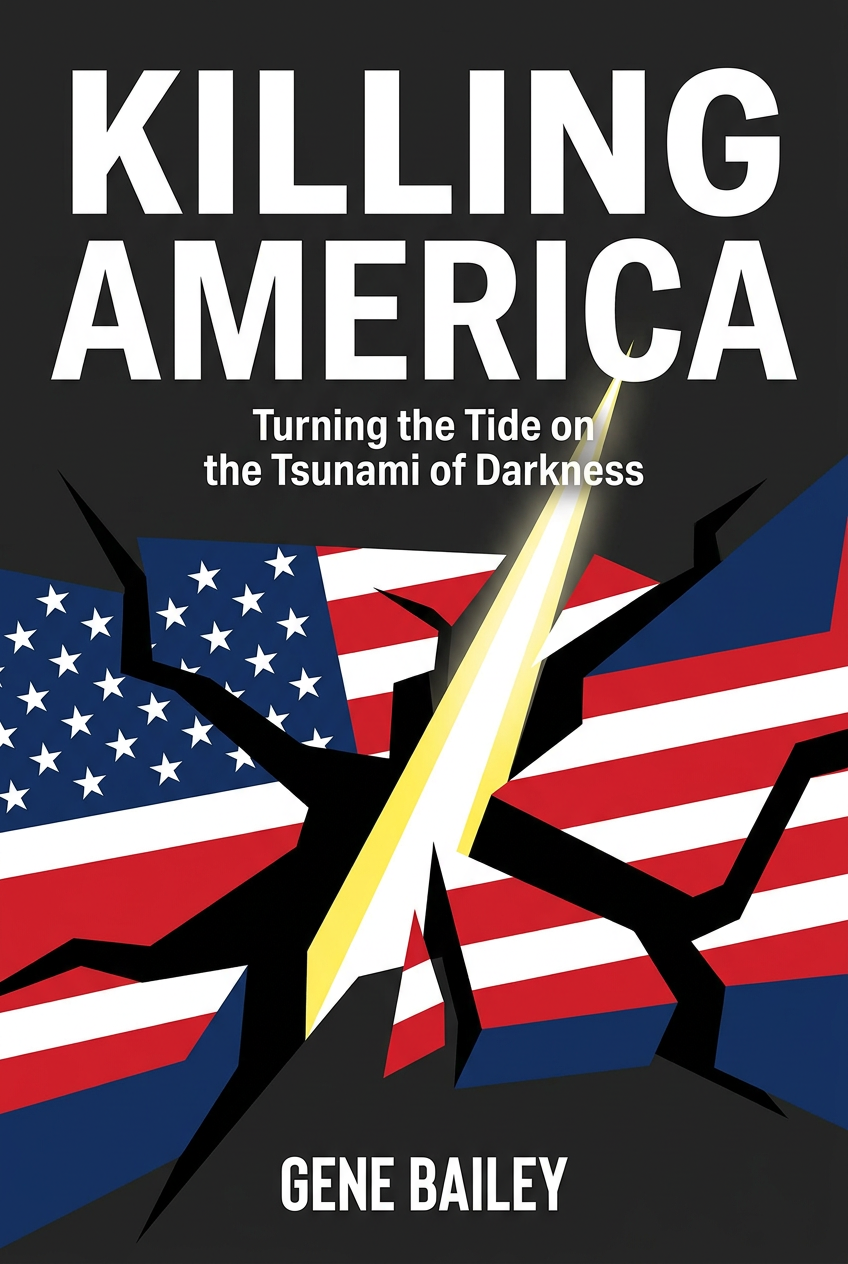
Killing America
Turning the Tide on the Tsunami of Darkness
What's it about
Feeling like America is losing its way? What if you could understand the hidden forces behind the cultural chaos and discover a clear path to reclaim the nation's spiritual foundation for yourself, your family, and your community? This is your guide to doing just that. Learn to identify the spiritual attacks undermining society and equip yourself with practical, faith-based strategies to stand firm. Gene Bailey reveals how to turn the tide against the darkness by activating your spiritual authority, becoming a beacon of hope, and taking decisive action to restore the values that once made the nation strong.
Meet the author
Gene Bailey is the Executive Director of Kenneth Copeland Ministries and Executive Vice President of Eagle Mountain International Church, bringing decades of high-level leadership and spiritual insight. His extensive experience overseeing major international ministry operations provides a unique vantage point on the cultural and spiritual battles facing the nation. This background has equipped him with the profound understanding necessary to write Killing America, offering a clear and urgent call for believers to stand for truth and reclaim the nation’s foundations.
Opens the App Store to download Voxbrief

The Script
A nation's greatness is measured by the virtues it can afford to forget. We often assume that the slow decay of a society's character is a passive process, like rust forming on abandoned machinery. But what if the most potent form of national decline isn't neglect, but a deliberate, methodical replacement? What if the very qualities that once defined a nation—resilience, integrity, faith—are not simply fading, but are being systematically dismantled and swapped out for weaker, more malleable substitutes? This is a quiet, internal renovation where the load-bearing walls of a nation's soul are hollowed out from within, leaving a beautiful but fragile facade, ready to collapse under the slightest pressure.
The architecture of this silent demolition is what has haunted Gene Bailey for decades. As a pastor, author, and CEO of a major Christian television network, he has occupied a unique vantage point, observing the subtle shifts in the cultural currents that shape the American psyche. He witnessed how foundational virtues were being re-cataloged as outdated liabilities, not through overt attack, but through a slow, almost imperceptible change in the nation's ambient story. This book was forged from the growing realization that the spiritual and moral framework he saw his grandparents inhabit was being treated as old furniture to be discarded in favor of a sleeker, emptier, and ultimately more fragile design.
Module 1: The Diagnosis of a Nation Under Attack
The core premise of "Killing America" is that the nation is facing a covert, internal assault. This is a slow, methodical poisoning orchestrated over generations. The goal is to dismantle America's foundational values and replace them with a new, controlling ideology.
This attack is strategic. The author argues the primary mechanism of attack is the erosion of foundational Judeo-Christian values. This involves a deliberate effort to remove God from public life, redefine core institutions like the family, and invert moral standards until what was once considered good is now called evil. For example, the book points to the removal of prayer and the Ten Commandments from schools as a starting point. It then connects this to what it sees as a cultural celebration of lifestyles and ideologies that directly contradict biblical principles, creating widespread moral confusion.
From this foundation, the book explains how this ideological battle plays out in our institutions. The author suggests cultural and institutional shifts are deliberate tools for subversion. He questions, for instance, the removal of cursive writing from many school curricula. Is it just a modern efficiency, or could it be a way to disconnect future generations from being able to read founding documents like the Constitution in their original form? This same critical lens is applied to media, which is accused of controlling narratives to influence public thought, and to education systems that prioritize what the author calls non-biblical viewpoints.
So what happens next? This leads to a state of public passivity. The author asserts that widespread complacency and distraction have enabled the attack to progress. For decades, many have been distracted by entertainment and personal comfort. They've been lulled into a state of inaction while freedoms were subtly stripped away. The book condemns this complacency, arguing that by not speaking out against the incremental attacks on their values, citizens have effectively become complicit in the nation's decline. It's a stark warning against the "it will never happen here" mindset.
But it’s not all doom and gloom. Despite this grim diagnosis, the book holds onto a critical belief. The author concludes that America is not dead yet, and hope for recovery remains. He frames the nation as the "last best hope for the world," a beacon of freedom whose survival is crucial. The book ends its diagnosis with an urgent call to action. It forces the reader to imagine where society will be in five years if no one stands up to fight back. The good news, he insists, is that the fight is not over.
Module 2: The Battleground of Ideas and Spirit
Now that we've covered the diagnosis, let's explore the book's framework for understanding the conflict. It argues that the most important battles are fought in the hearts and minds of the people.
The central conflict is framed as a spiritual one. The book posits that America's foundational problems and solutions are rooted in the spiritual realm. It's a battle between righteous, God-ordained principles and what the author describes as wicked, controlling spiritual forces. To support this, the book points to America’s founding documents, which reference a "Creator," and historical events like the 1607 Cape Henry landing, where settlers dedicated the land to Christ. In contrast, it points to modern movements that openly mock sacred things as evidence of the spiritual opposition at play. This spiritual lens changes the nature of the fight to one of principalities.
This brings us to a critical point about individual responsibility. Bailey argues that prayer alone is not enough. God's response to prayer often comes as an opportunity for action. He uses the film "Evan Almighty" as an analogy. A character prays to change the world, and God gives him a difficult, hands-on assignment. The message is clear: when we pray for change, we should expect to be given a job to do. This requires personal investment. The author uses another powerful analogy of a teenager who values a car more when he has to work for it himself. This concept of having "skin in the game" is central to the book's call for national restoration.
And here's the thing. That action requires courage. The author argues that you must be willing to draw a line in the sand to defend freedom. This is a symbolic act of taking a stand for truth and righteousness, even when it's risky. The book is filled with historical and biblical examples. Think of Colonel Travis at the Alamo, drawing a line and asking his men to cross it. Or the biblical story of Daniel, who refused to stop praying even under threat of death. These stories are models for modern courage. They show that one person's principled stand can inspire a nation.
But flip the coin. What happens when we fail to act? The book warns that moving the line back out of fear allows oppressive forces to gain ground. It uses the analogy of a playground bully. If you draw a line but keep retreating every time the bully steps forward, you will eventually be backed into a corner. The author cites the story of Mila, a survivor of the Russian Revolution, who warned that the incremental concessions and fear she saw in her home country are reappearing in America. Small compromises, repeated over time, can lead to a total loss of freedom. This "shock collar effect," where fear of consequences breaks the will to resist, is presented as a major danger.