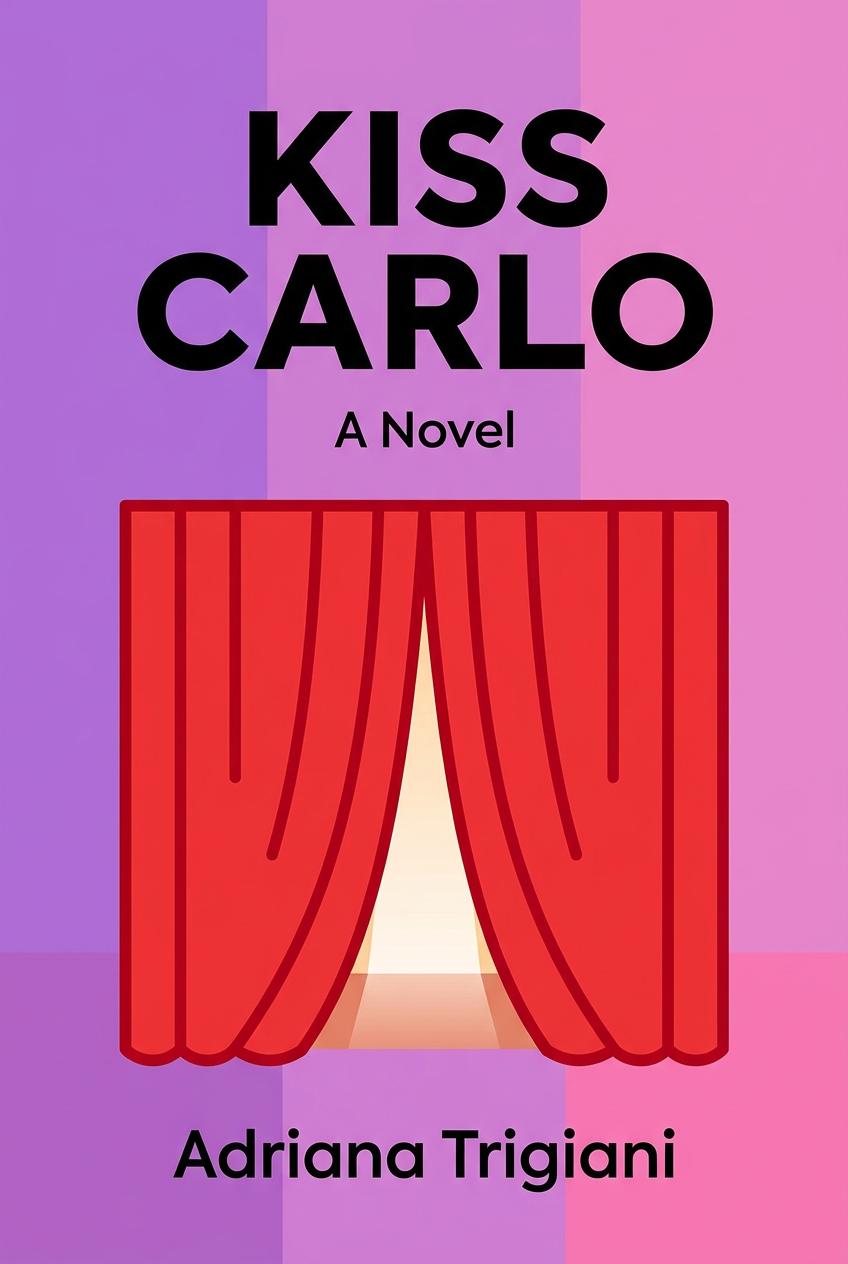
Kiss Carlo
A Novel
What's it about
Ever wonder if you're living the life you were meant to lead, or just the one you fell into? What if one fateful decision could change everything you thought you knew about family, love, and your own destiny? Get ready to explore this timeless question. You'll follow Nicky Castone, a cab driver from a sprawling Italian-American family of Shakespearean actors. When a long-buried family secret comes to light, Nicky is forced to choose between the comfortable life he knows and a thrilling, uncertain future in Hollywood and on Broadway. This is a story about loyalty, ambition, and finding your true calling.
Meet the author
Adriana Trigiani is the award-winning playwright and New York Times bestselling author of twenty books in fiction and nonfiction, beloved by millions of readers around the world. Raised in a vibrant Italian American family in Virginia, her rich cultural heritage and experience as a television writer and filmmaker deeply inform her storytelling. Trigiani masterfully crafts immersive, character-driven narratives like Kiss Carlo, drawing from the powerful family bonds, traditions, and dreams that have shaped her own remarkable life and career.
Opens the App Store to download Voxbrief

The Script
It's the annual town festival, a chaotic symphony of sizzling sausage, distant calliope music, and the boisterous greetings of neighbors. At one end of the crowded street, a young apprentice at his family’s shoe repair shop carefully stitches a worn leather sole, his movements precise, practiced, and small. He knows the history of this town through the scuffs and worn heels of its people. Each shoe tells a story of a journey taken, a dance floor worn smooth, a promise kept. At the other end of the same street, his cousin, a budding actor, stands on a makeshift stage, his voice booming, his gestures grand. He is weaving a different kind of story, one of heroes and villains, of grand passions and epic tragedies, meant for the entire crowd. They are two boys, bound by blood and separated by craft, each tasked with mending a different part of the world—one the tangible, the other the ephemeral.
This tension between the quiet, hands-on work of family legacy and the dazzling, public-facing pull of the stage is the world Adriana Trigiani was born into. Growing up in a sprawling Italian-American family in Big Stone Gap, Virginia, she was surrounded by storytellers. Her grandmothers, she recalls, didn't just share gossip; they performed it, complete with characters, acts, and dramatic reveals, turning the ordinary events of their Appalachian town into high drama. Trigiani absorbed this rhythm of life, the idea that every family has its own cast of characters and its own epic narrative playing out behind closed doors. She wrote "Kiss Carlo" to capture this very dynamic—the pull between the duty you owe your family and the personal destiny you crave, exploring what happens when the small, intimate stories of home collide with the bright, loud world of ambition.
Module 1: The Weight of Family Feuds and Hidden Histories
The story opens with a family at war with itself. It’s a powerful reminder of how easily relationships can fracture. The Palazzini brothers, Dom and Mike, are locked in a sixteen-year feud. It started over a small plot of land. A minor disagreement. But it spiraled into a bitter divide that split their family and their city. This is a deep exploration of how pride and resentment can poison generations.
One of the first key insights is that long-standing family conflicts are often fueled by pride, not substance. The land that sparked the feud had negligible value. The real issue was the perceived insult. Their father pitted them against each other, and they continued the fight long after he was gone. Dom became the traditional, frugal immigrant. Mike became the flashy, Americanized spender. Their identities were forged in opposition to each other. Their wives and children were forced to take sides. The feud became an institution, a core part of their family's story.
This leads to a crucial point about how we deal with the past. Shared trauma does not guarantee future unity. As young orphans sailing from Italy, Dom promised his brother, "I will never leave you." They clung to each other for survival. Yet, years later, this profound bond was completely erased by a fight over money and pride. It shows how present grievances can overwhelm even the most powerful shared history. The memory of their shared struggle was not enough to save their relationship.
And here’s the thing. The community around them adapted. Society often normalizes division instead of demanding reconciliation. South Philadelphia is described as having "two of everything." Two churches, two schools, two barbershops. The city’s social structure allowed the estranged family to live parallel lives. They could exist in a state of rage for years without ever needing to interact. The brothers even split the city into territories for their competing cab companies. The conflict was baked into the geography of their lives. It’s a stark look at how we can build systems that accommodate brokenness instead of healing it.
Module 2: The Search for an Authentic Self
We've seen how family history can trap you. Now, let's turn to the struggle to break free. The central character, Nicky Castone, feels this tension acutely. He’s an orphan raised by his aunt and uncle, the Palazzinis. He lives a predictable life. He drives a cab. He has a fiancée of seven years, Peachy. He's on a path that everyone expects of him. But he has a secret. For three years, he has been volunteering at the Borelli Theatrical Company, a struggling local theater. This is where he feels alive.
This introduces a powerful theme. True identity is often found in the spaces where you feel most uncertain. For Nicky, the theater is a place of chaos and passion. It’s the opposite of his stable, routine life. He loves the "volatile, dangerous, and restless sea" of live performance. It’s a place where he can explore emotions and connect with something deeper. He hides this passion from his family and fiancée. He knows they wouldn't understand. This secrecy creates a deep internal conflict. He feels obligated to marry Peachy and settle down. But his heart is in the theater.
So what happens next? A crisis forces his hand. After a passenger dies in his cab, Nicky is haunted by the experience. He seeks solace at the empty theater, not with his fiancée. This is where he finds Calla Borelli, the director. They share a moment of profound connection, talking about life, death, and art. This experience clarifies something for Nicky. A fulfilling life requires risking stability for passion. He realizes he can't marry Peachy. Their dreams are incompatible. She wants a modern, conventional life. He wants the messy, unpredictable world of art.
This decision leads to a dramatic turn. Nicky breaks the engagement, and Peachy’s furious father threatens him. To escape, Nicky hatches a wild plan. He decides to impersonate an ailing Italian ambassador, Carlo Guardinfante, who was scheduled to appear at a festival in Roseto, Pennsylvania. It’s a desperate, theatrical move. But for Nicky, it’s a chance to start over. He believes you can create the person you want to be by performing the role. He tells his accomplice, "I get the role of a lifetime, and save what’s left of it." He is attempting to rewrite his own story, using the only tools he has: his acting skills and his desire for a different life.