All Books
Self-Growth
Business & Career
Health & Wellness
Society & Culture
Money & Finance
Relationships
Science & Tech
Fiction
Topics
Blog
Download on the App Store

The Good Left Undone

A Novel

14 minAdriana Trigiani

What's it about

Have you ever wondered if your family's history holds the key to your own future? Discover a breathtaking, multi-generational saga that unearths the long-buried secrets, fierce loves, and profound sacrifices of one remarkable family, revealing how the past never truly leaves us. You'll follow the Cabrelli family of Tuscan artisans from the shores of Italy to the vibrant coasts of Scotland. As the matriarch, Matelda, nears the end of her life, she reveals a story of two star-crossed lovers torn apart by war, challenging everything her family thought they knew and inspiring them to confront the good they've left undone.

Meet the author

Adriana Trigiani is an award-winning playwright, television writer, and filmmaker, and the New York Times bestselling author of twenty books in fiction and nonfiction. Her deep connection to her Italian American heritage, rooted in family stories passed down through generations, provides the rich, authentic foundation for her beloved historical novels. Trigiani’s ability to weave her own family’s history into epic, heartfelt narratives about love, loss, and resilience is the signature of her celebrated work, including The Good Left Undone.
Listen Now

Opens the App Store to download Voxbrief

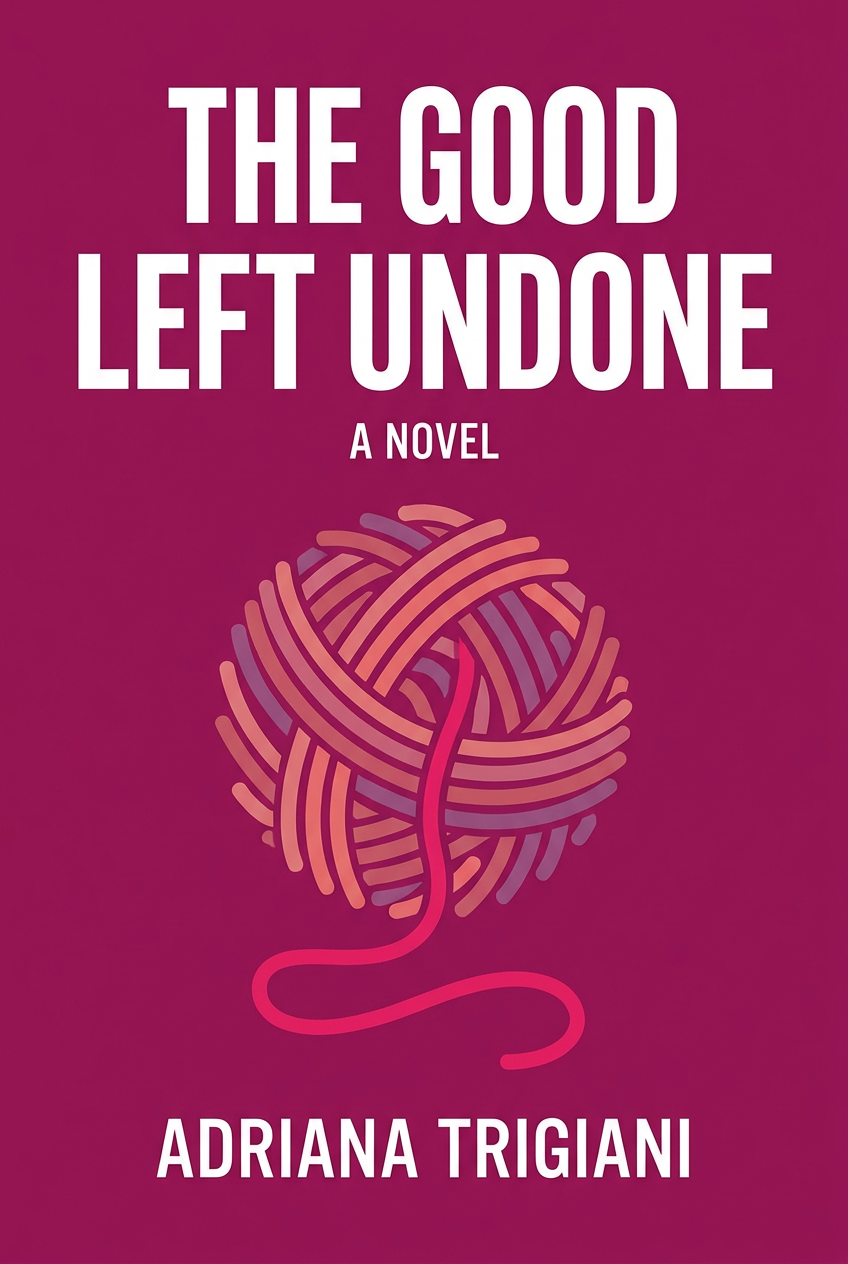
The Good Left Undone book cover

The Script

In a box in the attic sits a wedding dress, preserved in acid-free paper, a relic of a day frozen in time. Beside it, on a hanger, hangs another wedding dress from a different generation, this one soft from wear, its hem stained with wine and grass from a night of dancing, a small tear near the cuff where it caught on a splintered church pew. Both are symbols of a family's beginnings, but they tell two different stories. One is the official narrative—pristine, protected, and silent. The other is the lived-in truth, a chronicle of joy and mishap, a story told in its imperfections. It’s in the space between these two versions—the story we preserve and the story we actually live—that a family’s real legacy is found. It’s a legacy of small, accumulated moments, of secrets kept out of love, and of the good that often goes unnoticed, left undone in the official telling.

This gap between a family's public myth and its private, messy truth is the territory Adriana Trigiani has explored for decades. A celebrated author and playwright, Trigiani grew up surrounded by the powerful stories of her Italian grandmothers. She noticed how the official family history—the one told at holidays—was often a simplified, polished version. The richer, more complicated truths lay in the quiet conversations, the half-finished sentences, and the objects they held dear. For her, the story of her own family wasn't complete without understanding her grandmother's life in Scotland during World War II, a piece of the puzzle that was rarely discussed. The Good Left Undone was born from this desire to piece together that fragmented history, to honor the stories that get left in the margins, and to celebrate the strength of the women who live them.

Module 1: The Fragility of Memory and the Urgency of Legacy

The story opens with Matelda Roffo, an eighty-one-year-old matriarch. She is trying to recall a bedtime story her grandfather told her decades ago. It was about an elephant. She remembers bits and pieces, but the full narrative is gone. This small, personal failure introduces a central theme of the book. Family history is a fragile asset that requires active preservation. Matelda’s regret is palpable. She meant to write the story down so many times but never got around to it. It’s a feeling many of us can relate to. We assume the stories and the storytellers will always be there, until one day they aren't.

This leads to a powerful insight. The novel suggests that the past is a living, sensory presence. For Matelda, the scent of beeswax in church can trigger vivid recollections of her grandfather’s workshop. A walk along the Viareggio boardwalk brings back the ghosts of her parents in their youth. These sensory details are more potent than facts. The most enduring memories are anchored in physical sensations and emotional experiences. Simply listing names on a family tree is not enough. To preserve a legacy, you must capture the sights, sounds, and feelings that gave it life.

So how does this apply to us? It challenges us to become active archivists of our own family's narrative. Trigiani shows that aging is a process of reckoning with one's legacy. Matelda is acutely aware of her mortality. She spends her days getting her house in order, not just physically, but mentally. She's sorting through memories, trying to piece together the narrative for her children and grandchildren.

And here’s the thing. This process is often a race against time. The book poignantly illustrates the cruelty of aging on memory. Matelda can recall a specific Easter dinner from 70 years ago in perfect detail. She remembers the yellow tablecloth and the taste of her mother’s fresh bread. But she can’t remember what she ate for dinner last night. This contrast highlights a critical point. We must capture the stories of our elders while their long-term memory is still sharp. Their recall of recent events might fade, but their connection to the distant past—to the foundational stories of the family—can remain incredibly vivid. It’s our job to ask the questions that unlock it.

Module 2: The Interplay of Love, Identity, and Exile

Now, let’s move to the second part of this saga, which jumps back in time to Matelda’s mother, Domenica Cabrelli. Domenica is a young, brilliant nurse in pre-war Italy. She is passionate about her work and fiercely independent. But she lives in a world where a woman’s autonomy is constrained by family, church, and society. This sets up a powerful conflict.

Domenica’s story reveals a tough truth. Personal fulfillment often requires defying societal expectations and prescribed roles. Her mother, Netta, pressures her to marry a wealthy doctor and secure her social standing. But Domenica finds deep satisfaction in her nursing career. This tension comes to a head when she gives medical advice about family planning to a patient, a woman whose health is at risk from another pregnancy. This act of professional compassion violates church doctrine. Her defiance has severe consequences. She is publicly shamed and exiled, her nursing license revoked, and she is sent to work in a hospital in Marseille, France.

This exile introduces us to Domenica’s first great love, a Scottish sea captain named John McVicars. Their connection is immediate and intense, a beacon of light in a dark time. But it’s also complicated by the looming threat of war. Their story illustrates that love in turbulent times is a fragile dance between passion and pragmatism. Her friends warn her against marrying a sailor, a man who is always leaving. He, in turn, is wary of commitment, knowing most women want to pull a man from the sea. Their relationship is a microcosm of the uncertainty of the era.

And it doesn't stop there. The war attacks their very identities. Domenica is an Italian émigré in France, soon to be a woman without a country. McVicars, a Scot, is about to have his ship requisitioned for the war effort. Their personal lives are completely at the mercy of geopolitical forces.

Building on that idea, the story shows how displacement forces a re-evaluation of what "home" truly means. Domenica is torn from her family, her career, and her country. In Marseille, and later in Scotland, she is profoundly lonely. Yet, she finds resilience. A sense of home can be rebuilt through new connections, small comforts, and the persistence of memory. A warm encounter with an Italian-Scottish deliveryman, who speaks her language and knows her hometown, provides a moment of profound comfort. Her budding romance with McVicars offers a new anchor. She discovers that home is the feeling of being understood and cherished, even in a foreign land.

Read More