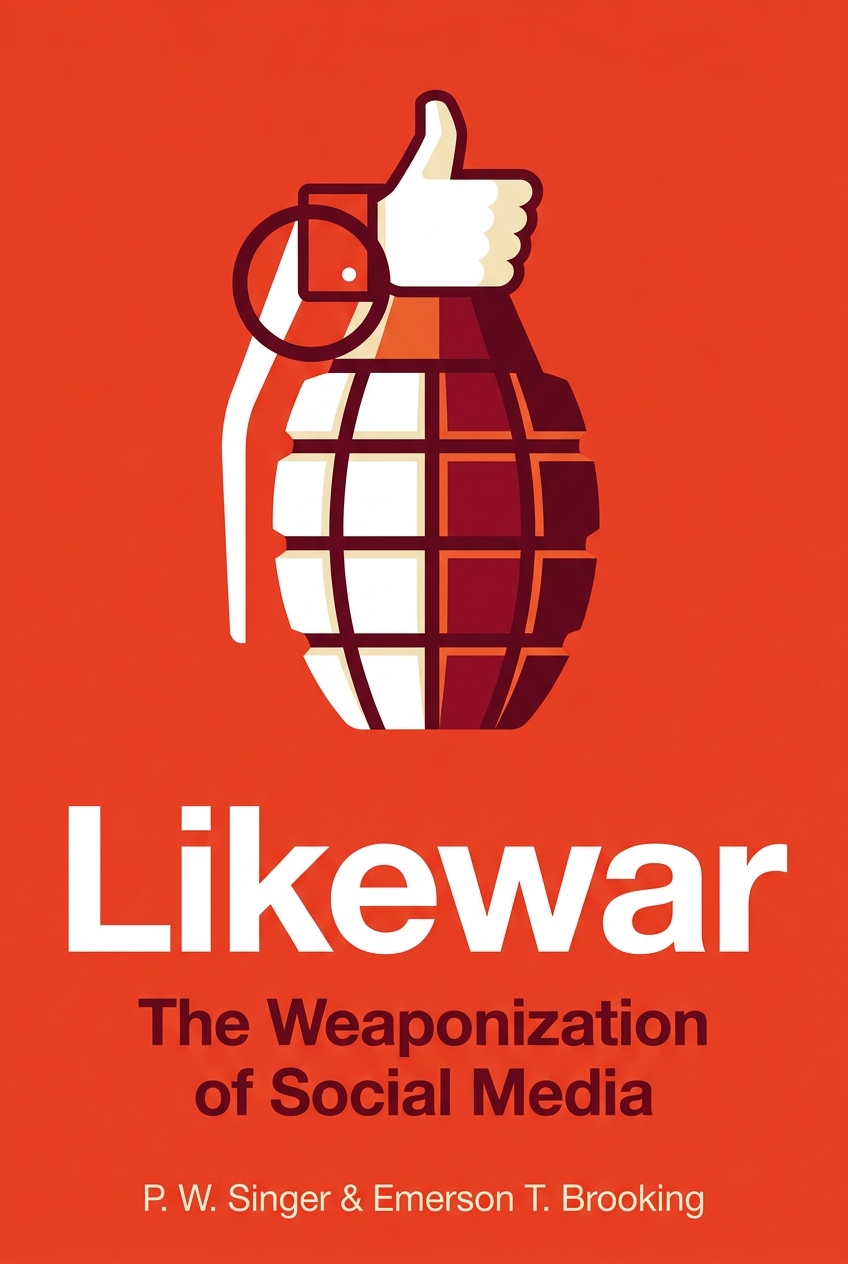
Likewar
The Weaponization of Social Media
What's it about
Ever wonder how a simple tweet or meme can ignite a protest, swing an election, or even start a war? Discover how social media has become the new global battlefield and learn the tactics used by governments, terrorists, and celebrities to manipulate you online. This summary of Likewar decodes the playbook of modern information warfare. You'll learn to spot bot armies, identify sophisticated propaganda, and understand the psychology behind viral disinformation. Gain the critical skills to defend yourself and see the hidden digital conflicts shaping your world.
Meet the author
P. W. Singer is a strategist at New America and an editor at Popular Science, recognized by the Smithsonian as one of the nation's 100 leading innovators. Emerson T. Brooking is a resident fellow at the Digital Forensic Research Lab of the Atlantic Council. Together, they combined Singer's deep experience in 21st-century warfare with Brooking's expertise in conflict and social media. Their unique partnership allowed them to document the collision of likes and bullets, revealing how online battles are shaping real-world conflict and our daily lives.
The Script
The most pivotal battlegrounds of the 21st century are psychological spaces. The weapons are likes, shares, and viral narratives. We often think of war as something fought by soldiers in distant lands, a domain of steel and strategy. Yet, the most profound conflicts now unfold directly inside our minds, delivered through the screens we hold in our hands. Every day, we are combatants in a war we don't even realize we're fighting, where victory is measured in attention, belief, and emotional reaction. This new form of warfare seeks to conquer consensus, turning our social feeds into front lines and our opinions into ammunition.
The architects of this invisible battlefield didn't just stumble upon these tactics. They were meticulously studied and documented by P. W. Singer, a strategist at the New America think tank, and Emerson T. Brooking, a research fellow specializing in conflict and technology. Their investigation began with a disturbing pattern they observed across the globe: from ISIS propagandists and Russian trolls to American political campaigns and corporate marketers. They saw that the same tools designed to connect us were being systematically weaponized to divide us. Combining Singer's deep background in modern warfare with Brooking's expertise in digital forensics, they embarked on a journey to decode this new reality, revealing how influence has become the ultimate currency of power.
Module 1: The New Laws of Power
The internet didn't just change how we communicate. It rewrote the rules of power. The authors argue that the digital age has collapsed the distance between war and politics, creating a new kind of conflict they call "Likewar." This is about hacking people's minds.
The first thing to grasp is that information itself is now the primary weapon in modern conflict. In the past, you needed armies and bombs to project power. Now, a viral meme or a coordinated botnet can be just as effective. Think of the 2014 ISIS invasion of northern Iraq. They were vastly outnumbered by the Iraqi army. But they launched a social media blitzkrieg with the hashtag #AllEyesOnISIS, spreading videos of executions and images of their convoys. The terror went viral, causing Iraqi soldiers to abandon their posts. ISIS captured the city of Mosul with minimal fighting. They won by weaponizing information to shatter their enemy's will to fight.
This leads to a chilling realization. In the battle for belief, truth is secondary to emotional resonance. The former CEO of Cambridge Analytica, Alexander Nix, said it best: "These are things that don’t necessarily need to be true as long as they’re believed." This is the core logic of Likewar. The goal is to control the narrative and shape perception. Russia’s "firehose of falsehood" strategy during the 2016 U.S. election was about flooding the zone with so many conflicting stories, conspiracy theories, and half-truths that people simply gave up trying to find the facts. The objective is to create confusion, sow division, and erode the very idea of a shared reality.
And here's the thing. This new conflict blurs the lines between the digital and physical worlds. Online disputes now directly escalate into real-world violence. In Chicago, gang wars are increasingly fought over "cyberbanging," where online insults on Facebook or Twitter are seen as public challenges that demand a violent response. The case of rapper "Young Pappy" is a stark example. His online taunts after a shooting led directly to his own murder, which in turn sparked a new cycle of retaliation. The screen is no longer a safe barrier. The conflict flows seamlessly from digital posts to physical streets.
So what happens next? This dynamic has forced everyone, from generals to presidents, to adapt. Militaries now see social media as a formal domain of operations. During the 2016 battle to retake Mosul from ISIS, the U.S. and its allies deployed portable cell towers and waged a "cognitive maneuver" campaign online to counter ISIS propaganda. The tactics of war and politics have fused into a single playbook. The same tools of virality, attention-seeking, and community manipulation are used by terrorist recruiters, political campaigns, and brand marketers. The fight for likes has become a fight for power.