All Books
Self-Growth
Business & Career
Health & Wellness
Society & Culture
Money & Finance
Relationships
Science & Tech
Fiction
Topics
Blog
Download on the App Store

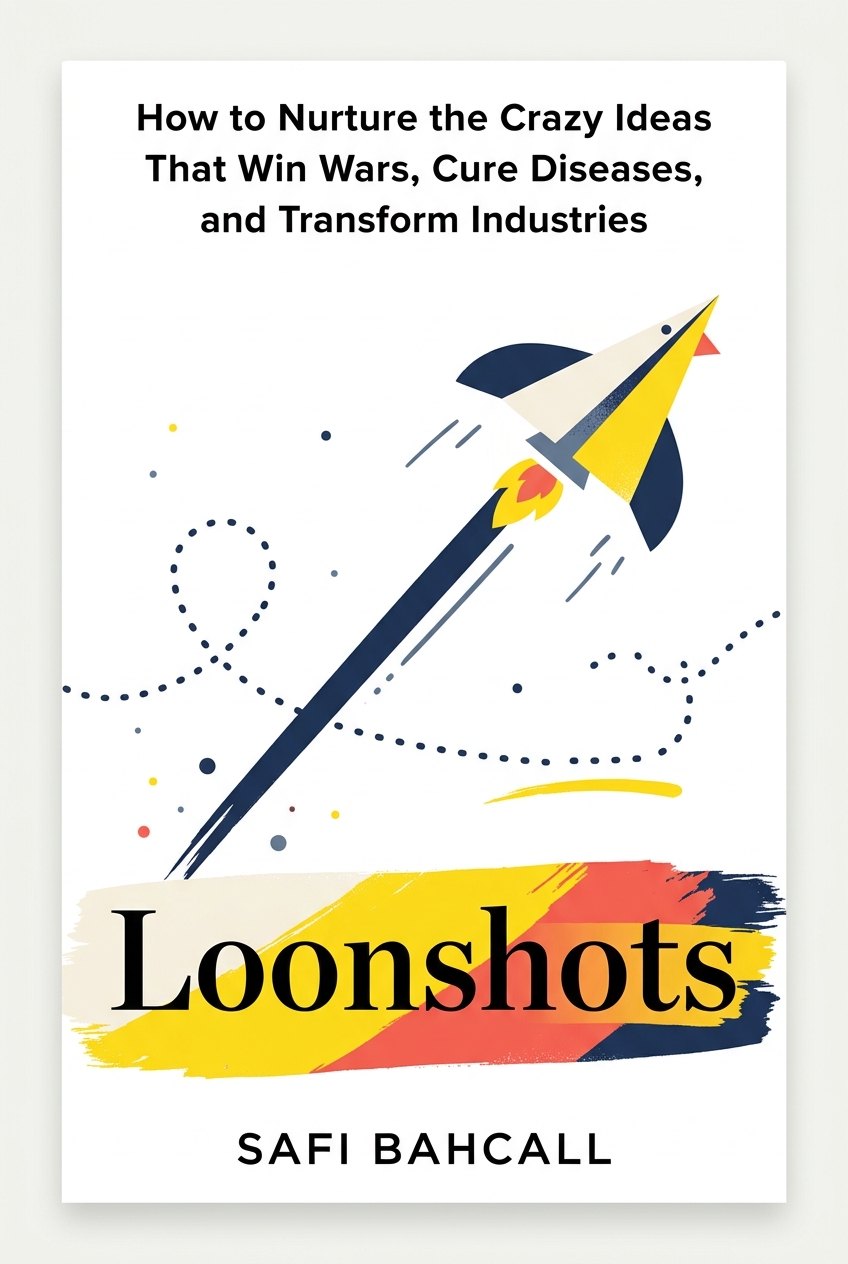
Loonshots

How to Nurture the Crazy Ideas That Win Wars, Cure Diseases, and Transform Industries

13 minSafi Bahcall

What's it about

Why do some great ideas change the world while others die on the vine? Discover the surprising science behind nurturing breakthrough innovations. You'll learn why your team's structure, not its culture, is the key to protecting fragile, game-changing ideas—or "loonshots"—from being crushed. Uncover the secret that separates companies that repeatedly innovate from those that stumble. Bahcall, a physicist and biotech entrepreneur, reveals how to balance and manage the two phases of group behavior: nurturing wild new ideas and efficiently executing on existing ones. Master this dynamic to transform your organization.

Meet the author

Safi Bahcall is a physicist, former public-company CEO, and biotech entrepreneur who has co-chaired President Obama’s council of science and technology advisors. His unique experience bridging the worlds of fundamental science and corporate leadership revealed the hidden structures that determine whether teams nurture or reject breakthrough ideas. This background gave him the key insights to develop his groundbreaking model for understanding group behavior and innovation, which he details in Loonshots.
Listen Now

Opens the App Store to download Voxbrief

Loonshots book cover

The Script

In 1992, George Clooney was a journeyman actor, known mostly for supporting roles and a string of failed TV pilots. He was talented, but his career was stuck. Meanwhile, the hit show ER was in development, and the role of Dr. Doug Ross was proving impossible to cast. The producers were looking for a specific kind of leading man, a known quantity, a safe bet. Clooney, however, saw the potential in the character and relentlessly pursued the part, sending passionate notes to the producers, convinced he was the right fit. He wasn't the obvious choice; he was a risk. The studio wanted a star; the show's creator, John Wells, championed Clooney, the passionate artist. This tension between backing the safe, established franchise and betting on a fragile, unproven—but potentially groundbreaking—idea is a constant battle inside every creative enterprise.

This exact dynamic, the struggle between nurturing wild ideas and protecting proven successes, fascinated a physicist named Safi Bahcall. After co-founding a biotech company aimed at developing new cancer drugs, he watched this pattern play out firsthand. He saw brilliant, world-changing ideas—potential 'loonshots'—either flourish or die based on the structure of the team around them. He noticed how easily the 'artists' developing fragile new concepts were crushed by the 'soldiers' tasked with scaling the last big hit. Bahcall realized that the solution was about managing the transition between these two phases. He spent over a decade analyzing why great teams kill great ideas, using his background in physics to understand these sudden shifts in group behavior, much like the way water suddenly freezes into ice.

Module 1: The Two Types of Loonshots

Let's start with a core idea. Not all breakthroughs are the same. Bahcall identifies two distinct types of loonshots. The first is the P-type loonshot, which is a breakthrough product or technology. Think of the jet engine or the transistor. These are tangible inventions that change what's possible. Pan Am, under its founder Juan Trippe, was a master of P-type loonshots. Trippe pioneered transoceanic flights and commissioned the Boeing 747. These were flashy, headline-grabbing innovations that built an empire.

But there's a second, more subtle type of loonshot. An S-type loonshot is a breakthrough in strategy or business model. These ideas often seem small or unglamorous. They are about finding a new way of winning. Walmart’s loonshot was a strategy. Sam Walton built massive stores in rural towns and operated on razor-thin margins. His competitors in the cities barely noticed. But this S-type loonshot quietly grew Walmart into the largest retailer in the world.

So here's the thing. Most organizations have a blind side. They become experts at one type of loonshot and completely miss the other. Pan Am was brilliant with P-type technology. But it was blindsided by the S-type strategies that emerged after airline deregulation in 1978. Competitors like American Airlines introduced frequent-flyer programs and sophisticated "yield management" pricing. These were S-type loonshots. They weren't as sexy as a new jet. But they were deadly effective. Pan Am, obsessed with its next big plane, never adapted. It went bankrupt. The lesson is clear. You must nurture both P-type and S-type loonshots to survive and thrive. A great product isn't enough. You need a great strategy to win the market. Google started with a P-type loonshot, a better search algorithm called PageRank. But it became dominant by layering on an S-type loonshot: the AdWords business model. That combination was unstoppable.

Module 2: Phase Transitions and the Invisible Axe

Now, let's turn to why organizations kill these brilliant ideas. Bahcall’s central argument is that group behavior is like a phase transition in physics. Think of water. At 33 degrees Fahrenheit, water molecules flow freely. They are dynamic and creative. At 32 degrees, they snap into a rigid, solid structure. Ice. The molecules are the same. But the system's behavior has completely changed. Bahcall argues that organizations do the same thing. This is a critical insight. Small changes in organizational structure can cause sudden and dramatic shifts in behavior.

In a small startup, everyone has a high stake in the project's success. Equity and recognition are tied to the outcome. The perks of rank, like a fancy title or a corner office, are low. The group is in a "liquid" phase. It's fluid and encourages risky, innovative ideas. But as the company grows, this changes. Let's say it grows past 150 people, a number Bahcall calls the "magic number." An individual's stake in any single project shrinks. Meanwhile, the perks of rank become much more important. Getting promoted is the new game. The system "freezes." The incentives shift from collective risk-taking to individual career advancement.

This is where the "Invisible Axe" falls. A middle manager at a large company has a choice. Champion a risky loonshot with a 10% chance of success? Or play it safe, support an incremental project, and focus on politics to get a promotion? The rational choice is to play it safe. So, the manager swings the Invisible Axe and kills the loonshot. It’s because the system incentivizes that behavior. This leads to a powerful conclusion. Leaders should focus on tuning the structural parameters of the organization. You can't just tell people to be more creative. You have to change the balance of incentives. You have to adjust the "temperature" of the system to prevent it from freezing. This means managing things like equity stakes, management span, and promotion criteria. These are the control knobs that determine whether your company is a fluid nursery for loonshots or a rigid ice block.

Read More