Nonviolent Communication
A Language of Life: Life-Changing Tools for Healthy Relationships (Nonviolent Communication Guides)
What's it about
Tired of arguments that go nowhere and conversations that leave you feeling misunderstood? Learn how to transform conflict into connection. This guide reveals a simple, powerful communication method to express your needs clearly and hear what others are truly saying, without blame or judgment. You'll discover the four core steps of Nonviolent Communication, a proven framework for navigating difficult discussions with empathy and respect. Master these tools to de-escalate tension, foster genuine cooperation, and build stronger, healthier relationships at home, at work, and in every part of your life.
Meet the author
Marshall B. Rosenberg, PhD was a globally recognized peacemaker and the award-winning founder of the Center for Nonviolent Communication, an international nonprofit organization. Drawing from his extensive experience mediating conflicts from war-torn regions to corporate boardrooms, he developed the Nonviolent Communication process. This powerful framework for compassionate connection emerged from his lifelong inquiry into what helps people connect to their natural empathy, even in the most trying circumstances, and share their resources willingly to enrich life.
The Script
Two biologists stand over identical, sealed ecosystems housed in large glass globes. Both contain the same soil, the same plant species, the same amount of water. For weeks, they thrive. Then, an identical stressor is introduced into each globe: a mild, acidic vapor, simulating polluted air. In Globe A, the plants begin to yellow within days. The leaves curl, growth halts, and a faint film of mold appears on the soil. The system is visibly sick, spiraling toward collapse. But in Globe B, something different happens. The plants droop slightly at first, but then they stabilize. New, smaller leaves begin to sprout. The system, while stressed, has found a way to adapt and sustain itself. The difference was in the air itself. The air pumped into Globe B was enriched with a complex blend of supportive microbes and nutrients, giving the entire system the resilience to process the external poison and continue to function.
Our conversations often feel like Globe A—a sterile environment where the slightest stressor, a critical comment or an unmet expectation, can poison the entire relationship. We see the other person start to wilt, or we feel ourselves shutting down, and we lack the resources to recover. Marshall B. Rosenberg saw this pattern not in a lab, but in the real world, from street gangs to corporate boardrooms, and he dedicated his life to figuring out what was missing from the air between people. As a clinical psychologist working in conflict mediation and peace programs around the globe, he spent decades refining a way to enrich our interactions. He wanted to give people a method for introducing the conversational equivalent of those supportive microbes—a language of empathy, honesty, and shared human needs that allows connection to not just survive, but thrive, even under pressure.
Module 1: The Four-Step Framework for Clear Communication
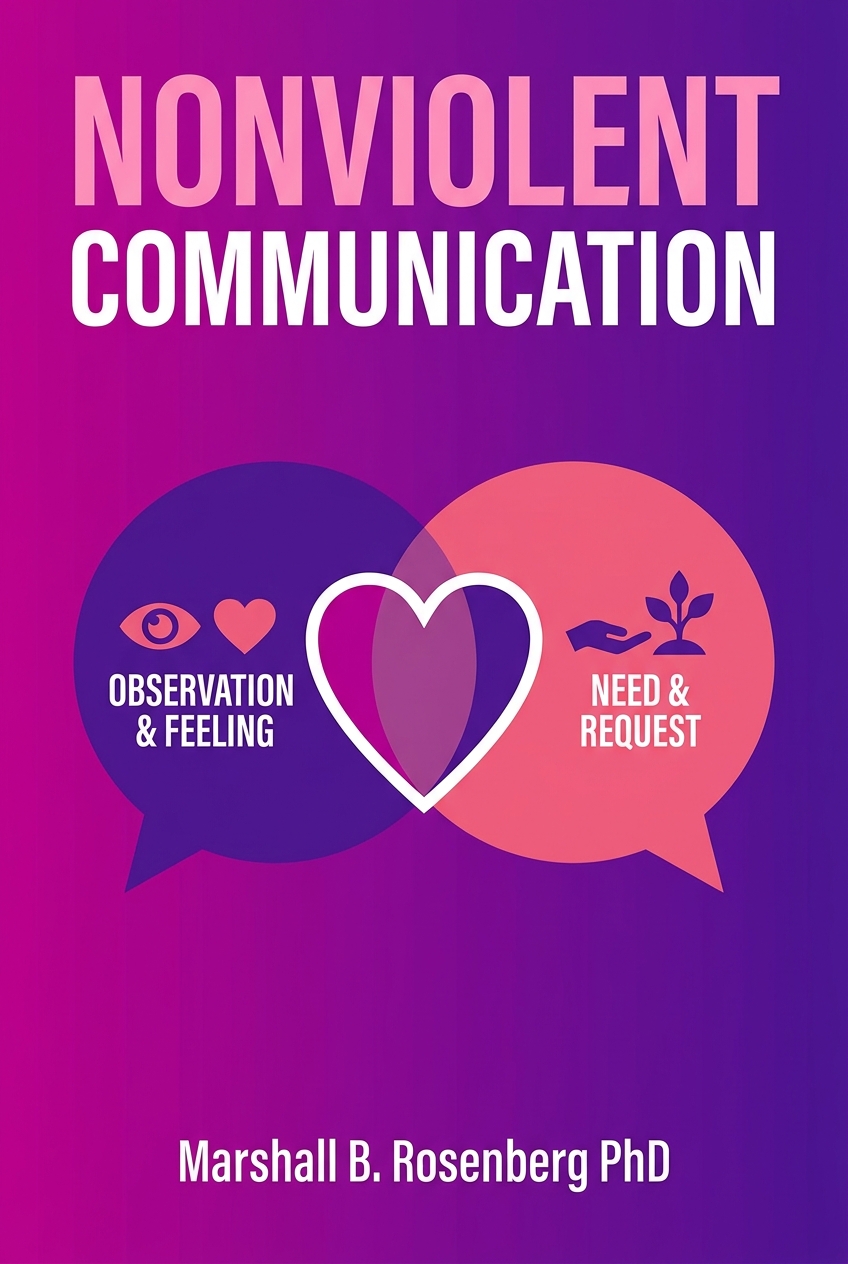
Most of our conflicts don't start with malice. They start with miscommunication. We use language that judges, blames, and demands. Rosenberg calls this "life-alienating communication." It's the default setting for most of us. It’s how our culture taught us to speak. But it creates distance. It shuts down collaboration. To fix this, Rosenberg offers a simple, four-part framework. It's designed to bring clarity and connection to any conversation.
The first part is to separate observation from evaluation. This is harder than it sounds. An observation is a pure fact. It's what a camera would record. "You were 15 minutes late to the stand-up" is an observation. An evaluation is a judgment. "You are unreliable" is an evaluation. When we lead with evaluation, people get defensive. Their brains shut down listening and switch to self-protection. So, start with the facts. State what you saw or heard, cleanly and without judgment. For instance, instead of saying, "Your code is sloppy," you could say, "I saw three functions in the last pull request that didn't have comments." This creates a shared reality. It's a neutral ground to start the conversation.
Next, state your feeling, not your thought. We often confuse our interpretations of others' actions with our own emotions. Saying "I feel ignored" is a thought about what someone else is doing to you. It contains a hidden accusation. A true feeling is an internal state. "I feel lonely" or "I feel frustrated" are feelings. Owning your feeling brings the focus back to your own experience. It's vulnerable. It's also disarming. When you state a pure feeling, it's hard to argue with. For example, after the observation about the code, you might say, "I feel concerned." This is your truth. It invites curiosity, not a counter-attack.
So what's next? You need to connect your feeling to a universal human need. This is the core of NVC. Rosenberg argues that all our feelings, positive or negative, are signals. They point to whether our fundamental needs are being met or not. These needs are universal. Everyone needs safety, respect, understanding, and autonomy. When you say, "I feel concerned because I have a need for predictability and team alignment," you are revealing the 'why' behind your emotion. This is a game-changer. You are sharing a deep, human need that your colleague also understands. They have the same needs. This insight moves the conversation from adversarial to collaborative. You are two people trying to meet your needs.
Finally, after sharing your observation, feeling, and need, you make a clear, positive, and actionable request. A request respects the other person's autonomy. The difference is critical. A demand implies a threat. "Do this, or else." A request respects the other person's autonomy. You are open to hearing 'no.' Your request should also be specific. "Be more responsible" is vague. It's not actionable. A clear request is, "Would you be willing to add comments to your functions before submitting your next pull request?" It's concrete. It's positive, asking for something to happen rather than not happen. And the "would you be willing" phrasing makes it a genuine request. This four-step process—Observations, Feelings, Needs, Requests—is the foundation for transforming difficult conversations.