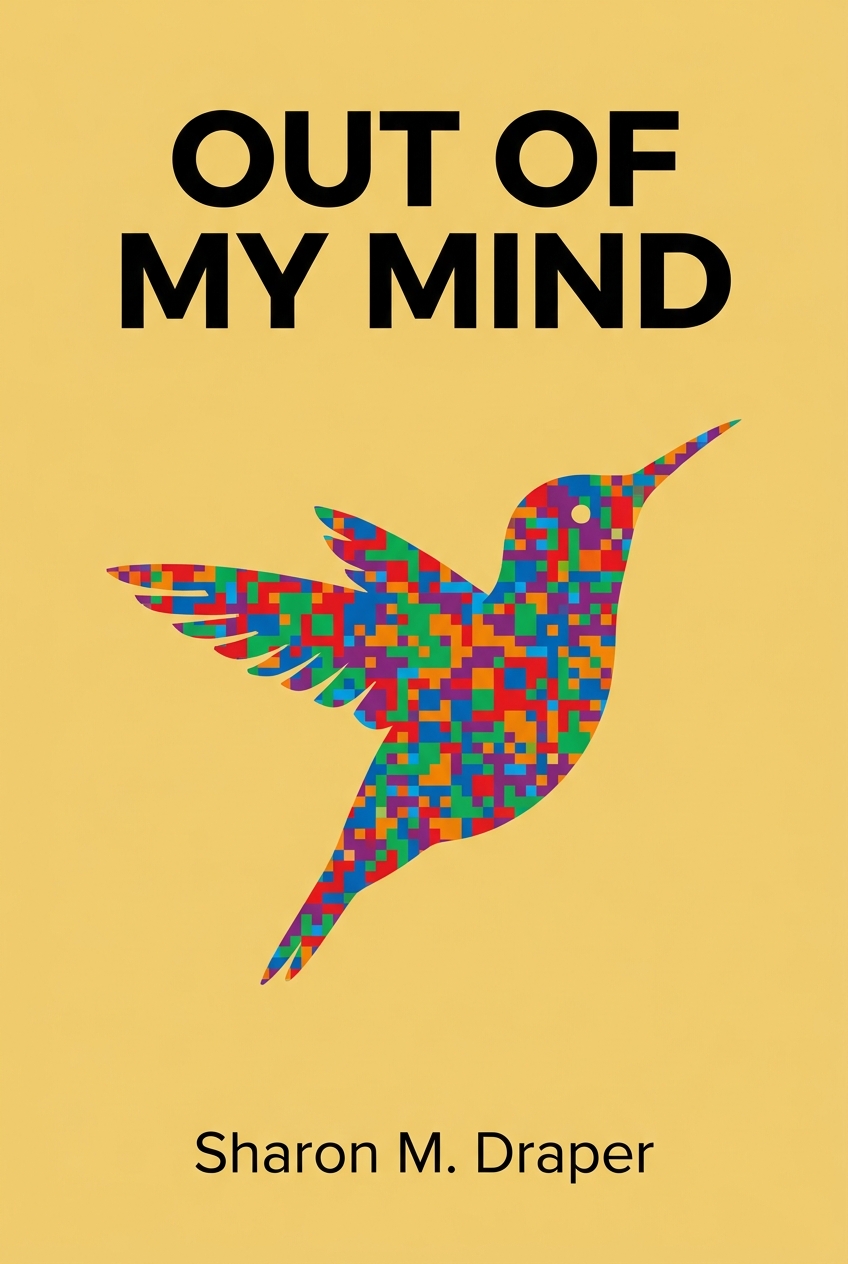
Out of My Mind
What's it about
Have you ever felt trapped inside your own head, bursting with thoughts you can't express? Imagine having a photographic memory and brilliant ideas, but no way to tell anyone. This is the world of Melody, a girl whose mind soars while her body stays silent. Discover the powerful journey of a young genius with cerebral palsy who refuses to be defined by her limitations. You'll learn how she fights to find her voice, challenges everyone's perceptions, and proves that the brightest minds can come in the most unexpected packages.
Meet the author
Sharon M. Draper is a five-time Coretta Scott King Award winner and a New York Times bestselling author who was also honored as the 1997 National Teacher of the Year. As a master educator, she saw the need for books that spoke to the hearts and minds of all children, especially those who felt unseen. Draper's experience as a teacher and her profound empathy for young people inspired her to write Out of My Mind, giving a powerful voice to a character who cannot speak.
The Script
Think of two pilots seated in identical, state-of-the-art flight simulators. Both are tasked with landing a passenger jet. The first pilot’s controls are responsive; every touch of the yoke, every flip of a switch, translates into a precise action on the screen. The second pilot’s simulator, however, has a hidden filter. Her movements are perfect, her knowledge of the controls is flawless, but an invisible intermediary garbles her commands. A smooth turn becomes a jerky lurch. A gentle descent becomes a sudden drop. She sees the runway, knows exactly how to land, but the machine between her mind and the simulated world refuses to obey. She is a prisoner in her own cockpit, her intelligence and skill completely masked by a system that cannot translate her intent.
This profound disconnect between a brilliant, capable mind and a body that won't cooperate is the chasm Sharon M. Draper set out to explore. As a lifelong teacher and a National Teacher of the Year, Draper had spent decades observing students whose inner worlds were far richer than their outward performance suggested. She was particularly moved by the experiences of children with severe physical disabilities but vibrant intellects. She wrote Out of My Mind to give a voice to those trapped inside—to build a bridge into the silent, frustrated cockpit and show the world the skilled pilot sitting at the controls, waiting for a way to finally be understood.
Module 1: The Prison of a Brilliant Mind
Melody Brooks introduces us to a profound paradox. She is a genius with a photographic memory, but she has severe cerebral palsy. She can't speak a single word. She can't walk, feed herself, or control her movements. This creates a stark and painful chasm between her inner world and her outer reality.
From her earliest moments, Melody absorbed everything. She remembers every word her parents spoke, every song they played, every detail from television documentaries. Her mind is a fortress of knowledge, filled with "mountains of phrases and sentences and connected ideas." Yet, to the outside world, she is often seen as having limited intelligence. This is the core tension of her existence. Her brilliant mind is a prisoner in a body that won't obey her commands.
This leads to a critical insight. Your perception of someone's ability is limited by their tools of expression. Melody's parents fill her world with language and music. Her father speaks to her like an adult, sharing his love for jazz and pointing out constellations. Her mother surrounds her with classical music. Melody experiences this sensory input with incredible richness. She even has synesthesia, seeing colors and smelling scents when she hears music. But when she tries to share this joy, her body betrays her. An attempt to express delight results in uncontrollable physical movements. Her mother, loving but unaware, just sees a spasm and continues feeding her applesauce. Melody's rich inner experience remains invisible.
So what does this mean for us? It means we must actively fight the assumption that a lack of conventional output equals a lack of thought. Think about the meeting where someone is quiet. Or the team member who struggles to articulate their ideas under pressure. We often default to judging the contribution we can see or hear. Draper's work challenges us to look deeper. When Melody tries to warn her mother about lead-painted toys she saw on a news report, her only means of communication is a "tornado explosion"—a physical outburst of kicks and screams. Her mother misinterprets it as a tantrum, leaving the store embarrassed. The vital warning is lost. Melody's intelligence, her care, her knowledge—all of it is rendered useless by her inability to communicate it in a way others can understand.
And it doesn't stop there. This constant misunderstanding breeds a profound sense of isolation. Melody knows she is smart. She knows she understands complex ideas. But because she cannot prove it, she is trapped. She reflects, "Nobody knows it's there but me... Nobody gets it. Nobody. Drives me crazy." This is a powerful reminder for anyone in a leadership or collaborative role. The burden of communication falls on both the speaker and the listener. We have a responsibility to create environments where different forms of expression are possible and to be patient enough to find them. We must question our own biases about what intelligence looks like and sounds like. Melody’s story shows us that the most brilliant contributions can come from the most unexpected sources, if only we have the wisdom to look for them.