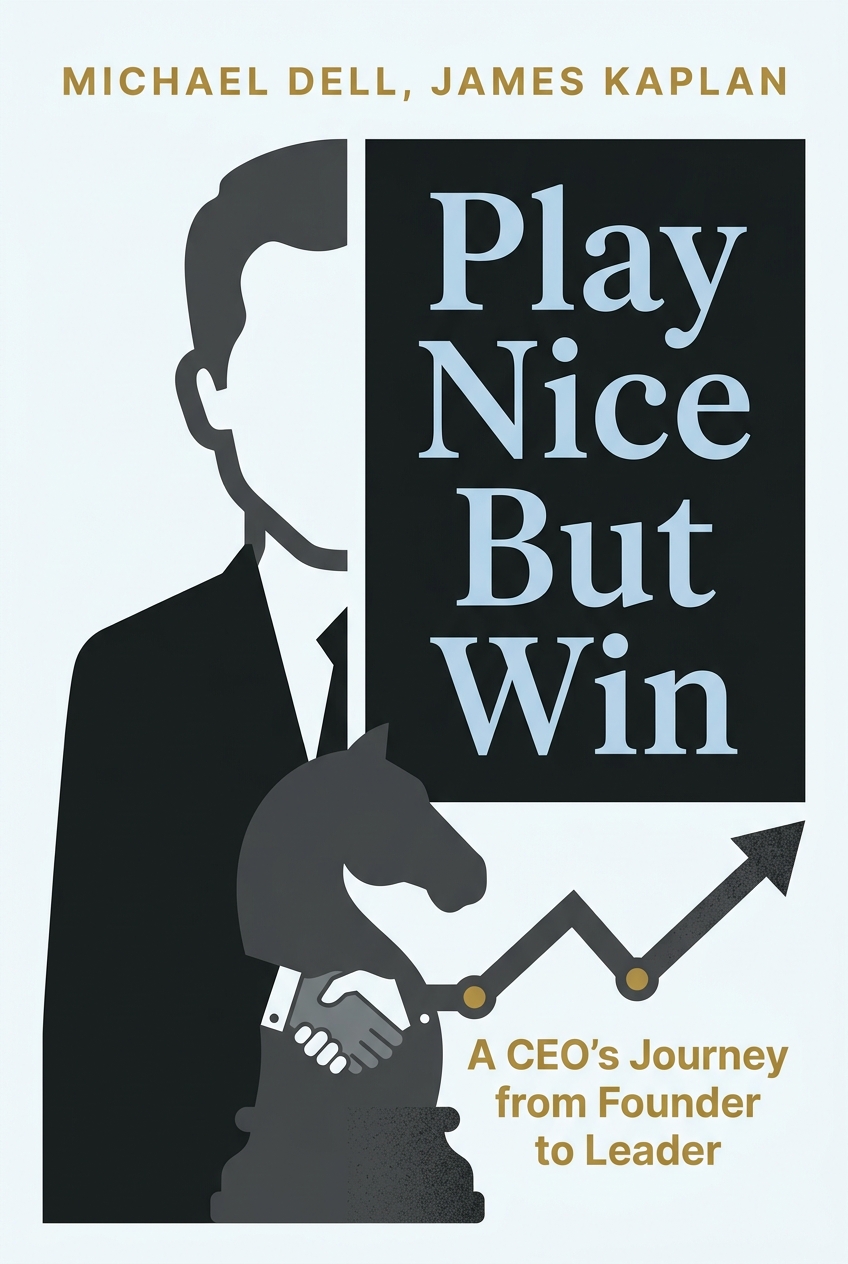
Play Nice But Win
A CEO's Journey from Founder to Leader
What's it about
How do you build a legendary company and win in a cutthroat market without losing your integrity? Michael Dell, the founder of Dell Technologies, shares his playbook for transforming a startup idea into a global empire by playing nice, but always playing to win. You'll uncover his behind-the-scenes strategies for navigating vicious boardroom battles, executing one of the largest corporate takeovers in history, and fostering a culture that prioritizes both customer value and ethical leadership. Get ready to lead your team to victory.
Meet the author
Michael Dell is the founder and CEO of Dell Technologies, a global powerhouse he started from his college dorm room with just $1,000. His journey, marked by fierce competition and the largest tech privatization in history, shaped his unique leadership philosophy. In Play Nice But Win, he shares the unfiltered story and the hard-won principles that guided him through decades of industry-defining battles, offering a masterclass in building a business and leading with integrity and conviction.
Opens the App Store to download Voxbrief

The Script
For two decades, Roger Federer defined tennis not just with his victories, but with his style. On screen, he was an artist, a ballet dancer with a racquet whose movements seemed to defy the brutal physics of the sport. His sportsmanship was legendary, his composure absolute. He was, by all accounts, one of the nicest and most respected figures in the game. But that image of effortless grace obscures the cold reality of what it takes to win twenty Grand Slam titles. Beneath the calm exterior was a relentless competitor with a killer instinct, a strategic mind that dismantled opponents with surgical precision. His composure was a weapon. He proved that you didn't have to be a raging bull to dominate. You could be a gentleman and still be the most feared person on the court, a living example of the power found in the space between civility and ruthless ambition.
This same tension—between principled conduct and an absolute will to win—is the central challenge in the cutthroat arenas of business. How do you build alliances with the same people you must outperform? How do you maintain integrity while fighting off corporate predators? This is the puzzle Michael Dell has wrestled with his entire life. After founding a company in his college dorm room and building it into a global technology giant, he found himself in the fight of his career: a battle to take Dell private against the fierce opposition of Wall Street sharks and activist investors. It was the largest corporate takeover in history, a high-stakes war that tested every principle he held. This book, co-written with James Kaplan, is the story of that fight and the hard-won philosophy that emerged from it—a playbook for how to compete fiercely and win, without sacrificing your soul in the process.
Module 1: The Scrappy Founder's Edge
Michael Dell’s journey did not begin in a boardroom. It began in a dorm room with a simple, powerful insight. He saw a massive inefficiency in the PC market. Retailers marked up components and sold pre-packaged machines. Customers had no choice and paid too much. Dell’s core idea was to build a better machine for less money and sell it directly to the user. This simple premise contained the seeds of a revolution.
His early ventures were a masterclass in exploiting market gaps. Before building computers, he arbitraged them. He would drive to cities with a surplus of IBM PCs, buy them below cost, and sell them for an instant profit in cities with shortages. It was about understanding the supply chain from the ground up, learning its every inefficiency and opportunity. He learned that the person closest to the customer has the most power. By cutting out the middleman, he controlled the relationship, the experience, and the margin. This direct model became Dell's foundational advantage. It was a practical solution born from a lack of capital. He couldn’t afford to build inventory, so he built to order. This constraint became his greatest strength.
Building on that idea, Dell understood that you must go directly to the source to control your destiny. He didn't just sell directly to customers; he bought directly from suppliers. Unsatisfied with buying components through distributors, he flew to Asia. He met with manufacturers like Samsung and Sony in their factories. He negotiated pricing for massive volumes he couldn't yet afford, securing commitments that saved the company millions. This direct engagement gave him a deep understanding of the supply chain that his competitors, who relied on layers of intermediaries, simply did not have. He saw the inner workings of the entire ecosystem. This knowledge was a bigger competitive advantage than any single piece of technology.
And here's the thing about that early phase. The company culture was defined by a scrappy, resourceful mindset. A "ragtag band of buccaneers" can outmaneuver an established navy. Dell's first engineering teams were unconventional. They were housed in modified apartments, working extreme hours to build the next product. When the company grew too fast for its accounting systems, the order-tracking method was literally handwritten forms hung on clotheslines. This was the result of a relentless focus on speed and growth, a system built for pure velocity. They picked up talent wherever they could find it, creating a loyal, motivated team that thrived on solving impossible problems with limited resources.
Module 2: The Pain of Scaling
We've covered the entrepreneurial spark. Now, let's turn to the challenges of turning that spark into a sustainable fire. Hyper-growth is a dream for any founder, but it’s also a nightmare. It breaks systems, burns out people, and exposes every weakness in an organization. In 1993, Dell's sales were exploding, but the company was internally imploding. The very success that put them on the map was threatening to wipe them out.
This is where Dell learned a critical lesson: you must shift focus from pure growth to disciplined operations. The mantra could no longer be "Growth, Growth, Growth." The new focus, driven by CFO Tom Meredith, became "Liquidity, Profitability, and Growth," in that order. This was a profound shift. It meant slowing down intentionally to build the systems and processes needed to scale. It required a level of operational discipline that the scrappy startup phase lacked. This change was essential for survival. It allowed Dell to manage its cash flow, improve product quality, and build a foundation for the next stage of expansion.
This brings us to another key insight. As a founder, your job is to hire people who know more than you do. Michael Dell was a visionary and a brilliant operator, but he knew his limits. To navigate the complexities of scaling from a billion-dollar company to a ten-billion-dollar behemoth, he needed experience he didn't have. He recruited Mort Topfer from Motorola, a seasoned executive with deep expertise in global operations and supply chain management. Topfer brought the discipline and structure Dell needed. This move highlights a crucial transition for any founder. You have to evolve from being the person with all the answers to the person who builds a team of experts and empowers them to execute.
Furthermore, Dell's journey shows that failure is a process to be embraced, a source of crucial lessons. The company’s path was littered with setbacks. An early attempt to enter the server market failed because customers didn’t trust the brand in that high-stakes category. The first Dell notebooks were plagued with design flaws, leading to a costly and embarrassing recall of 17,000 units. A motherboard design flaw left the company with a massive inventory of obsolete memory chips. Each of these failures was painful. But each one provided a crucial lesson. The server failure taught them about building enterprise trust. The notebook recall forced them to get serious about product design and quality control. The inventory crisis led to a world-class supply chain management system. This culture of learning from mistakes, what they called "Pleased But Never Satisfied," became a core part of their DNA.
Module 3: The Public Market Paradox
So far, we've seen Dell's rise from a dorm room to a global powerhouse. But this success brought a new, more insidious challenge. By the 2010s, Dell was a public company, and the very market that had celebrated its growth now threatened to strangle its future. The world was changing fast. The PC was no longer the center of the universe. The future was in software, cloud computing, and enterprise services. Dell needed to pivot, and pivot hard.
The problem was that public markets are terrible at funding long, messy transformations. The quarterly shot clock of a public company is the enemy of long-term vision. Wall Street analysts and investors demand predictable, quarter-over-quarter growth. But a real transformation is neither predictable nor immediately profitable. It requires massive, upfront investments that depress short-term earnings. When Dell tried to explain its shift toward end-to-end IT solutions, the market didn't listen. Investors saw only a declining PC business, and the stock price plummeted. This created a vicious cycle. The lower the stock price, the more pressure the company faced to cut long-term investments and prop up short-term profits.
This pressure created an opening for a new kind of threat. When a company's market value is disconnected from its long-term potential, activist investors will emerge to exploit the gap for a quick profit. For Dell, this threat came in the form of Carl Icahn, a notorious corporate raider. Icahn and other activists saw a company with a low stock price and a strong cash flow. Their plan was simple: force the company to take on debt to pay a massive one-time dividend, or break the company up and sell off the pieces. They had no interest in Dell's long-term transformation. Their goal was to extract as much cash as possible, as quickly as possible, leaving the company crippled and unable to compete.
So here's what that means for any leader in a similar position. Dell realized he was in an unwinnable game. He couldn't transform the company while simultaneously satisfying the market's short-term demands and fending off activists. The rules of the public market were rigged against his long-term strategy. His profound realization was that to save the company, you may have to break the rules of the game entirely. He couldn't win by playing defense. He had to go on offense with a move so audacious that no one saw it coming. He decided to take the company private. This would free him from the quarterly shot clock, silence the activists, and give him the freedom to execute his vision without public scrutiny. It was a monumental gamble that would trigger one of the biggest corporate battles of the decade.