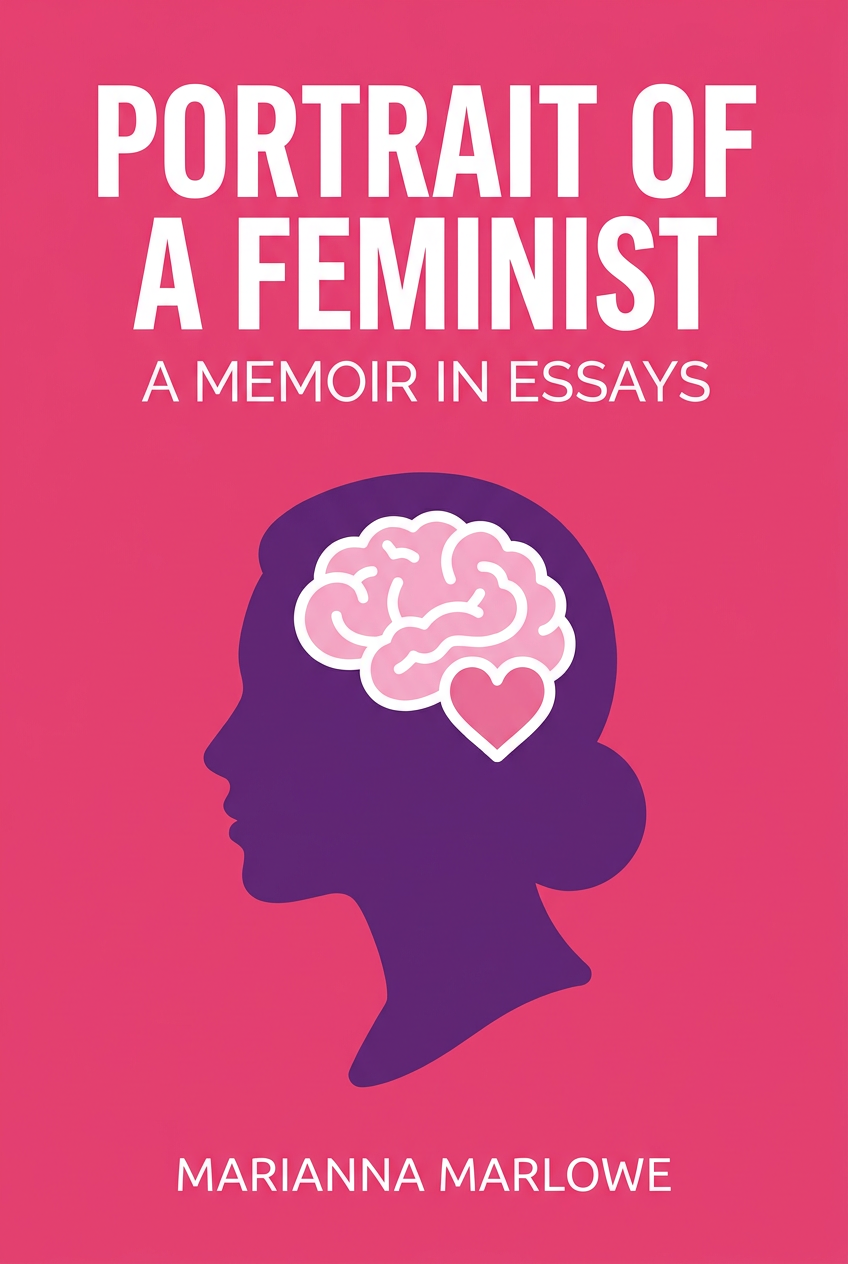
Portrait of a Feminist
A Memoir in Essays
What's it about
Ever wondered if your personal struggles are part of a much bigger picture? What if the challenges you face in your career, relationships, and even with your own body are actually reflections of a larger societal script? This memoir will show you how to connect the dots. You'll discover how Marianna Marlowe navigated the subtle and overt biases that shape a woman's life. Through her raw, personal essays, you'll gain powerful insights into recognizing systemic barriers, reclaiming your narrative, and transforming personal frustration into a source of profound strength and collective change.
Meet the author
Marianna Marlowe is the award-winning cultural critic whose incisive commentary on gender and media for The Atlantic has shaped national conversations for over a decade. Her work is informed by her early career in Silicon Valley, where she first witnessed the systemic inequities that would fuel her lifelong advocacy and scholarship. This unique blend of frontline experience and sharp analysis defines her powerful voice.
Opens the App Store to download Voxbrief

The Script
Two women stand before the same abstract painting in a silent gallery. One, an art historian, sees a deliberate rebellion against post-war formalism, a calculated dialogue with the color field painters of the era. She points out the compositional tension, the artist’s rejection of a central focal point, and the way the brushstrokes document a frantic, almost desperate energy. The other woman, the artist’s granddaughter, sees none of that. She sees the ochre from the clay soil behind her grandmother’s cottage. She sees the violent slash of crimson that matches the story of a slammed door after a bitter argument. The deep, calming blue is the exact shade of the shawl her grandmother wore every evening, the one that always smelled of turpentine and lavender. For one, the painting is a public statement in a historical conversation. For the other, it is a private diary, a vocabulary of a life lived.
This gap between the public record and the private reality of a woman’s life is precisely what drove Marianna Marlowe to write Portrait of a Feminist. As a cultural biographer, Marlowe had spent years documenting the lives of influential women, piecing together their stories from newspaper clippings, official records, and public interviews. Yet, she was consistently haunted by the feeling that she was only capturing the polished, public-facing version—the art historian’s view. After discovering a box of her own grandmother's contradictory letters and journals, which painted a far messier and more interesting picture than the family’s official stories, she realized the most vital parts of a woman’s identity are often found in the quiet, personal artifacts that defy simple explanation.
Module 1: The First Impressions of Power
The seeds of a feminist identity are often planted long before we have a name for it. For Marlowe, they were sown in childhood, through the quiet observation of her parents' relationship. This is where she first learned about power imbalances as a lived reality.
The core lesson here is that early family dynamics create the blueprint for our understanding of justice. Marlowe’s father controlled the family finances with an iron fist. Her mother, despite her high-society upbringing in Peru, had no economic agency. She couldn't buy new clothes or even visit her family without permission. It was a fundamental lack of autonomy. At just five years old, Marlowe saw this injustice so clearly that she wrote a letter to her wealthy aunt, begging for money on her mother's behalf. It’s a heartbreaking and powerful image. A small child, sitting on a toilet seat, already trying to correct a power imbalance she could feel but not yet name.
This leads to a crucial insight. Our emotional allegiances in childhood shape our lifelong values. Marlowe became her mother's "second-in-command." She was a confidant, a defender, and an emotional sponge for her mother's pain. She absorbed her mother’s disappointments as her own. This experience of defending the "underdog" in her own home became a defining feature of her personality. It created a powerful, lifelong drive to stand up for those who are silenced or dismissed. It’s a reminder that our most deeply held principles are often born from our earliest emotional bonds.
But here’s the thing. This identity isn't always straightforward. Feminism is often complicated by cultural and generational tensions. Marlowe’s Peruvian mother, the very person whose struggle inspired her, rejected the label "feminist." She associated it with "loud and unfeminine" American women. Her mother's idea of femininity was rooted in tradition, like wearing a bra 24/7 to maintain one’s appearance. Yet, in her own way, she was a fighter. She constantly pushed back against her husband’s control, demanding more financial input and personal freedom. This shows that feminism is a quiet, practical resistance waged within the constraints of a specific culture.
Module 2: The Scripts of Silence and Resistance
As we grow, the world hands us scripts. Scripts for how to be a "good girl," how to react to danger, and how to navigate the confusing world of adult attention. Marlowe’s experiences as a young girl in Ecuador and the United States show how these scripts are learned, and more importantly, how they can be broken.
One of the most powerful points is that young girls are socialized to prioritize politeness over their own safety. Around age ten, Marlowe was on a hike when a man exposed himself. Her first instinct wasn't to scream or run. Her "social instincts" took over. She simply looked away, silent, normalizing the violation. It’s a chillingly common story. The unwritten rule is: don’t make a scene, don’t cause embarrassment, even when you are the one being violated. This conditioning teaches girls to silence their own gut feelings, to sacrifice self-preservation for the sake of social harmony.
However, the book offers a powerful counter-narrative. Defiant resistance, even mockery, can reclaim agency and shatter fear. In a similar incident, another man exposed himself to Marlowe and her friends. While Marlowe and one friend froze, their friend Fatima reacted differently. She pointed, shouted, and mocked the man, humiliating him until he fled. That act of defiance was a "counterspell." It transformed the girls' fear into exhilaration and a sense of collective power. It proved that the script of female passivity could be rewritten, in real time, with courage and a refusal to be intimidated.
This brings us to a darker theme. The male gaze, especially from authority figures, can be a profound violation of safety. At a pool party, Marlowe recalls her friend's father, a "shadowy figure," watching the young girls in their swimsuits from a balcony. He never said a word, but his drunken, silent observation felt predatory. It was a loss of innocence, a realization that even the homes of friends, under the watch of adults, were not always safe spaces. The camera becomes a recurring symbol of this predatory gaze. In another memory, a family friend obsessively photographs Marlowe’s younger sister, treating the camera like a weapon to "catch and then hold fast" his subject. The act of being photographed becomes an act of possession.
And here’s the real kicker. The complicity of silence allows predatory behavior to flourish. In these memories, the adults who should have intervened often did not. Whether it was due to social hierarchies, like the predator being a work superior, or simply the unspoken rule of the 1970s and 80s not to discuss "certain topics," the silence of the adults was deafening. This silence protected the perpetrators and taught the children a dangerous lesson: what you are experiencing is not real, or if it is, it’s not to be spoken of. It’s a powerful argument for why we must create environments where speaking up is not only allowed but expected.