All Books
Self-Growth
Business & Career
Health & Wellness
Society & Culture
Money & Finance
Relationships
Science & Tech
Fiction
Topics
Blog
Download on the App Store

Propaganda

16 minEdward Bernays, Mark Crispin Miller

What's it about

Ever wonder why you buy certain products or believe specific ideas? This summary of Propaganda unlocks the secrets of public persuasion, showing you how unseen forces shape your thoughts and decisions, and how you can use these same techniques to influence others. Discover the psychological triggers and mass media strategies developed by Edward Bernays, the "father of public relations." You'll learn how he used propaganda not for control, but to engineer consent, guide public opinion, and build powerful campaigns. Master these timeless principles to ethically persuade audiences, market your ideas, and understand the hidden architecture of modern influence.

Meet the author

Hailed as the "father of public relations," Edward Bernays was the Austrian-American pioneer who literally wrote the book on influencing public opinion. As the nephew of Sigmund Freud, he was the first to merge psychology with mass media, developing groundbreaking persuasion techniques for corporations and governments alike. His work provides a masterclass in the hidden mechanics of modern society, revealing the powerful forces that shape our thoughts and desires.
Listen Now
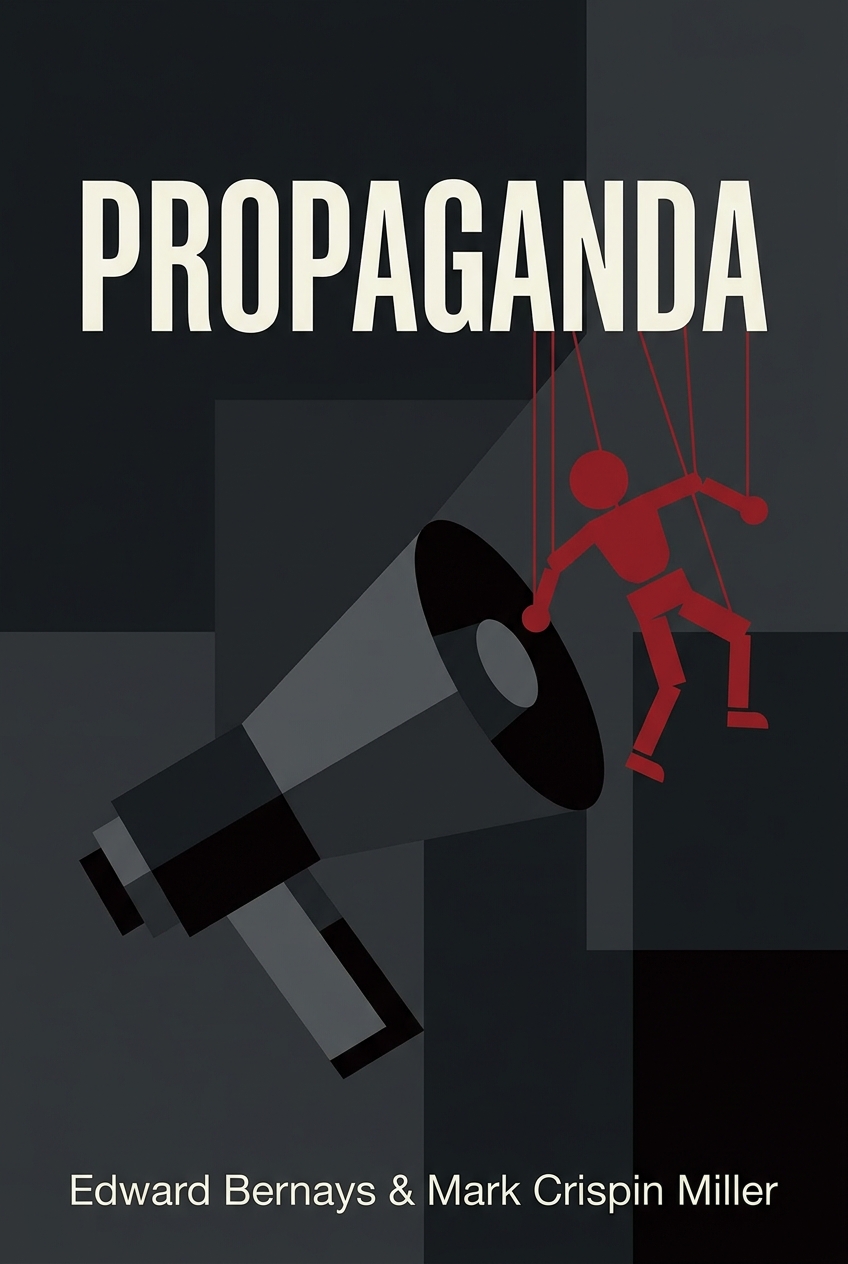
Propaganda book cover

The Script

We believe our preferences—the brands we choose, the leaders we support, the causes we champion—are the result of a rational, internal process. We weigh the options, consider the facts, and arrive at a conclusion that is uniquely our own. But what if this cherished sense of intellectual sovereignty is an illusion? What if the very architecture of our modern world is built on manufacturing our consent to choices already made for us? This is about something far more subtle and powerful: the invisible shaping of the public mind, a process where our most deeply held beliefs are quietly installed by unseen hands. It suggests that democracy itself might be a stage where the drama of public opinion is carefully scripted and directed.

The man who first articulated these unnerving principles wasn't a dystopian novelist or a cynical critic, but the very architect of the system itself. Edward Bernays, the nephew of Sigmund Freud, saw the chaotic and dangerous energy of the masses as a problem to be managed. Fresh from his work crafting pro-war messaging for the U.S. government during World War I, he realized the same psychological techniques could be applied to peacetime commercial and political goals. He saw this as a necessary act for a functioning, orderly society. He wrote "Propaganda" as a proud declaration—a handbook for the intelligent minority to guide the public toward what he considered civilized, beneficial outcomes. He was, in essence, selling the public on the idea that they needed to be sold.

Module 1: The Invisible Government and Organized Chaos

Bernays starts with a bold, almost unsettling claim. He says that in any complex society, a small, unseen group of people pulls the strings. They are the "invisible government." They shape our thoughts, our tastes, and our ideas. This is a functional reality of modern life.

Think about it. We live in a world of overwhelming choice. If every voter had to personally research every single candidate, democracy would grind to a halt. So, political parties emerge. They narrow the field to a few viable options. They are a form of this invisible government. The same logic applies to the economy. If you had to test every brand of soap or bread, your life would be chaos. So, society consents to have its choices curated. This curation is done through propaganda.

This leads to the first core idea. Propaganda is the executive arm of the invisible government. It's the mechanism that organizes modern life. Bernays saw it as a solution to the problem of "organizing chaos." As society grows more complex, with technologies like radio and newspapers connecting millions, the need for this organized persuasion only increases. An intelligent minority, he argues, must regiment the public mind. This is done just as an army regiments the bodies of its soldiers. It ensures everyone is marching in the same general direction.

So how does this work in practice? The new propaganda targets the group, not the individual. The old way was to shout a message at a crowd. The new way is far more subtle. It works by understanding the anatomy of society. It maps our interlocking group loyalties. A person is not just a voter. They are a member of a church, a professional association, a hobby club, and a family. Influence the leader of one group, and the message spreads through the network.

For instance, a front-page story in the New York Times might seem like objective news. Bernays reveals that often, it's carefully placed propaganda. A statement from the State Department or a report from the Carnegie Foundation is designed to shape public opinion on a specific issue. It is a manufactured event, created to achieve a desired effect.

This brings us to a critical technique. Propaganda creates circumstances to make a desired action feel natural. You don't sell a product directly. You change the environment so the product becomes the logical choice. To sell more velvet, for example, Bernays didn't run ads saying "Buy Velvet." His team went to the fashion centers of Paris. They convinced top designers and socialites to use velvet. Fashion magazines reported on this new "trend." Department stores stocked it. Suddenly, women across America wanted velvet dresses. The desire felt organic, but it was meticulously engineered.

Finally, Bernays argues that progress itself depends on propaganda from intelligent minorities. A widespread public desire, like for safer food, is powerless until it's organized. It needs a voice. It needs focus. Active, proselytizing minorities are the ones who articulate these desires. They use propaganda to turn vague sentiment into effective action that pressures legislatures and corporations. In this view, propaganda is the engine of social change.

Read More