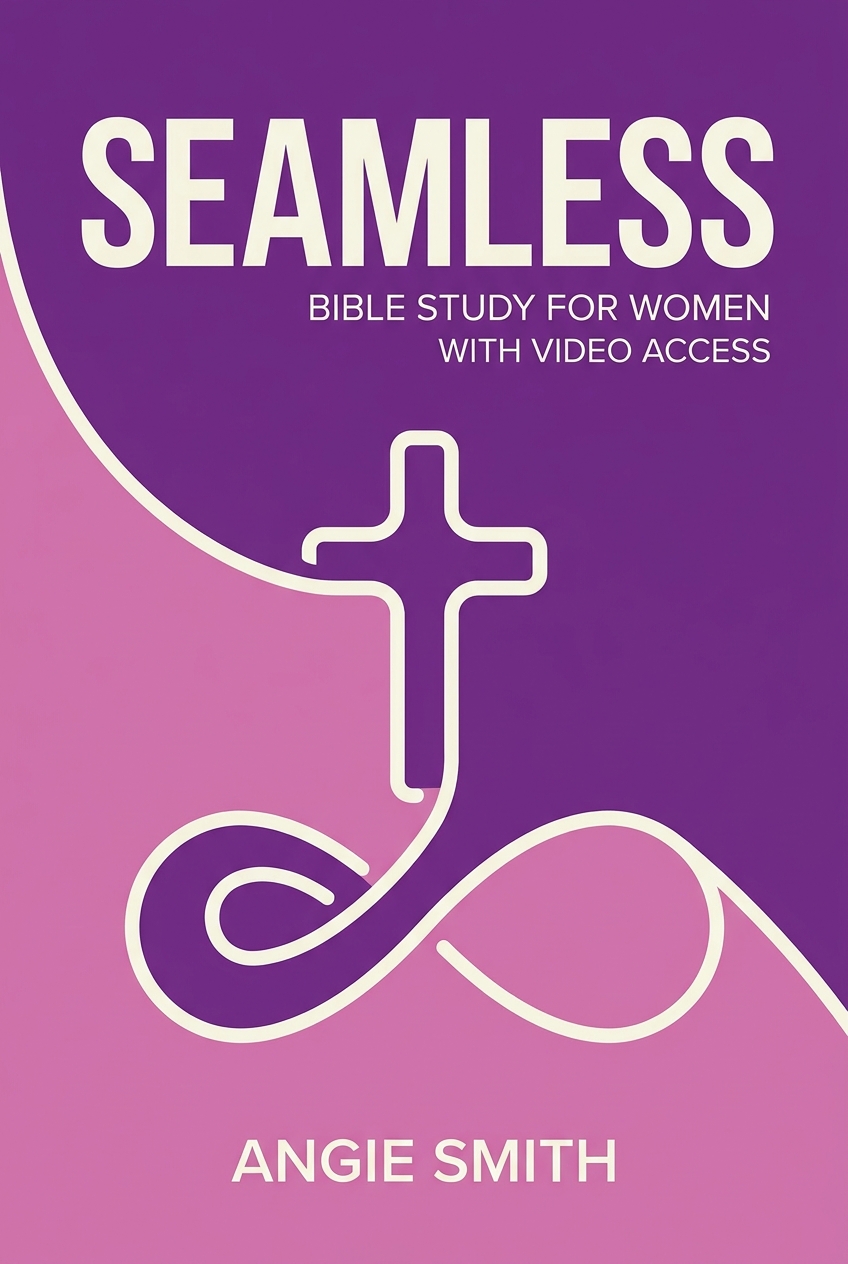
Seamless - Bible Study for Women with Video Access
What's it about
Ever felt like the Bible is just a collection of disconnected stories? What if you could see the entire Bible as one seamless story, finally understanding how the Old and New Testaments fit together to reveal God's plan for you? This study makes it possible. Discover how all the people, places, and promises of the Bible are woven into a single, breathtaking narrative from Genesis to Revelation. Angie Smith guides you through key connections, helping you grasp the overarching story of Scripture and find your place within it.
Meet the author
Angie Smith is the bestselling author of multiple books for women and children, including Seamless, and is a popular speaker at national women's conferences. After her own experience of feeling lost in the grand narrative of Scripture, she developed a passion for making theology accessible. Angie's gift is in helping women see the Bible as one complete story, connecting the dots from Genesis to Revelation in a way that is both deeply encouraging and easy to understand.
Opens the App Store to download Voxbrief

The Script
In a museum’s restoration workshop, two conservators are given identical tasks: reassemble two ancient, shattered mosaics. The first conservator lays out every piece on a vast white cloth, sorting them by color, then by shape, then by the texture of their edges. She meticulously cleans each fragment, numbers it, and logs it in a catalog. Her process is precise, logical, and exhaustive. She studies each piece in isolation, confident that if she understands the parts perfectly, the whole will eventually emerge. Weeks turn into months. Her catalog is a masterpiece of detail, but the mosaic itself remains a constellation of beautiful but disconnected fragments. The second conservator begins differently. She finds the four corner pieces first, then the most distinct fragments that hint at a central image—the curve of a robe, the glint of a crown. She assembles these anchor points, creating a loose but recognizable framework. Only then does she begin sorting the remaining thousands of pieces, not by their individual properties, but by how they might fit into the emerging picture. She works from the whole to the parts, letting the ghost of the complete story guide her hand. Her process is messier, more intuitive, but in a fraction of the time, a coherent, breathtaking narrative begins to take shape from the pile of rubble.
The Bible can often feel like that first workshop—a vast collection of beautiful but intimidatingly separate pieces. We can spend years studying the individual fragments of law, poetry, and prophecy, yet miss the single, breathtaking story they unite to tell. Angie Smith knew this feeling intimately. As a wife, mother, and speaker, she found herself in conversations with women who loved God but felt overwhelmed by the sheer scale of the scriptures, unsure how the story of a shepherd boy in one book connected to a fisherman in another. This sense of a shared struggle, this longing to see the bigger picture, is what led her to create Seamless. She wanted to offer a way to step back and see the framework first, to trace the single, unbroken thread of God’s love that runs from Genesis to Revelation, turning a pile of sacred fragments into one seamless story.
Module 1: The Foundation — Understanding the Story's Structure
The first step in seeing the Bible as a seamless story is to grasp its fundamental structure. Many people view the Bible as two distinct books: a story about God and Israel, and then a completely separate story about Jesus and the church. Smith argues this is a critical misunderstanding. Instead, the entire Bible is one continuous narrative.
The study begins by laying out the major historical periods of the biblical account, from Creation and the Fall to the Patriarchs, the Exodus, the era of the Judges, the Kingdom, the Exile, and finally, the coming of Christ. The purpose of mapping these eras is to see God's consistent character and unfolding plan. By understanding the chronological flow, you start to see patterns. You see how God makes promises to Abraham, how those promises are carried through his descendants, and how the law given to Moses sets the stage for a Savior who would one day fulfill it perfectly.
For example, the study connects the Passover lamb in Exodus, whose blood saved the Israelites from death, directly to Jesus, who is called the "Lamb of God" in the New Testament. This is a deliberate, continuous thread. The Old Testament introduces the problem of sin and the need for a sacrifice. The New Testament reveals the ultimate solution. By seeing these connections, the Bible stops being a collection of isolated stories and starts becoming a unified epic of redemption.
This leads to a powerful realization: The Old Testament is the setup for the story's climax. Every prophecy, every law, and every historical event creates a sense of anticipation. It builds a "story tension" that can only be resolved by the person and work of Jesus Christ. Smith encourages readers to view the Old Testament with this forward-looking perspective, constantly asking, "How does this point to what's coming?"
Module 2: The People — Seeing Christ in the Characters
Building on that structural foundation, the study then shifts focus to the people of the Bible. It's easy to see biblical figures as either flawless heroes or irredeemable villains. Smith pushes back on this, showing that they are complex, often broken individuals whose lives serve as a foreshadowing of Christ.
A key insight here is that many Old Testament figures serve as "types" or previews of Jesus. For instance, Joseph, who was betrayed by his brothers, sold into slavery, and later rose to a position of power to save them from famine, is a powerful parallel to Jesus. Christ was betrayed by his own people, "sold" for silver, and through his suffering and exaltation, provides salvation for all who come to him. The study walks through figures like Moses the lawgiver, David the king, and Adam the head of humanity, showing how each one reflects an aspect of Jesus's future role, yet ultimately falls short. This highlights the need for a perfect Prophet, Priest, and King.
Furthermore, the study delves into the covenants—the binding promises God makes with His people. You have the covenant with Abraham, promising a great nation and a blessing to the world. You have the covenant with Moses, establishing the law. You have the covenant with David, promising an eternal throne. Each covenant builds upon the last, progressively revealing more of God's plan. Smith shows how these are installments in a single, overarching plan of redemption. Jesus is presented as the fulfillment of all these covenants. He is the descendant of Abraham who blesses all nations, the one who perfectly obeys the law of Moses, and the son of David who reigns on an eternal throne.
This module is intensely practical. It transforms how you read biblical narratives. Instead of just seeing David as a king who messed up, you see him as a flawed placeholder for a perfect King to come. The sacrificial system becomes a constant, tangible reminder that sin requires a payment—a payment that would one day be made, once and for all.