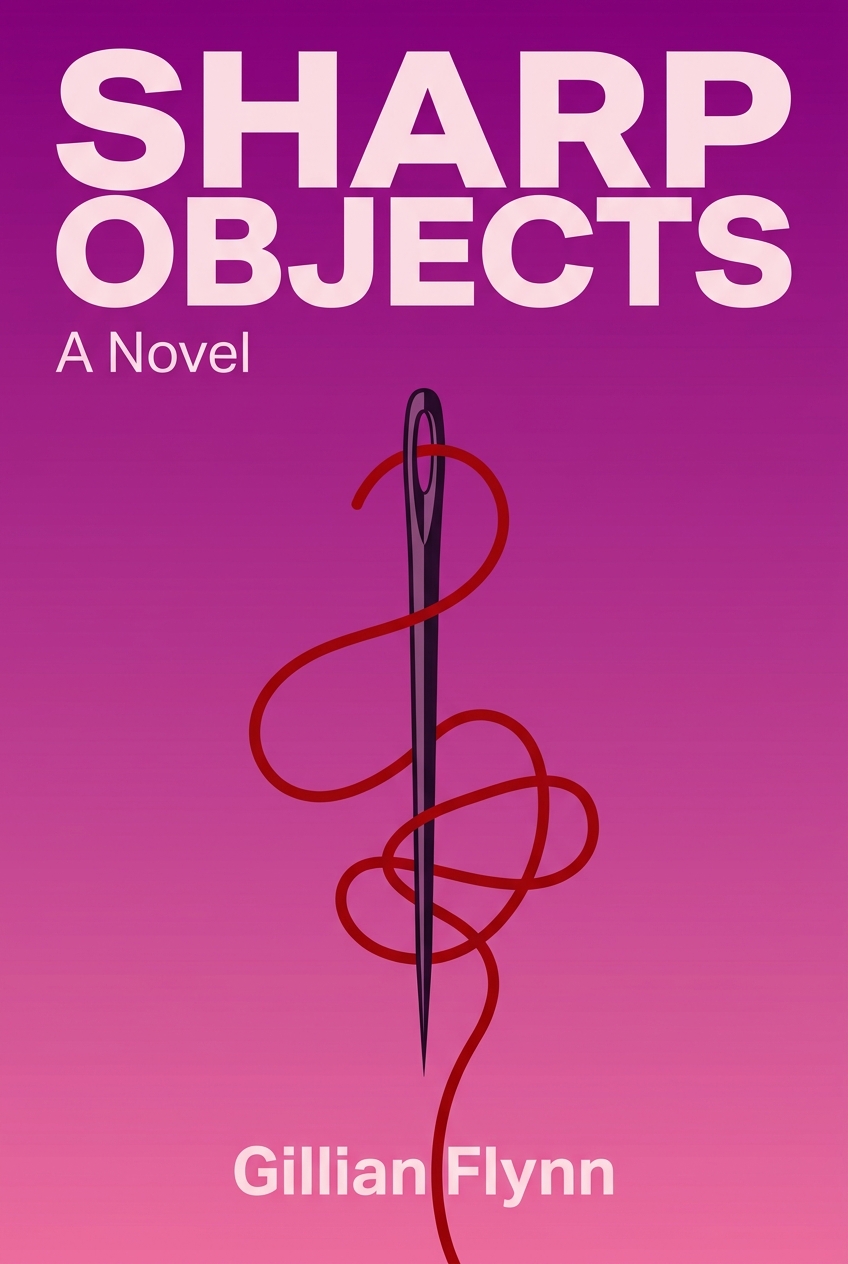
Sharp Objects
A Novel
What's it about
Ever wondered if you can truly escape your past? For journalist Camille Preaker, returning to her hometown to cover a grisly murder means confronting the childhood trauma she’s spent years trying to forget. But as she digs deeper, she finds the darkness isn't just in her memories. Get ready to unravel a chilling psychological mystery. You'll follow Camille's investigation into the murders of two young girls, forcing her to reconnect with her estranged, neurotic mother and a half-sister she barely knows. As the lines between reporter and victim blur, you’ll discover that the most dangerous secrets are often the ones kept within a family, and some wounds never heal.
Meet the author
Gillian Flynn is a 1 New York Times bestselling author and an award-winning former chief TV critic for Entertainment Weekly, celebrated for her mastery of the psychological thriller. This background in pop culture journalism gave her a unique lens on the dark side of American life, informing the chillingly authentic and complex female characters that define her work. Her deep dive into media and societal pressures provided the foundation for the haunting, unforgettable world she created in Sharp Objects.
The Script
A professional dollhouse maker, known for her meticulous recreations of Victorian mansions, receives a strange commission. The client wants a perfect replica of their childhood home, but with one disturbing alteration: every miniature object—from the tiny porcelain teacups to the grandfather clock in the hall—must be crafted with a hidden, razor-sharp edge. The dollhouse, a symbol of idealized domesticity, becomes a landscape of concealed threats. Each room is a beautiful trap, every memory it holds has the potential to draw blood. The project forces the artisan to confront a disquieting truth: the most profound damage is caused by the thousand tiny, unseen cuts inflicted over years within the very walls meant to keep you safe.
The closer she gets to finishing, the more the house feels like a confession. It’s a silent testament to the idea that some families are a collection of finely sharpened instruments, all kept in the same drawer. This unsettling landscape of beautiful, dangerous things is precisely the world Gillian Flynn wanted to explore. After years as a journalist for Entertainment Weekly, where she dissected the polished surfaces of pop culture, Flynn became fascinated by the darkness that often lurks just beneath. She noticed how female rage and pain were frequently sanitized or dismissed, and she felt a pull to write a story that refused to look away from the ugly, intricate, and often inherited nature of violence, especially between women. Sharp Objects became her way of building that dollhouse, inviting readers inside to feel the unnerving prick of every perfectly placed, perilous detail.
Module 1: The Poison of the Past
The central theme of "Sharp Objects" is the inescapable nature of trauma. It embeds itself in your psyche and your body, shaping every decision you make. For Camille Preaker, returning to her hometown of Wind Gap is a forced confrontation with the ghosts of her childhood.
This brings us to a crucial insight. Childhood trauma physically reshapes your present reality. When Camille drives back into Wind Gap, the town isn't just a place. It’s a minefield of visceral memories. The park where she first smoked a cigarette, the road to the hospital where her sister died, the neighbor's hunting shed where she first encountered a twisted fusion of sex and violence. Each location triggers a physical, sensory response. Flynn makes it clear that Camille's past is an active, living force. Her psychological scars manifest in physical ways, most notably through the words she has carved into her own skin. This self-harm is her private language, a way to make emotional pain tangible. It's a coping mechanism she developed as a teenager that persists into adulthood, a constant, physical reminder of her unresolved pain.
So what happens next? This leads to the second point. Families often build a facade of normalcy to conceal deep dysfunction. Camille’s family home is a perfect example. It's a beautiful, meticulously kept Victorian house. But inside, the emotional landscape is cold and sterile. Her mother, Adora, greets her with performative politeness, not warmth. She’s more concerned with appearances than with her daughter's well-being. Adora's distress shows up in a physical "tell"—she pulls at her eyelashes, a habit that left her without any during Camille's traumatic childhood. This small detail reveals a household where emotional pain is suppressed until it erupts in strange, physical ways. The family dynamic is built on unspoken rules and emotional distance, a carefully constructed illusion that shatters under the pressure of Camille's return.
And here's the thing. In toxic environments, love and control become indistinguishable. Adora's "care" for her daughters is a form of control. She infantilizes Camille's half-sister, Amma, dressing her like a doll. She constantly criticizes Camille, undermining her choices and her very identity. This dynamic is rooted in a twisted form of maternal love that Adora learned from her own mother. As Camille uncovers her family's history, she realizes this is a pattern, a "sickness" passed down from mother to daughter. Adora's need to control is so absolute that she prefers her children to be sick and dependent. This is the dark secret at the heart of the Preaker family: care is a weapon, and illness is a form of love.