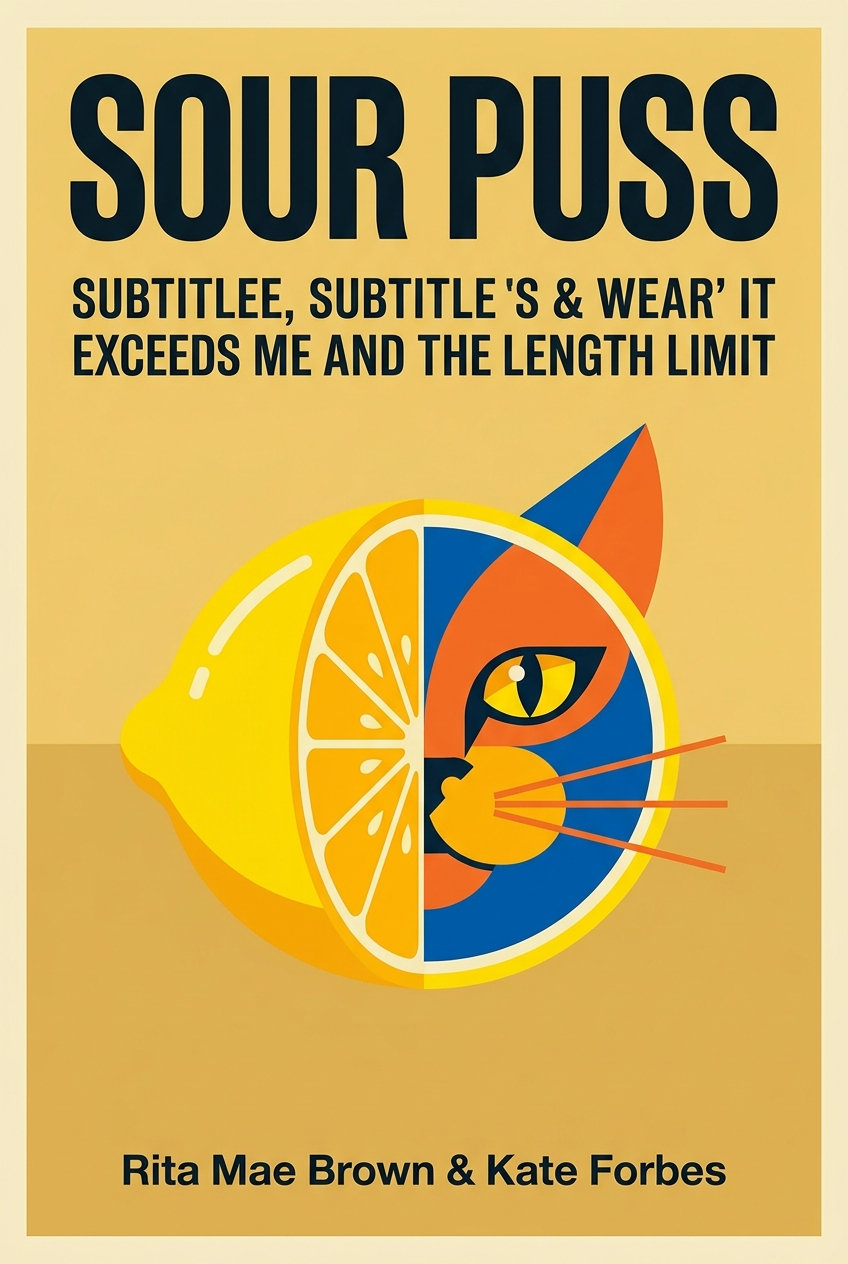
Sour Puss
What's it about
Ever wondered how a simple trip to the grocery store could unravel a town's darkest secrets and lead to murder? Get ready to join postmistress Mary "Harry" Haristeen and her crime-solving pets as they sniff out a killer whose motives are as sour as a rotten lemon. You'll learn to spot clues where others see only everyday life. This isn't just another cozy mystery. You'll dive into the quirky world of Crozet, Virginia, where a bitter rivalry between two grocers turns deadly. Follow Harry, her astute cat Mrs. Murphy, and her loyal corgi Tee Tucker as they piece together a puzzle of jealousy, greed, and long-buried resentments. Can you solve the crime before the killer strikes again?
Meet the author
Rita Mae Brown is an Emmy-nominated screenwriter and a New York Times bestselling author of more than fifty novels, including the beloved Mrs. Murphy mystery series. A lifelong animal lover and master of foxhunting, Brown combines her deep understanding of animal behavior with her sharp wit to bring the four-legged characters of Sneaky Pie Brown's world to life. Her Virginian farm, shared with a menagerie of horses, hounds, and cats, provides the authentic backdrop and endless inspiration for her charming mysteries.
Opens the App Store to download Voxbrief

The Script
The old farmer’s market is a stage, and every vendor is a performer. One stall, however, is a masterclass in silent theater. Two women, nearly identical in their faded overalls and sun-worn hats, stand behind twin tables piled high with heirloom tomatoes. The first woman is a whirlwind of cheerful efficiency. Her hands fly, bagging produce, making change, and offering a bright, genuine smile with every transaction. Her line is long, but it moves with a joyful rhythm. Next to her, her sister presides over an identical bounty, but her space is shrouded in a palpable quiet. Her movements are just as efficient, her tomatoes just as vibrant, but a subtle, weary slump in her shoulders and a tightness around her eyes telegraphs a different story. Customers approach her table hesitantly, as if sensing they are intruding on a private sorrow. They complete their purchases with a polite murmur and quickly move on, leaving her in a pocket of stillness amidst the market's buzz. Both women sell their tomatoes, but only one sells a sense of connection.
The subtle, unspoken dramas of small-town life—the histories and heartaches exchanged in a glance across a market stall—are the lifeblood of Rita Mae Brown's work. A lifelong Virginian, master of foxhounds, and devoted observer of both human and animal behavior, Brown noticed how the deepest truths of a community are rarely spoken aloud. They are embedded in the routines, the rivalries, and the quiet alliances of everyday life. She created the 'Mrs. Murphy' mystery series, co-authored with her feline companion Sneaky Pie Brown, as a way to explore this world. In 'Sour Puss,' she uses the seemingly simple lives of her characters, both human and animal, to unravel a complex web of secrets, showing how the keenest detectives are often the ones who pay attention to the stories no one is telling.
Module 1: The Hidden Dangers in Plain Sight
The story opens with a seemingly idyllic event. Harry Haristeen, a farmer and our main character, has just remarried her veterinarian husband, Fair. Their community in Crozet, Virginia, is a tight-knit world of foxhunting, farming, and now, a booming wine industry. But beneath the surface, tensions are simmering. A local academic, Professor Vincent Forland, is an expert in mycotoxins, which are fungal toxins. He gives a lecture to local vintners. During the talk, he makes a chilling point. The knowledge to weaponize agricultural science is surprisingly accessible. He explains that the same fungi that attack grain crops can be refined into potent bioweapons. The technology isn't complex. A bright student with basic lab equipment could produce them. This is a real-world vulnerability, hiding within the very science used to grow our food.
This idea plants a seed of unease. So what happens next? The professor vanishes. His car is found abandoned in a parking garage. The police, including Deputy Cynthia "Coop" Cooper, start a methodical investigation. They check accident reports and tow services. But there are no easy answers. The disappearance introduces the book's central theme. Expertise in a specialized field can make you a target. Forland's knowledge of plant diseases and their potential for harm made him valuable, and therefore, vulnerable.
And it doesn't stop there. The local vineyards are a hotbed of professional rivalry. We meet Toby Pittman, a talented but volatile winemaker. He resents a former classmate, Arch Saunders, for landing a prestigious job. We also meet Rollie Barnes, a wealthy but insecure investor. These are high-stakes competitions for status, profit, and legacy in the demanding world of viticulture. This leads to a critical insight. Personal resentments often drive professional conflicts, creating a fertile ground for disaster. The community is a pressure cooker. The professor's disappearance is just the first sign that something is about to boil over. The danger is already inside the gates.
Module 2: The Unseen Ecosystem of Farm and Community
Now, let's turn to one of the most unique aspects of this book: the animals. Harry’s farm is home to her tiger cat, Mrs. Murphy, a portly gray cat named Pewter, and a corgi named Tucker. They are characters with their own perspectives, social dynamics, and a surprising grasp of human affairs. Through their eyes, we see a different layer of reality. They observe the chaos of Harry’s wedding with dry wit, calculating that the money spent could buy a lifetime supply of tuna. This establishes a core principle of the story. Animals act as perceptive observers, often noticing details that humans miss.
Their world is a microcosm of the human one, complete with its own rules and politics. The cats have a "bargain" with the barn mice to keep the peace. They gossip with Simon, the possum who lives in the rafters. And they are acutely aware of the farm's natural predators, like Flatface the owl and Matilda the blacksnake. This brings us to a broader point about the setting. A healthy ecosystem, whether on a farm or in a company, relies on a complex web of checks and balances. The owl and the snake control the mice. The bees pollinate the crops. Every creature has a role. Harry, the farmer, understands this deeply. She sees these animals as partners in the enterprise of running a farm.
This perspective becomes crucial as the mystery deepens. While the humans are tangled in their own dramas, the animals are out exploring. They discover a patch of disturbed earth near an old peach orchard. It’s a detail the humans have overlooked. This discovery highlights how the narrative operates on two levels. The humans investigate with logic and procedure. The animals investigate with instinct and observation. And here's the thing. True understanding requires integrating both instinctual awareness and logical deduction. The animals' non-verbal cues—their persistence in leading Harry to the site—force her to pay attention. They act as a bridge between the unseen world and the human one, ultimately guiding her toward a grim discovery that changes everything.