All Books
Self-Growth
Business & Career
Health & Wellness
Society & Culture
Money & Finance
Relationships
Science & Tech
Fiction
Topics
Blog
Download on the App Store

Spirituality Before Religions

Spirituality is Unseen Science...Science is Seen Spirituality

14 minProf Kaba Hiawatha Kamene

What's it about

Ever wondered if there's a deeper connection between the spiritual and the scientific? What if the answers to life's biggest questions weren't hidden in dogma, but in a universal knowledge that predates all modern religions? This book summary unlocks that ancient wisdom for you. You'll discover how to see the unseen science within spirituality and the visible spirituality in science. Learn from Prof Kaba Kamene how ancient African civilizations understood concepts like quantum physics and cosmology through a spiritual lens, giving you a powerful new framework for understanding yourself and the universe.

Meet the author

Professor Kaba Hiawatha Kamene is a world-renowned educator and historian with over 40 years of experience dedicated to the research of ancient African history and spirituality. His lifelong journey as a "teacher of teachers" and curriculum specialist has focused on restoring the deep, often hidden, connections between African spiritual systems and modern scientific principles. This profound expertise illuminates his work, revealing the spiritual knowledge systems that predate and inform our contemporary understanding of the universe.
Listen Now

Opens the App Store to download Voxbrief

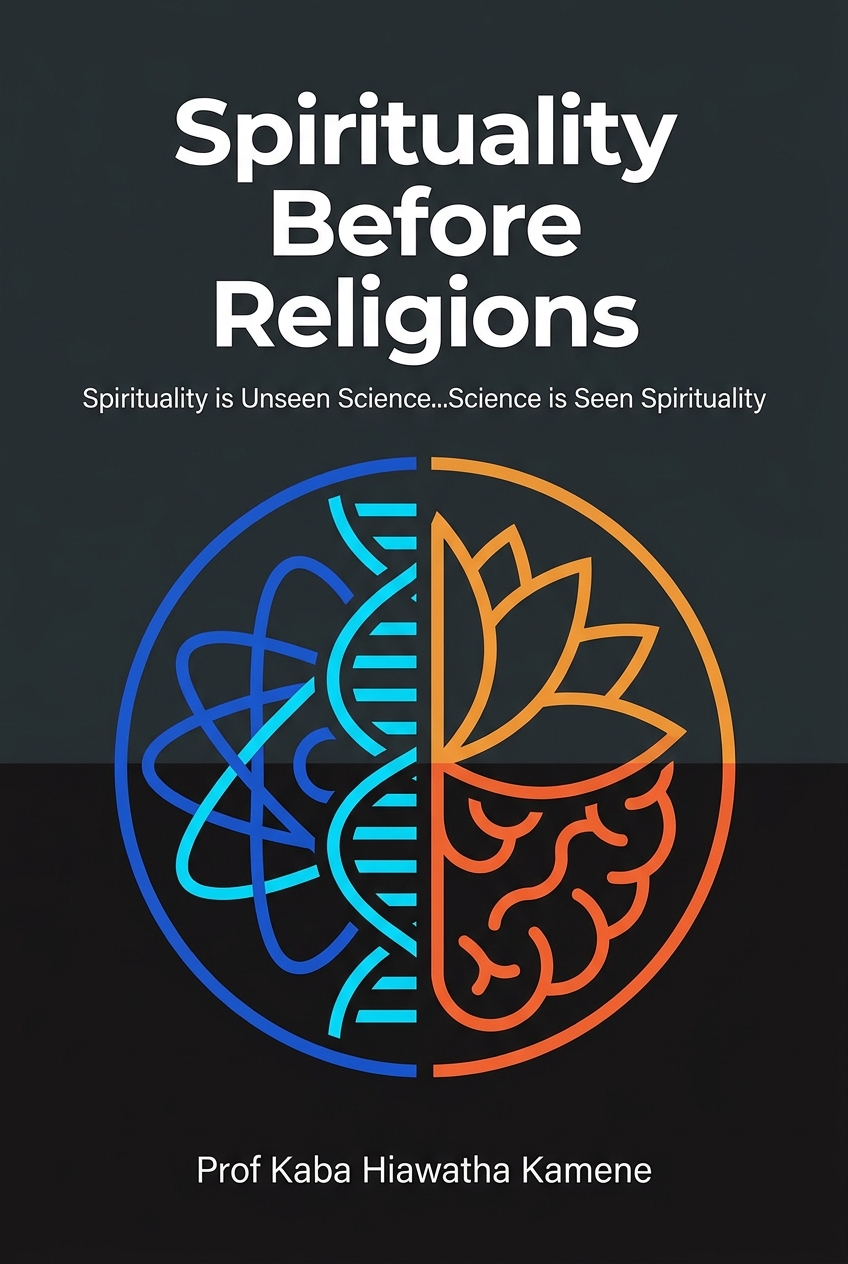
Spirituality Before Religions book cover

The Script

Two apprentice archeologists are given identical tasks: reconstruct the belief system of an ancient, pre-literate culture from two separate, newly discovered burial sites. The first apprentice, trained in the grand traditions of Rome and Greece, meticulously documents the placement of every pot, every bead, every tool. He creates a detailed catalog, attempting to force the artifacts into a familiar framework of gods, goddesses, and afterlives he already understands. His final report is precise, academic, and ultimately hollow, describing what the objects are, but not what they meant. The second apprentice, however, approaches the site differently. She doesn't start with a catalog. Instead, she sits quietly for days, observing the way the light hits the burial mound at dawn, the direction the bodies are facing, the patterns etched into the pottery that seem to mirror the constellations above. She notes the recurring symbols that mimic the flow of the nearby river. Her report is less a catalog and more a narrative, one that speaks of a people whose spiritual life was woven into the very fabric of their existence—in their relationship with the sun, the earth, and the cycle of life and death.

This second approach—understanding spirituality as an inherent human connection to the cosmos—is the life's work of Professor Kaba Hiawatha Kamene. For over four decades as a master teacher and historian, he witnessed generations of students disconnected from their own ancestral heritage, trying to find meaning within systems of belief that felt foreign to them. He saw how the story of spirituality had been edited, with its most ancient African origins often treated as a footnote rather than the foundational text. "Spirituality Before Religions" was born from this deep-seated need to restore the original narrative, to take us back to a time before the institutions, to the fundamental human impulse to understand our place in the universe, an impulse that is everyone's birthright.

Module 1: The Unity of All Things—Spirituality as Unseen Science

The central premise of the book is a radical reframing of reality. It challenges the modern split between the spiritual and the material. Kamene argues they are two sides of the same coin. This is presented as a foundational principle of ancient African thought, a "Sacred Science" that saw the universe as a single, interconnected system.

The book's subtitle itself is a core insight: Spirituality is Unseen Science, and Science is Seen Spirituality. This idea, rooted in Kemetic philosophy, suggests that what we call "spirituality"—consciousness, intuition, life force—is simply the invisible dimension of the same universal laws that science observes in the material world. Think of it like this: science studies the observable effects, like gravity's pull on an apple. Spirituality studies the unseen principle, the fundamental force itself. They are describing the same reality from different vantage points.

From this foundation, Kamene introduces a powerful concept from ancient Kemet: "Tep Heseb." This translates to "an accurate reckoning by using a correct method." It was the gateway to all knowledge. True understanding requires integrating intuitive wisdom with methodical observation. You can't have one without the other. This ancient method didn't separate the mystical from the measurable. For example, the study of the stars, what we call astronomy, was also the study of cosmic principles, or astrology. The movement of celestial bodies was both a physical event and a spiritual message. One of the book's most striking examples is its interpretation of the Memphite Theology, an ancient creation text. The text describes creation beginning with a trinity: Nun, the primordial matter; Ptah, the energy that gives it form; and Atum, the creative intelligence or "word." Kamene argues this is a sophisticated scientific cosmology. It describes the universe originating from a state of pure potential, which is organized by energy and brought into being by information. This ancient spiritual story mirrors modern concepts like the Big Bang, where energy and physical laws shape a universe from a singularity.

And it doesn't stop there. The book extends this unity to the human experience. Humans exist as the bridge between the micro-cosmic and the macro-cosmic. We are the midpoint. Our bodies contain an inner atomic world, the realm of quantum physics. We also exist within an outer cosmic world, governed by the laws of relativity. Kamene suggests that ancient thinkers understood this intuitively. We are the living connection between the infinitely small and the infinitely large. Our consciousness is the faculty that allows us to perceive both realms. This perspective makes the human experience deeply meaningful. We are the universe's way of knowing itself.

Module 2: The African Cradle of Civilization and Thought

Now, let's turn to the historical anchor of the book. Kamene makes a bold and meticulously argued claim: the spiritual and scientific systems that shaped the world originated in Africa. Specifically, he traces them to the ancient civilizations of the Nile Valley, starting with Kush in the south and moving north to Kemet. This is about following the archaeological and textual evidence to its source.

A key assertion is that ancient Kemet was an African civilization founded by Kushite peoples from the south. The book presents archaeological evidence from Qustal, a site in ancient Nubia, now modern Sudan. Excavations there uncovered royal tombs with pharaonic symbols that predate the first known Egyptian dynasty by several generations. This suggests that the political and spiritual systems of the pharaohs developed first in Kush and migrated north. The book argues that Kemet was, in essence, a child of Kush. This reframes the entire history of the region, placing the interior of Africa at the center of innovation.

Building on that idea, the book presents a wealth of evidence for the sophistication of these early African societies. The "Golden Ages" of Kemet coincided with periods of indigenous African rule. The Old Kingdom, the era of the great pyramids, and the Middle Kingdom, known for its classical literature, were founded and led by rulers from the south. In contrast, the "Intermediate Periods," marked by foreign invasions and internal chaos, saw little cultural or technological advancement. For example, the pyramids are presented as marvels of sacred science. They were aligned with celestial bodies like Orion's Belt and functioned as spiritual tools representing the principle of "As Above, So Below." The knowledge required for such feats, Kamene argues, was a product of this unified African worldview.

This leads us to a crucial point about interpretation. To understand this ancient wisdom, you have to use the right lens. Sacred texts from Kemet are encoded with integrated scientific and spiritual knowledge. They can't be read as just myth or just science. They are both. Kamene offers a compelling example with the "Aten Text," a hymn to the sun. On the surface, it’s a beautiful piece of spiritual poetry. But the book interprets it as a scientific document describing photovoltaics—the conversion of light, heat, and sound into energy. The text details how the sun's rays animate all life, a process we now understand through biology and physics. This approach reveals a hidden layer of scientific understanding within what was once dismissed as simple sun worship.

So here's what that means for us today. The book suggests that by overlooking these African origins, we've inherited a fragmented and incomplete understanding of our own intellectual history. Reconnecting with this source is about recovering a more holistic way of thinking.

Read More