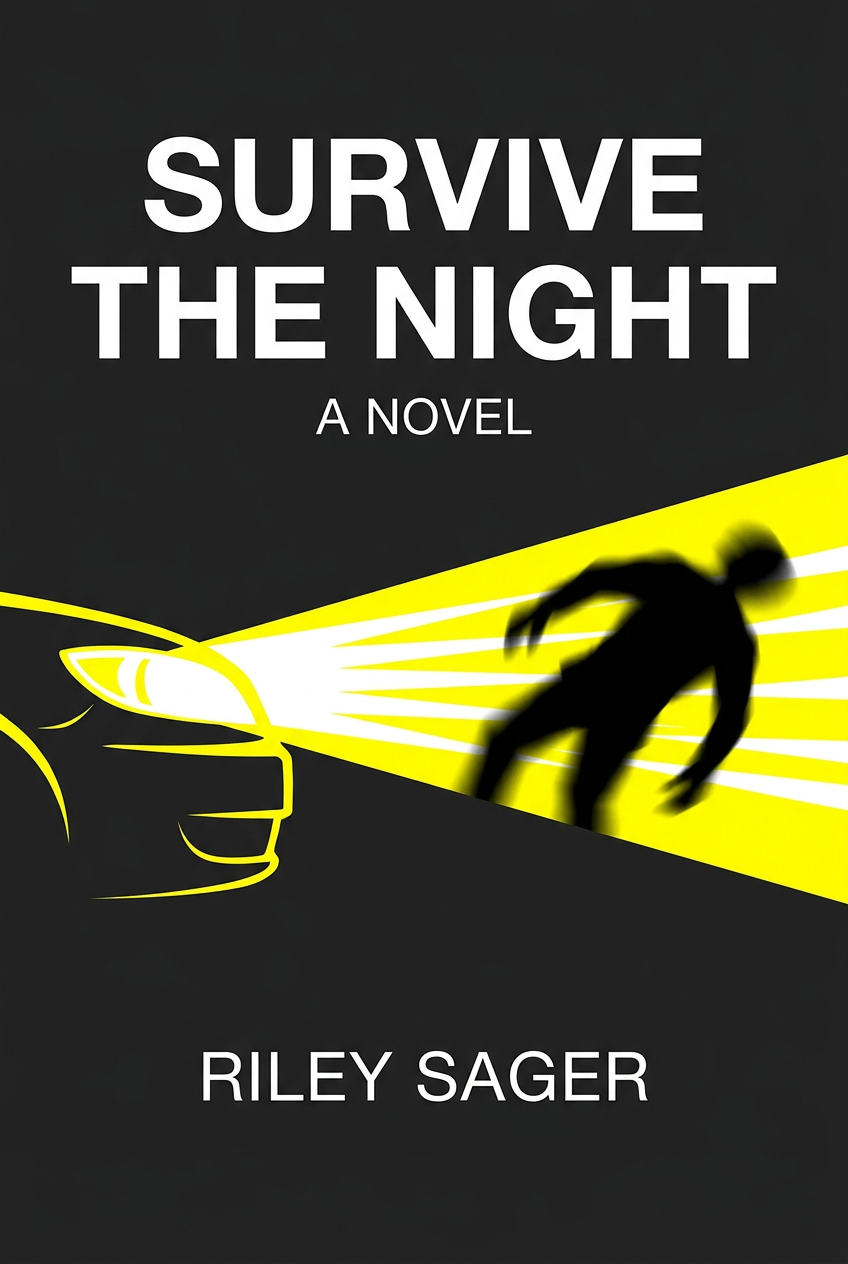
Survive the Night
A Novel
What's it about
What if the person offering you a ride is the same person you're running from? This gripping summary plunges you into a claustrophobic 1991 road trip where a college student, haunted by her friend's recent murder, begins to suspect her driver is the campus killer. You'll explore the chilling cat-and-mouse game that unfolds inside the car. Discover how the protagonist uses her obsession with classic movies to decipher clues and stay one step ahead. Can you spot the lies and survive a journey where every mile could be your last?
Meet the author
Riley Sager is the New York Times bestselling author of seven psychological thrillers, firmly establishing him as a modern master of suspense and a leading voice in the genre. A former journalist, editor, and graphic designer, Sager draws from his experience in crafting intricate narratives to create the twist-filled, high-stakes plots his readers crave. His passion for classic horror films and suspense novels fuels his unique ability to blend cinematic tension with gripping, unforgettable storytelling that keeps you guessing until the final page.
Opens the App Store to download Voxbrief

The Script
The car door slams shut, sealing you inside a tiny, rumbling world of vinyl and glass. It’s just you and the driver, a stranger whose face is intermittently illuminated by the hypnotic rhythm of passing headlights. Outside, the world is a dark, indecipherable blur. Inside, every sound is amplified: the soft click of the turn signal, the rustle of a jacket, the almost imperceptible shift of weight in the driver's seat. A friendly question about where you’re headed could be simple kindness. Or it could be a probe, a way of gathering information. A hand reaching for the radio dial could be innocent, or it could be a feint, a prelude to something else entirely. The air grows thick with unspoken possibilities, each mile a turn of the screw, tightening the knot of suspicion until the shared silence between you feels heavier than any sound.
This is the high-stakes gamble of trusting a stranger, a scenario where the line between safety and mortal danger is impossibly thin. That feeling—the creeping dread that the person offering you a ride might be the very monster you're trying to escape—is the engine of Riley Sager’s thriller, Survive the Night. Sager, a master of twisting classic film tropes into modern psychological suspense, was captivated by the inherent vulnerability of the road trip. He wanted to explore that specific, claustrophobic paranoia that can only exist within the confines of a moving car, miles from anywhere, with someone you don't really know. By setting the story in 1991, before the safety net of cell phones and GPS, he strips his protagonist of any easy escape, forcing her to rely on nothing but her wits and her increasingly frayed intuition to determine if the man behind the wheel is her savior or her executioner.
Module 1: The Unreliable Mind — When Grief Distorts Reality
The story centers on Charlie, a college student consumed by grief and survivor's guilt after her best friend, Maddy, is murdered by a serial killer. This trauma has profoundly altered her perception. She experiences vivid, cinematic hallucinations she calls "movies in her mind." These are immersive, sensory episodes that replace her reality with something else entirely. The core idea here is that profound trauma can fundamentally rewire your perception of reality.
This concept is introduced immediately. Charlie is in her empty dorm room, but for a moment, she sees it as it was in the past. It’s warm, cluttered, and filled with the presence of her friend Maddy. She can even smell Maddy's perfume. Then, a voice shatters the illusion, and she's back in the cold, stark present. Her brain, unable to cope with the pain, offers her a temporary, cinematic escape. This is a deep insight into human psychology. When reality is too painful, the mind may construct an alternative.
For Charlie, this coping mechanism becomes a critical vulnerability. She constantly frames her life in movie terms. She thinks about her goodbyes in the style of classic films like Casablanca. She even sees a potential killer but dismisses him as a "figment of her imagination... something out of a movie." This leads to a crucial second insight: coping mechanisms designed to protect you can become your greatest liability. Because she's used to her mind playing tricks on her, she can no longer distinguish a real threat from a mental fabrication.
This is the central conflict. Charlie accepts a ride from a stranger, Josh, to flee the campus where Maddy was killed. She knows it's a risk. But her need to escape the traumatic environment is so overwhelming that it overrides her rational fear. Inside the car, every strange comment, every inconsistency in Josh's story, becomes a terrifying question. Is he a killer? Or is she just having another "movie in her mind"? This blurring of lines is the engine of the story's suspense. It forces us to ask what we would do if we couldn't trust our own senses in a life-or-death situation.
Module 2: The Anatomy of a Predator — Deception as a Weapon
As the car ride progresses, the tension escalates. Josh seems friendly, but his story has holes. He claims to work at the university, but a simple test question from Charlie proves he's lying. He says he's from one place, but his driver's license says another. Sager uses this dynamic to explore how predators operate. It’s about psychological manipulation. The first principle of this predatory playbook is that charm and a plausible facade are a predator's most effective tools.
Josh doesn't appear threatening. Charlie initially assesses him as a "nice" guy, a "grad student" type. He uses this non-threatening appearance to his advantage. He knows that people make snap judgments based on looks. He wears a university sweatshirt to blend in. He has a "great smile." These are all calculated elements of his performance, designed to lower a victim's guard.
The next step in this manipulation is exploiting a target's vulnerability. Josh quickly picks up on Charlie's grief and guilt. He creates what he calls the "temporary intimacy" of the car ride. It's a space where two strangers, unlikely to meet again, can share secrets. He encourages her to confess her story, creating a false sense of connection and trust. This leads to the second insight: predators create isolated environments to foster false intimacy and control the narrative. By getting Charlie alone in the car, he cuts her off from her support system and makes himself the sole arbiter of her reality.
This is where the gaslighting begins. When Charlie catches him in a lie, he has an explanation. When she recalls a suspicious event, he suggests it was just another "movie in her mind." He systematically dismantles her confidence in her own perception. He makes her believe she is the unreliable one, the "crazy" one. At one point, Charlie sees a different name on his license. Later, he shows her a license with the name he gave her, "Josh Baxter." She is left questioning her own sanity. Did she see it? Or did she imagine it? This is a terrifyingly effective tactic. By making the victim doubt their own mind, the predator gains complete control.