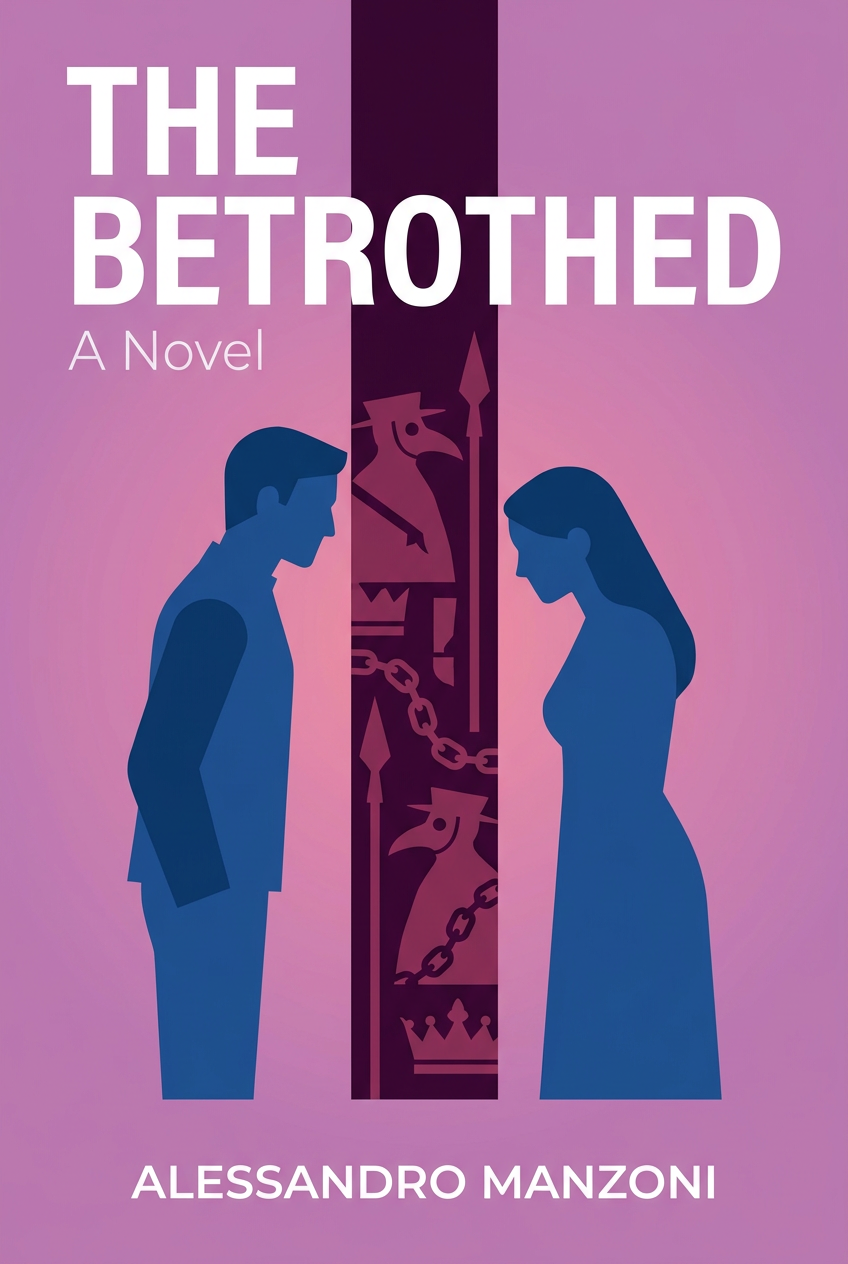
The Betrothed
A Novel
What's it about
What if the world seemed determined to keep you from your true love? In 17th-century Italy, two young villagers, Renzo and Lucia, find their wedding day shattered by the whims of a powerful and corrupt nobleman, forcing them on a desperate journey to reunite. Discover how their unwavering faith and love are tested by war, famine, and a devastating plague. This epic tale isn't just a historical romance; it's a profound exploration of resilience, the struggle between good and evil, and the incredible power of hope against all odds.
Meet the author
Alessandro Manzoni is a towering figure of Italian literature, celebrated for pioneering the modern Italian novel and shaping the nation's unified language with his masterpiece, The Betrothed. A leader of the Italian Romantic movement, he drew upon deep historical research and his own profound Catholic faith to explore themes of divine providence, justice, and the resilience of the human spirit. His work transformed the literary landscape, creating a novel that was both a sweeping historical epic and an intimate portrait of ordinary lives.
Opens the App Store to download Voxbrief

The Script
Two families live on the same small lake. The first family’s boat is a sleek, modern vessel, built for speed and efficiency. Its hull is polished, its engine meticulously maintained, its purpose clear: to cross the water as quickly as possible. The second family’s boat is an old, wide-beamed wooden craft, heavy with generations of use. It has been patched with different kinds of wood, its sail is a quilt of repairs, and it’s filled with fishing nets, picnic baskets, and the occasional sleeping child. To the first family, the second boat is an inefficient relic. To the second, the first boat is just a machine that skims the surface, missing the deep currents, the shifting sandbars, and the quiet coves where the best fish hide. One sees the lake as a distance to be conquered; the other sees it as a world to be inhabited.
This tension between the clean, direct path and the messy, lived-in reality is the very water that buoys Alessandro Manzoni’s masterpiece. Manzoni himself was a man caught between two worlds—the rational, enlightened world of his French intellectual upbringing and the deep, often chaotic faith of his native Italy. After a profound religious reawakening, he struggled to reconcile the grand, abstract ideals of history and justice with the tangled, deeply personal, and often unjust experiences of ordinary people. He wanted to write a national epic for a nation that didn't yet exist, but he chose to focus on two young, illiterate silk weavers, Renzo and Lucia, whose simple desire to marry is thwarted by the whims of a petty lord and the vast, indifferent machinery of plague, famine, and war. The Betrothed was his attempt to show that the true story of a people is found in the cluttered, resilient, and deeply human boat of everyday life.
Module 1: The Anatomy of Powerlessness
Let's begin with the core problem Manzoni presents. It’s a world where power is just held, not earned. The story opens with a simple parish priest, Don Abbondio. He's walking home one evening, planning the next day's wedding for two young villagers, Renzo and Lucia. But two armed thugs, called bravi, stop him. They work for a local nobleman, Don Rodrigo. The message is simple. "This wedding is not to happen." Or else.
Don Abbondio immediately folds. Why? Because he knows the rules of the game. In a broken system, the law protects the powerful, not the just. Manzoni makes this painfully clear. He shows us official decrees, pages of them, outlawing these very thugs. But the decrees are useless. The bravi are sponsored by nobles. They can hide in palaces or monasteries where the police dare not enter. Justice is a performance. Real power is private and enforced with violence. Don Abbondio's survival strategy for sixty years has been simple: avoid conflict, bow to the strong, and never take a stand. His cowardice is a rational response to a corrupt environment.
This brings us to the first response to powerlessness: seeking help from the system. Renzo, the young groom, is furious. He tries to get help. He goes to a lawyer, a man nicknamed Dr. Azzeccagarbugli—Dr. Argle-Bargle. Renzo brings a gift of capons, a humble payment. The lawyer assumes Renzo is a criminal looking for a way out. He proudly pulls out a decree that perfectly describes the crime committed against Renzo. But the moment Renzo mentions the name of the oppressor, Don Rodrigo, the mood shifts. The lawyer panics. He throws Renzo out of his office. The scene is almost comical, but its message is chilling. Formal systems of justice are performative when they fear the powerful. The law exists on paper. In practice, it’s a tool for the well-connected, not a shield for the innocent.
So what's left? The church. Lucia and her mother, Agnese, turn to a respected Capuchin friar, Padre Cristoforo. This introduces the second major power structure in the novel. Where secular law fails, spiritual authority becomes the last resort for the oppressed. Padre Cristoforo isn’t just a priest; he's a man with a past. He was once a nobleman named Lodovico who killed a man in a duel over a point of honor. Wracked with guilt, he joined the monastery, taking the name of the servant who died defending him. His life is now a continuous act of atonement. He uses his residual aristocratic confidence to confront injustice. This is a critical insight. Moral authority, when wielded with courage, can challenge raw power. Padre Cristoforo agrees to confront Don Rodrigo directly. He walks into the lion's den. He enters Don Rodrigo's fortified palace, a place decorated with the portraits of ancestors who were all "terrors to their enemies." The confrontation is electric. It’s a clash between the power of force and the power of faith. And it sets in motion the central conflict of the entire novel.
Module 2: The Nature of Crisis and Its Human Response
Manzoni shows us personal crises, and he also scales up to show what happens when an entire society collapses. The second half of the book is dominated by two massive historical events: a famine and the bubonic plague. It's here that the story becomes a powerful analysis of human behavior under extreme pressure.
First, the famine. Manzoni shows how a grain shortage, worsened by war, leads to bread riots in Milan. His analysis is stunningly modern. He identifies the root cause of the chaos. Government price controls during a shortage create perverse incentives and worsen the crisis. The Grand Chancellor, Antonio Ferrer, tries to solve the famine by fixing the price of bread at an artificially low level. The public loves it. But bakers are forced to sell at a loss. They run out of flour. The supply chain breaks down. The public, not understanding economics, blames hoarders and bakers. This leads to the core insight about mob psychology. In a crisis, the public seeks simple scapegoats, not complex causes. The crowd, convinced there is hidden grain, becomes a mob. They loot bakeries, destroy equipment, and hunt for officials to lynch.
It’s in this riot that we see Renzo again. He's fled to Milan and gets swept up in the chaos. He’s naive. He thinks the riot is a righteous uprising. He gives a drunken speech in a tavern, calling for justice and reform. He doesn't realize he's being watched. An undercover police agent befriends him, gets his name, and the next morning, Renzo is arrested. This sequence is a masterclass in social dynamics. Individual idealism is easily exploited by institutional power, especially in times of chaos. Renzo’s naive belief in popular justice makes him a perfect target. He only escapes because the lingering mob, hostile to any authority, rescues him from the police.
But then Manzoni shows us what happens when the crisis deepens. The famine gives way to the plague. And here, the dynamic shifts. The riots stop. Why? Extreme, existential suffering leads to apathy, not rebellion. When death is everywhere, people stop fighting the system. They just try to survive. The city becomes a hellscape. Social order dissolves. The wealthy hide. The poor die in the streets. And a new, terrifying power class emerges: the monatti. These are the plague workers, the men hired to transport the sick and bury the dead. They are untouchable. They loot homes, extort families, and carouse drunkenly on carts piled high with corpses. They are the ultimate symbols of societal collapse, where the most reviled job becomes a position of absolute power. Manzoni’s depiction is a stark reminder that in the absence of order, the most brutal and opportunistic actors thrive.