All Books
Self-Growth
Business & Career
Health & Wellness
Society & Culture
Money & Finance
Relationships
Science & Tech
Fiction
Topics
Blog
Download on the App Store

The Color Monster

A Story About Emotions

15 minAnna Llenas

What's it about

Ever wonder how to help your child understand their big, confusing feelings? Discover a simple, colorful way to talk about emotions, turning frustration into understanding. This story introduces a friendly monster whose mixed-up colors represent his jumbled-up feelings, offering you a perfect tool to start the conversation. You'll learn how to help your child sort their emotions—like happiness, sadness, anger, fear, and calm—into different colors, just like the monster does. This visual approach makes it easy for kids to identify and express what they're feeling, building emotional intelligence one color at a time.

Meet the author

Anna Llenas is an internationally bestselling author and illustrator who trained as an art therapist, specializing in helping both children and adults manage their emotions. Her background in advertising and graphic design, combined with her therapeutic expertise, inspired her to create The Color Monster. Through her unique blend of art and emotional intelligence, she provides a visual language for feelings, making complex emotions understandable and accessible to all ages, touching hearts in over thirty-five countries.
Listen Now

Opens the App Store to download Voxbrief

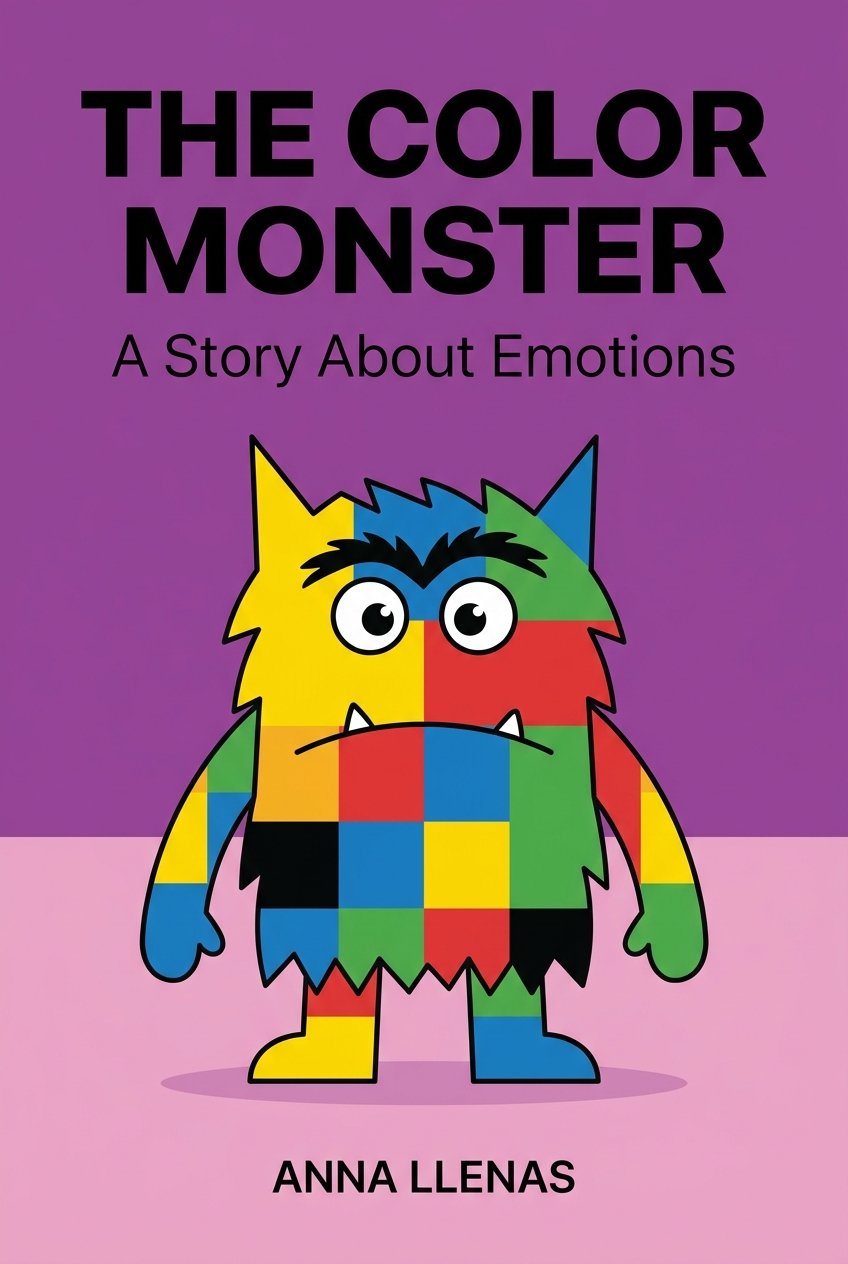
The Color Monster book cover

The Script

A child sits on the floor with a big box of crayons, every color spilled out into a chaotic pile. She picks up a yellow, then a blue, then a red, and tries to draw a house, but the colors smear together into a murky, confusing brown. She doesn't know why it looks so messy. She feels a frustration bubbling up, a tightness in her chest, but she doesn't have a word for it. She just knows it’s a 'yucky' feeling. A moment later, a bright sunbeam hits her face through the window, and a warm, light feeling spreads through her, but it gets mixed in with the 'yucky' feeling, and now she’s just confused. This jumble—the inability to name the distinct threads of our inner world—is a fundamental human experience, where our joy, sadness, anger, and fear can feel like an tangled, overwhelming knot inside us, leaving us feeling lost and misunderstood, even by ourselves.

This exact feeling of a beautiful, colorful mess is what inspired Anna Llenas to create her now-famous monster. Working as an art therapist and designer, she saw firsthand how both children and adults struggled to articulate their emotions. They knew they felt something, but they couldn't untangle the strands. She wanted to give them a visual language, a way to see their feelings as separate, manageable things. So, she created a lovable monster whose colors were all mixed up, and through the simple act of sorting those colors into jars, she offered a gentle, accessible way for anyone to begin the work of understanding their own heart.

Module 1: The Anatomy of Entitlement

The story opens with Mr. and Mrs. Meek, two painfully shy librarians. They are quiet, gentle, and utterly overwhelmed by their daughter, Myrtle. From birth, Myrtle is described as an "absolute HORROR." Her first word isn't "Mama" or "Dada." It's "MORE." This single word becomes the engine of the entire narrative, and the Meeks' response to it sets the stage for disaster. They give her everything she asks for, hoping each indulgence will be the last. It never is.

This dynamic reveals a critical insight: Excessive indulgence reinforces and escalates negative behavior. Myrtle demands toys, and her parents buy them. She immediately smashes them and demands more. They give her chocolate biscuits, and she spits the crumbs back in their faces. Their compliance teaches her that tantrums and disrespect are effective tools for getting what she wants. Each act of appeasement fuels her sense of entitlement, making her demands grow more frequent and more aggressive. For anyone managing a difficult stakeholder or a demanding team member, this is a familiar pattern. Giving in for the sake of peace often buys you less peace, not more.

What's more, the book shows that material possessions cannot satisfy an emotional void. Myrtle’s bedroom is a museum of bizarre junk. It's piled high with everything from an ant farm to zebra dung, including absurdities like a jar containing one of Albert Einstein’s burps and a remote-controlled hedge. Yet, amidst this "universe of junk," she remains profoundly bored and dissatisfied. She still wants "one more 'FING'," a desire so vague she can't even describe it. This illustrates a fundamental truth. No amount of stuff can fill a deeper sense of emptiness. Myrtle's endless accumulation is a symptom of a core unhappiness that material goods are powerless to solve.

Ultimately, this cycle of indulgence and dissatisfaction leads to a complete breakdown of order. The Meek's passivity has real-world consequences. Parental inability to assert boundaries leads to household chaos and a total loss of control. Myrtle's morning howls for breakfast literally shake the house, shattering pictures and cracking plaster. Her parents are "hurled out of bed" and spend their days "doing their daughter’s bidding." They have become servants in their own home, ruled by the whims of a child they are terrified to confront. Their failure to set boundaries has destroyed their own autonomy and peace. The chaos is a physical manifestation of their surrendered authority.

Read More