All Books
Self-Growth
Business & Career
Health & Wellness
Society & Culture
Money & Finance
Relationships
Science & Tech
Fiction
Topics
Blog
Download on the App Store

The Design of Everyday Things

Revised and Expanded Edition

13 minDon Norman

What's it about

Ever been frustrated by a door you can't figure out how to open or a gadget with confusing controls? This summary reveals the hidden principles of good design that separate intuitive products from infuriating ones, showing you why it's never your fault. Discover Don Norman's core concepts of discoverability and feedback that empower designers to create seamless user experiences. You'll learn how to apply these timeless rules to everything from physical objects to digital interfaces, ensuring what you create is not only beautiful but also effortlessly usable.

Meet the author

Don Norman is a distinguished cognitive scientist and usability engineer, widely regarded as a foundational voice in the field of user-centered design and human-computer interaction. His unique background, blending psychology, computer science, and engineering, gave him a groundbreaking perspective on why we struggle with everyday objects. This led him to champion the idea that products should be designed for people, a principle that has since revolutionized industries and shaped the modern world of technology and design.
Listen Now

Opens the App Store to download Voxbrief

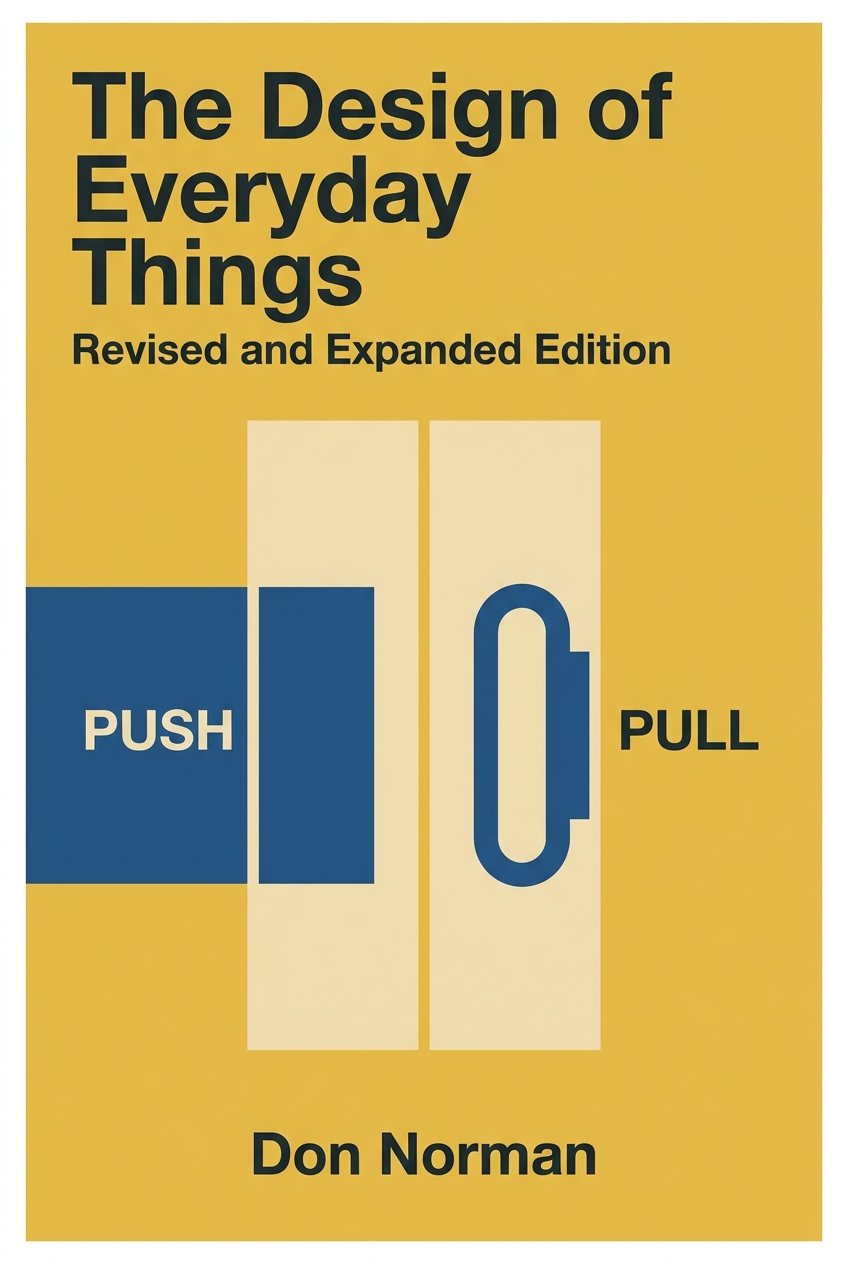
The Design of Everyday Things book cover

The Script

You're standing in front of two glass doors. One has a flat metal plate where you'd expect a handle. The other has a vertical bar. Instinctively, you push the plate and pull the bar. It works. You don't think about it; you just know. Now imagine a third door, identical to the others, but with two identical vertical bars, one on each side of the glass panel. Do you push? Do you pull? You hesitate, a flicker of uncertainty. You try one, it doesn't move. You try the other. Success. In that brief moment of confusion, you’ve just encountered a design failure.

That moment of hesitation, that split-second of frustration when an object doesn’t communicate how it wants to be used, is what fascinated Don Norman. A cognitive scientist and usability engineer with a background at Apple, Norman found himself increasingly vexed by these tiny, unnecessary struggles baked into the world around him—from baffling light switches to inscrutable stovetops. He realized these were design flaws. His journey into cataloging these everyday annoyances, which he dubbed 'Norman Doors,' led him to write this foundational text for the rest of us, to give us a language for the silent, often frustrating, dialogue we have with the objects in our lives.

Module 1: The Psychology of Everyday Action

Why do we get confused by simple objects? It comes down to two gaps. The Gulf of Execution and the Gulf of Evaluation. The Gulf of Execution is the gap between your goal and the actions you need to take. Think of a complex TV remote. Your goal is simple: turn up the volume. But which of the fifty buttons do you press? That chasm of uncertainty is the Gulf of Execution. The Gulf of Evaluation is the gap between your action and understanding the result. You press a button. Did it work? Is the volume changing? The lack of clear feedback creates this second gulf.

Great design bridges these gulfs. It does this by making things discoverable and understandable. Discoverability means you can figure out what actions are possible and where to perform them. A flat plate on a door signals "push." A handle signals "pull." These are called signifiers. They are perceptible clues that guide your action. Without them, you're just guessing.

Understanding comes from a good conceptual model. This is your mental story of how something works. A strong conceptual model allows users to predict the outcome of their actions. Scissors have a brilliant conceptual model. The two holes clearly suggest where your fingers go. The direct connection between squeezing the handles and closing the blades is obvious. You understand it instantly. In contrast, a refrigerator with two temperature controls—one for the freezer, one for the fridge—often creates a faulty conceptual model. Users think they control each compartment independently. In reality, one control often manages the overall coldness while the other diverts air. This mismatch leads to endless frustration. Why is my lettuce freezing? The design gave you a broken model.

To bridge these gulfs, designers use a few key principles. The first is providing clear signifiers that communicate where and how to act. A "PUSH" sign is a signifier. So is a well-shaped handle. The second is mapping. This is the relationship between a control and its effect. Natural mapping uses spatial analogies to make this relationship intuitive. Think of a car seat control shaped like the seat itself. Pushing the front of the control lifts the front of the seat. The mapping is perfect. You don't need a manual.

Finally, there's feedback. Feedback must be immediate and informative, confirming an action and its result. When you press an elevator button, it should light up immediately. This simple feedback says, "I got your request. Help is on the way." A lack of feedback makes us push the button again and again. It creates uncertainty and erodes trust in the system.

Read More