All Books
Self-Growth
Business & Career
Health & Wellness
Society & Culture
Money & Finance
Relationships
Science & Tech
Fiction
Topics
Blog
Download on the App Store

The Divided Self

An Existential Study in Sanity and Madness

12 minR. D. Laing

What's it about

Ever feel like you’re wearing a mask, terrified of who you’d be without it? This summary of R. D. Laing's classic explores why some people feel fundamentally unreal and disconnected from themselves, offering a radical new perspective on sanity, madness, and the pressure to conform. You'll discover how a "false self" develops to protect a fragile "true self" from a world that feels invalidating. Learn why this internal split leads to anxiety and isolation, and gain a profound, compassionate understanding of the inner experience of those labeled "mentally ill."

Meet the author

R. D. Laing was a pioneering Scottish psychiatrist who fundamentally challenged conventional understandings of mental illness and became an iconic figure in the counter-culture of the 1960s. His radical perspective was forged through direct clinical work with schizophrenic patients, leading him to argue that madness could be a sane response to an insane world. This profound empathy for the patient's experience, viewing psychosis not as a medical disease but as a complex personal journey, is the revolutionary heart of his work.
Listen Now

Opens the App Store to download Voxbrief

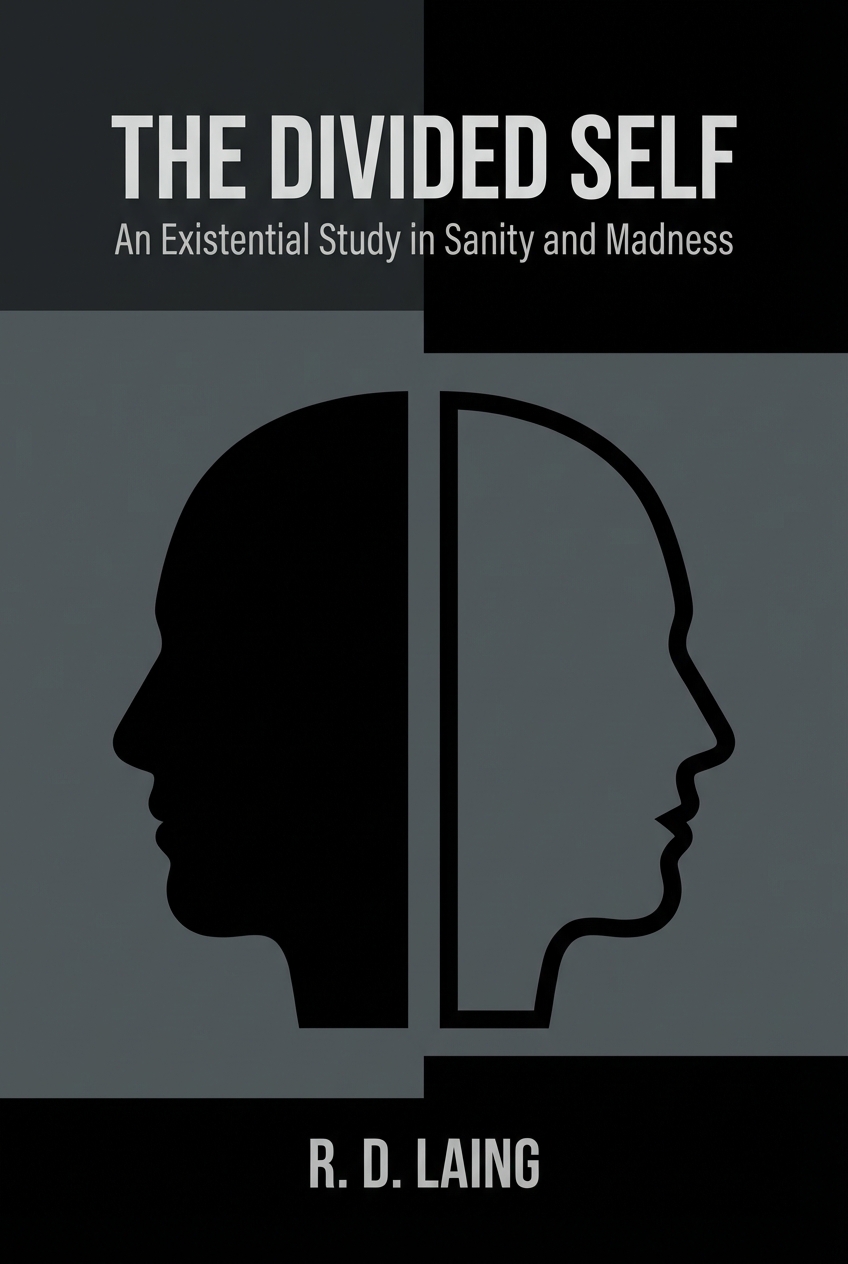
The Divided Self book cover

The Script

A young boy stands in his elementary school classroom, his mind a whirlwind of private symbols and unspoken rules. He watches his classmates interact, their laughter and arguments governed by a social code he can’t quite decipher. His understanding of the words is fine; their entire reality seems built on a different foundation. To survive, he begins to construct a public version of himself, a carefully managed performance designed to mimic their behavior, to say the right things and laugh at the right times. But this public self is a hollow shell, and behind its mask, his true, private self retreats further and further inward, into a world that is rich and complex but terrifyingly isolated. This is a strategy for survival in a world that feels alien and threatening. The longer the performance goes on, the more the two selves drift apart, until the boy is no longer sure which one is real.

This profound sense of alienation was a central concern for R.D. Laing, a Scottish psychiatrist who witnessed countless individuals whose internal worlds had fractured under the pressure to conform. Working in mental hospitals in the 1950s and 60s, he was struck by the inadequacy of the standard psychiatric labels. He saw patients as people whose 'madness' was a desperate, often logical, attempt to preserve their identity in the face of unbearable family or social dynamics. Laing wrote The Divided Self to challenge the very definition of sanity, arguing that the experience of being 'schizoid'—fundamentally split between an inner 'true' self and an outer 'false' self—was an understandable response to an impossible situation, a sane reaction to an insane world.

Module 1: The Core Wound — Ontological Insecurity

Laing starts with a fundamental question: What does it feel like to be you? For most of us, the answer is a given. We feel real. We feel alive. We feel whole. We have a stable sense of our own existence. Laing calls this "primary ontological security." It’s the bedrock of a healthy mind.

But what if that bedrock is missing? What if you lack a firm, self-validating sense of your own reality? This is the state Laing calls "ontological insecurity." It’s a foundational uncertainty about your own being. The ontologically insecure person feels more unreal than real. More dead than alive. Their identity is fragile. Their autonomy is always in question. This is a constant, existential dread.

For a person in this state, ordinary life becomes a minefield. Laing identifies three specific anxieties that haunt the ontologically insecure person.

First is engulfment, the dread of losing your identity in any relationship. For this person, to be understood is to be captured. To be loved is to be swallowed. A patient might fear therapy because they'll be comprehended, believing this will annihilate their fragile self. So, they choose isolation.

Next comes implosion, the terror that reality will crash in and obliterate you. The person feels a profound emptiness inside. Like a vacuum. Any contact with the vibrant, demanding outside world is felt as a violent intrusion. It threatens to shatter their non-existent inner structure.

Finally, there is petrification, the fear of being turned into a thing. This is the dread of being treated as an object, a robot, an "it." It’s the fear of losing your subjectivity and autonomy. To defend against this, the person might preemptively turn others into things. They'll observe a loved one's laugh as a series of muscle contractions. This act of depersonalizing others is a desperate attempt to neutralize their power.

So what happens next? Laing shows that ontological insecurity forces a defensive split in the self. To survive these constant threats, the individual creates a division. A line is drawn between a hidden, inner "true self" and an outer, compliant "false self." This is the birth of the divided self.

Module 2: The Divided Self in Action — The False-Self System

We've established the core wound. Now, let's explore the defense mechanism it creates. To protect its fragile, terrified core, the self splits in two.

First, you have the "unembodied self." This is the secret, inner "true self." It detaches from the body. It retreats from the world. It exists only in the mind, as an observer. It watches life from a safe distance, like a spectator in a theater. Its main job is to remain hidden and pure.

Second, you have the "false-self system." This is the outer shell. It's the part that interacts with the world. It’s a compliant, adaptable persona designed to meet the expectations of others. It’s the "good" child, the "model" employee, the "normal" person. It's a performance. And the inner self is the director, critic, and reluctant audience.

Here's the critical insight: The false-self system is built from compliance and impersonation. It learns what others want it to be, and it becomes that. Laing gives the example of David, a patient who was a "perfect model child." He did everything his parents wanted. But this compliance was a strategy to keep his true self safe. After his mother's death, this impersonation became compulsive. He began dressing in her clothes, unconsciously mimicking her. The false self, born of compliance, had turned into a caricature.

This leads to a key distinction. The schizoid false self is a prison, not a normal social mask. We all wear masks. We act differently with our boss than with our best friend. But for a healthy person, the mask is a tool. We can take it off. Spontaneity is still possible. For the schizoid individual, the false self feels alien, compulsive, and deadening. The inner self watches the false self's actions with a sense of futility and disgust.

And here's the thing. This creates a terrible paradox. The inner self, hidden away for safety, receives no direct experience. It gets no "supplies" from reality. It begins to starve. It feels empty, sterile, and dead. Meanwhile, the false self goes through the motions of life. It might have a job, a relationship, even a family. But the inner self feels nothing. A patient described having sex with his wife. He said his body was there, but his mind was just an observer. He was having sex with his idea of his wife. The real connection was impossible.

Ultimately, the split between the true and false self destroys the capacity for authentic relationships. The individual is trapped. They desperately long for real connection. But their entire defensive system makes it impossible. They are caught between the terror of being seen and the agony of being invisible.

Read More