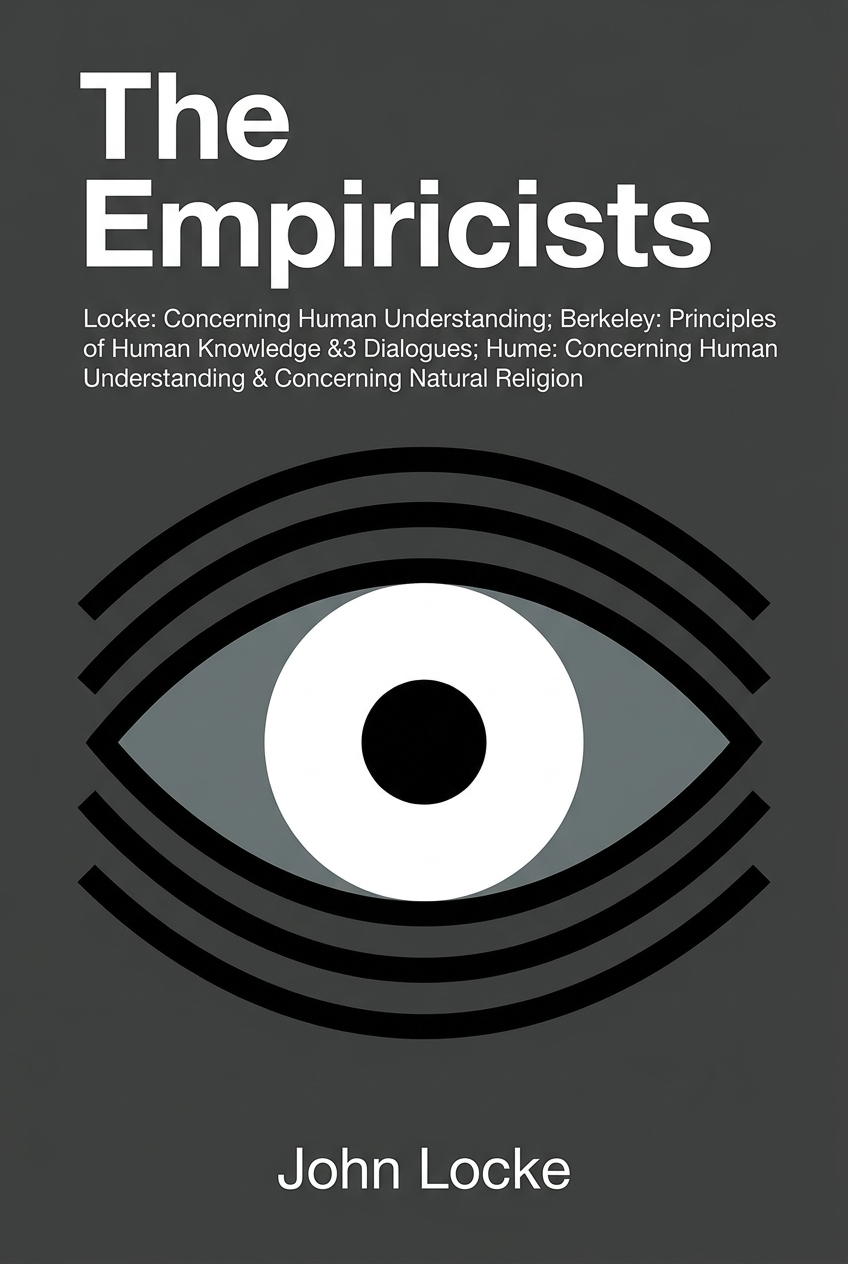
The Empiricists
Locke: Concerning Human Understanding; Berkeley: Principles of Human Knowledge &3 Dialogues; Hume: Concerning Human Understanding & Concerning Natural Religion
What's it about
Ever wonder if what you see is actually real, or just a trick of your mind? Get ready to question everything you think you know about reality, knowledge, and even yourself. This summary unpacks the groundbreaking ideas that shaped how we understand the world. You'll explore how your mind starts as a blank slate, discover why you can't prove the existence of anything outside your own perception, and learn why your most cherished beliefs might just be habits. Uncover the core principles that form the foundation of modern science and thought.
Meet the author
Widely hailed as the "Father of Liberalism," John Locke was a 17th-century English philosopher whose groundbreaking theories on government and knowledge shaped the very foundations of Western democracy. A trained physician and an influential member of the Royal Society, his insistence that knowledge comes only from sensory experience was a radical departure from tradition. This empirical approach, born from a lifetime of scientific observation and political turmoil, laid the groundwork for modern thought and inspired generations of thinkers, including America's founding fathers.
What's it about
Ever wonder if what you see is actually real, or just a trick of your mind? Get ready to question everything you think you know about reality, knowledge, and even yourself. This summary unpacks the groundbreaking ideas that shaped how we understand the world. You'll explore how your mind starts as a blank slate, discover why you can't prove the existence of anything outside your own perception, and learn why your most cherished beliefs might just be habits. Uncover the core principles that form the foundation of modern science and thought.
Meet the author
Widely hailed as the "Father of Liberalism," John Locke was a 17th-century English philosopher whose groundbreaking theories on government and knowledge shaped the very foundations of Western democracy. A trained physician and an influential member of the Royal Society, his insistence that knowledge comes only from sensory experience was a radical departure from tradition. This empirical approach, born from a lifetime of scientific observation and political turmoil, laid the groundwork for modern thought and inspired generations of thinkers, including America's founding fathers.
The Script
You've reached the end of the free preview.