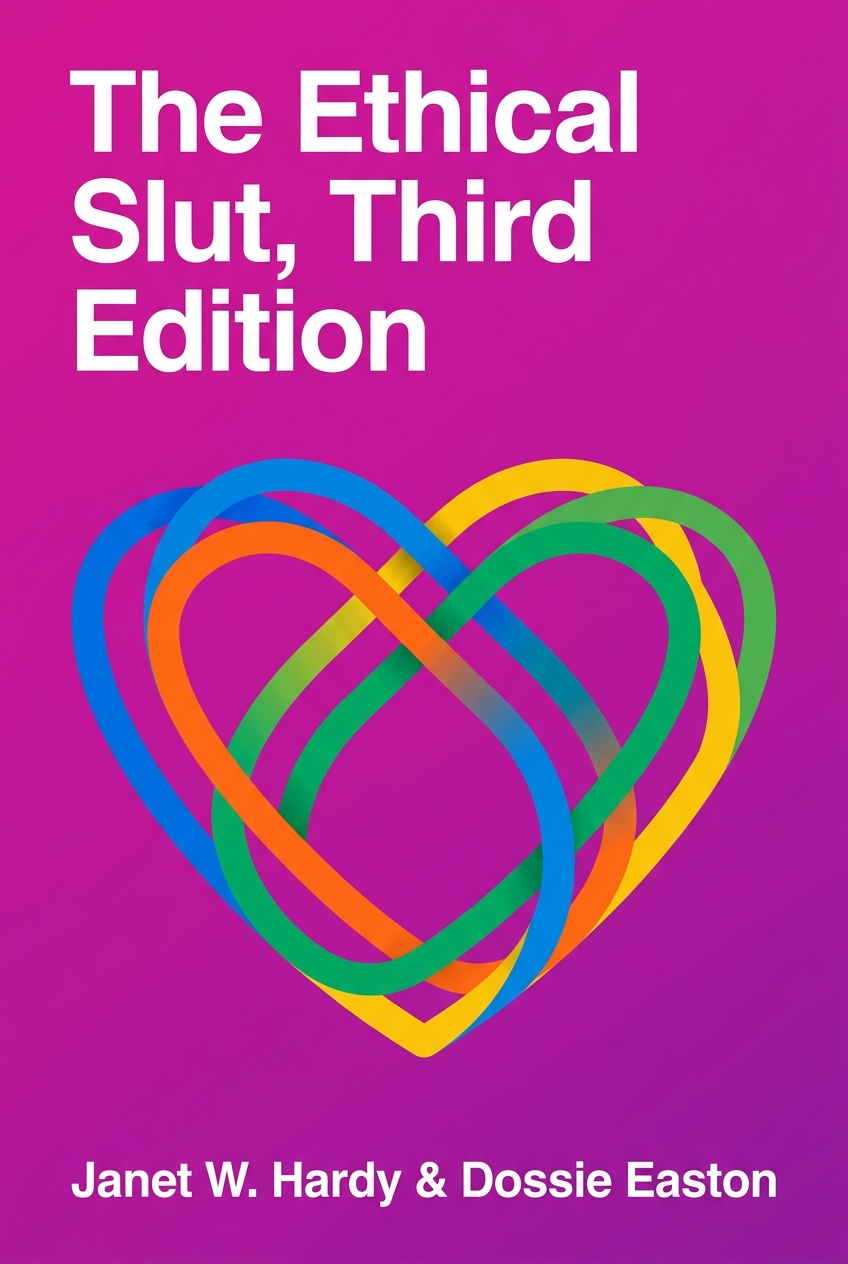
The Ethical Slut, Third Edition
A Practical Guide to Polyamory, Open Relationships, and Other Freedoms in Sex and Love
What's it about
Ready to explore relationships beyond the traditional rulebook? This guide shows you how to navigate polyamory, open relationships, and other forms of consensual non-monogamy with honesty and integrity. Discover how to manage jealousy, communicate your desires, and build fulfilling connections on your own terms. You'll learn practical strategies for everything from finding partners to creating healthy agreements and handling complex emotions. Uncover the secrets to maintaining trust, fostering intimacy, and cultivating a love life that is both ethical and liberating, no matter what your relationship style looks like.
Meet the author
Dossie Easton, MFT, and Janet W. Hardy are pioneering therapists and authors whose groundbreaking work has made them leading authorities on polyamory and unconventional relationships for over two decades. Drawing from their extensive clinical practice and personal experiences within the polyamorous community, they co-authored The Ethical Slut to provide a compassionate, practical roadmap for navigating the complexities of consensual non-monogamy. Their combined expertise offers an authentic and judgment-free guide to building honest, loving, and multi-partner relationships.
The Script
We treat sexual fidelity as the ultimate stress test for a relationship's strength. Its presence is seen as the bedrock of trust, its absence a catastrophic failure. Yet this singular focus creates a strange paradox: by making one specific act the sole measure of loyalty, we inadvertently make our connections more fragile, not less. We build an entire architecture of love on a foundation that can be shattered in a single moment, treating intimacy as a brittle, all-or-nothing contract rather than a resilient, evolving practice. What if the most destructive force in modern relationships is the very ideal of perfect, exclusive fidelity itself—an ideal that often encourages secrecy over honesty and creates a silent pressure cooker of unspoken desires?
This exact question began to surface in the therapy practices of Dossie Easton and Janet W. Hardy. Easton, a licensed marriage and family therapist, and Hardy, a writer and publisher, saw countless individuals and couples struggling within the rigid confines of conventional monogamy. They were seeing a failure of the available models for expressing love. Their clients' experiences revealed that the supposedly 'safe' path was often the one causing the most pain, secrecy, and disconnection. Realizing there was no practical guide for those exploring love, sex, and commitment outside traditional lines, they decided to create one themselves, pooling decades of professional and personal experience to document the skills needed for honest, consensual, and multi-partner relationships.
Module 1: Redefining the Foundations of Love and Sex
This book starts by tearing down old definitions and building new ones. It argues that many of our beliefs about relationships are social constructs, not natural laws. The authors propose a radical shift in perspective, moving from a mindset of scarcity to one of abundance.
First, the authors reclaim the word "slut" as a term of empowerment. Historically, "slut" has been a weapon used to shame women for their sexuality. The authors redefine it as a positive identity for any person, of any gender, who believes sex is a good thing and that pleasure is a worthy goal. An ethical slut is defined by their commitment to treating people with honesty, respect, and care. This reframing is a direct challenge to the double standards that celebrate male promiscuity while condemning female sexuality.
Building on that idea, the book asserts that love and intimacy are abundant resources. Our culture often operates on a "starvation economy" of love. It suggests you have a finite amount to give. If you love one person, it must mean you love another less. The authors call this a myth. They compare love to a mother's affection for her children. The mother of nine can love each child as deeply as the mother of one. The book encourages us to exercise our "love muscles." The more love and connection we practice, the greater our capacity for it becomes.
This naturally leads to a new understanding of relationships. The authors argue that a relationship's value is determined by the quality of the connection itself. A one-night stand can be just as life-enhancing and meaningful as a lifelong partnership. The goal can simply be connection, pleasure, or shared experience in the present moment. This frees relationships from the pressure of a predetermined "relationship escalator," where every connection is expected to progress toward cohabitation and lifelong monogamy.
Finally, at the core of this philosophy is a simple but profound principle: you are already a whole person. Society often sells us the idea that we need a "better half" to be complete. This book rejects that. The fundamental unit is one. Self-love, self-awareness, and self-reliance are the foundations. By building a strong, loving relationship with yourself first, you can engage with others from a place of wholeness, not neediness. This internal security is what makes ethical relationships possible.