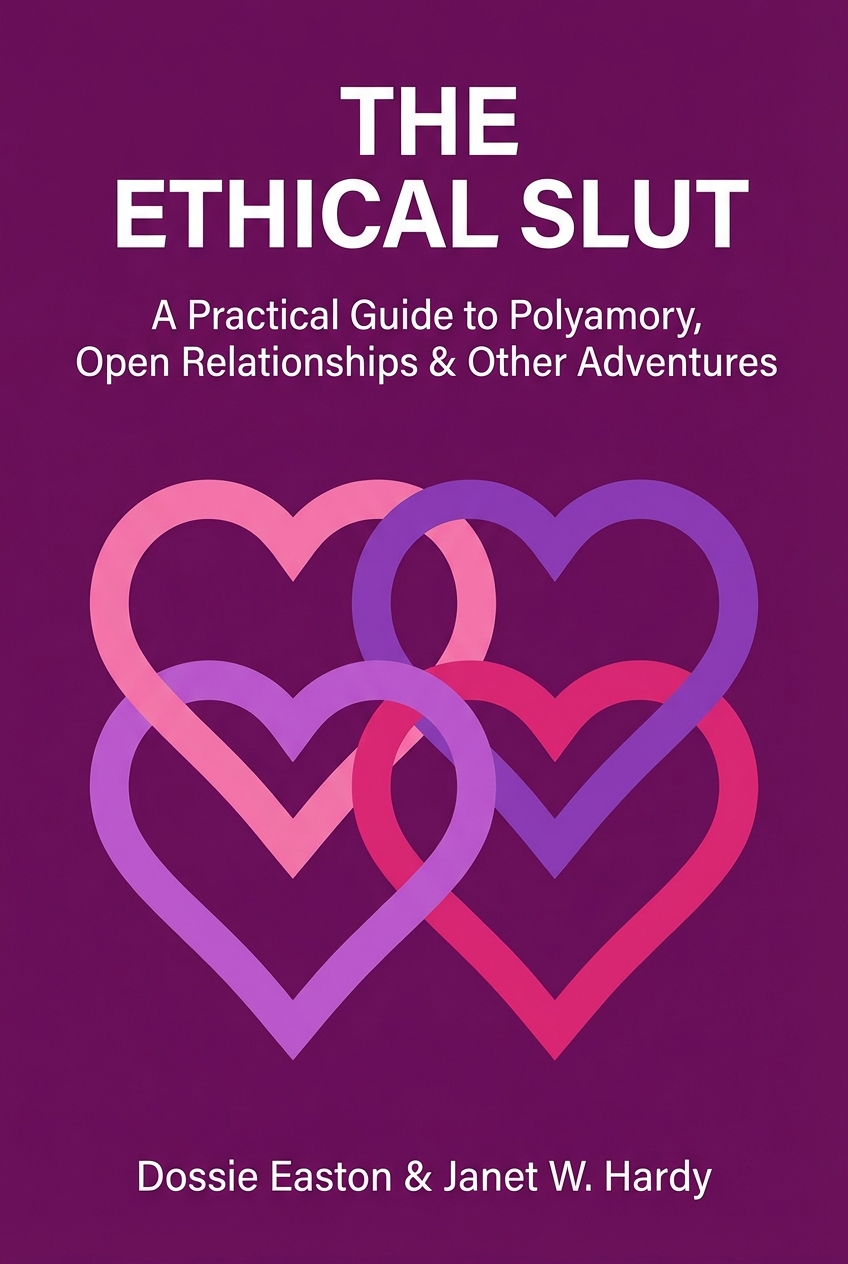
The Ethical Slut
A Practical Guide to Polyamory, Open Relationships & Other Adventures
What's it about
Ready to explore relationships beyond monogamy without the jealousy and drama? This guide shows you how to build loving, honest, and fulfilling connections with multiple partners. Discover the freedom of ethical non-monogamy and learn to create relationships that work for you, on your terms. You'll get practical advice for navigating open relationships, polyamory, and other adventures with confidence and integrity. Learn essential communication skills to handle jealousy, manage your time, and maintain healthy boundaries. This is your roadmap to embracing more love, pleasure, and intimacy in your life, ethically and joyfully.
Meet the author
Dossie Easton, a licensed marriage and family therapist for over three decades, and Janet W. Hardy, a writer and sex educator, are the groundbreaking authors of The Ethical Slut. Their combined expertise emerged from decades of personal experience and professional practice within non-monogamous communities. Frustrated by the lack of resources, they created the guide they wished they'd had, blending therapeutic insight with lived experience to champion ethical, communicative relationships for a new generation of readers exploring unconventional love and sexuality.
The Script
We are taught that the heart is a finite resource, a single-family home with room for only one lifelong tenant. Its most precious commodity, romantic love, is framed as a zero-sum game: giving more to one person means giving less to another. Jealousy, in this model, is the natural, even necessary, security system that protects our most valuable investment. This entire emotional economy is built on a foundation of scarcity—the belief that love, commitment, and desire are limited goods that must be hoarded and guarded. But what if this core premise is simply wrong? What if the heart operates like a muscle that grows stronger with use, its capacity for connection expanding rather than depleting?
This counter-intuitive view of love as an abundant, renewable resource is precisely what sex educator Dossie Easton and writer Janet W. Hardy began to explore. Easton, a licensed marriage and family therapist, spent decades counseling individuals and couples who felt trapped and shamed by desires that didn't fit the conventional script. They were seeking to expand commitment, to love honestly and ethically without the constraints of forced monogamy. Seeing a profound gap in literature that treated these desires with respect and practical guidance, she partnered with Hardy to create a resource that offered a new way to play the game—one based on communication, consent, and the radical idea that love is an abundant gift to be shared.
Module 1: Deconstructing the Default Settings
We all operate with a set of default assumptions about relationships. These ideas are so pervasive they feel like gravity. They are the air we breathe. The authors argue that the first step to building a more authentic life is to identify and question these invisible scripts.
One of the most powerful scripts is what they call the "Relationship Escalator." It's a prescribed path. You meet someone. You date exclusively. You move in together. You get married. You have kids. You stay together until death. This model is everywhere. It's in movies, songs, and legal systems. But it's not the only way. The authors suggest that stepping off the Relationship Escalator frees you to design relationships that fit your actual needs. You might find a partner you love deeply but never want to live with. Or you might build a primary partnership with someone you aren’t sexually involved with. The possibilities are endless once you see the escalator for what it is: a social construct, not a mandate.
To do this, you have to challenge your own thinking. Specifically, the book urges us to embrace spectrums instead of binary, either/or thinking. We are taught to see the world in opposites. Monogamous or polyamorous. Right or wrong. Good or bad. This dualistic view creates judgment and limits our options. The authors point out a common argument: "Either you're wrong or I'm crazy!" A more productive question is, "Can you think of any more options?" This shift opens up space for nuance and compromise. Many conflicts are just differences in preference, like one person preferring creamy peanut butter and another liking chunky.
This process of deconstruction requires a deep dive into your own programming. The authors are clear: you must critically analyze the societal conditioning that shapes your views on love and sex. Our ideas are heavily influenced by media that rewards conformity and punishes difference. They are shaped by legal and financial systems that historically favored one type of family. And they are formed by sex education that is often absent or woefully incomplete. The book gives a striking statistic. Only half of American teens receive sex education beyond abstinence and STIs. Far fewer learn about consent or LGBTQIA+ issues. Recognizing these influences is the first step toward unlearning the beliefs that no longer serve you.
Finally, this journey of deconstruction extends to the words we use. The authors argue that expanding your vocabulary for sex, gender, and relationships is essential for clear communication. Many of us grew up with language that was childish, coarse, or overly clinical. These words are inadequate for expressing complex adult desires. The book encourages readers to find words that feel right for their bodies and experiences. This includes exploring gender-neutral language, which can dismantle assumptions and foster inclusivity. By consciously choosing our words, we take control of our own narratives.