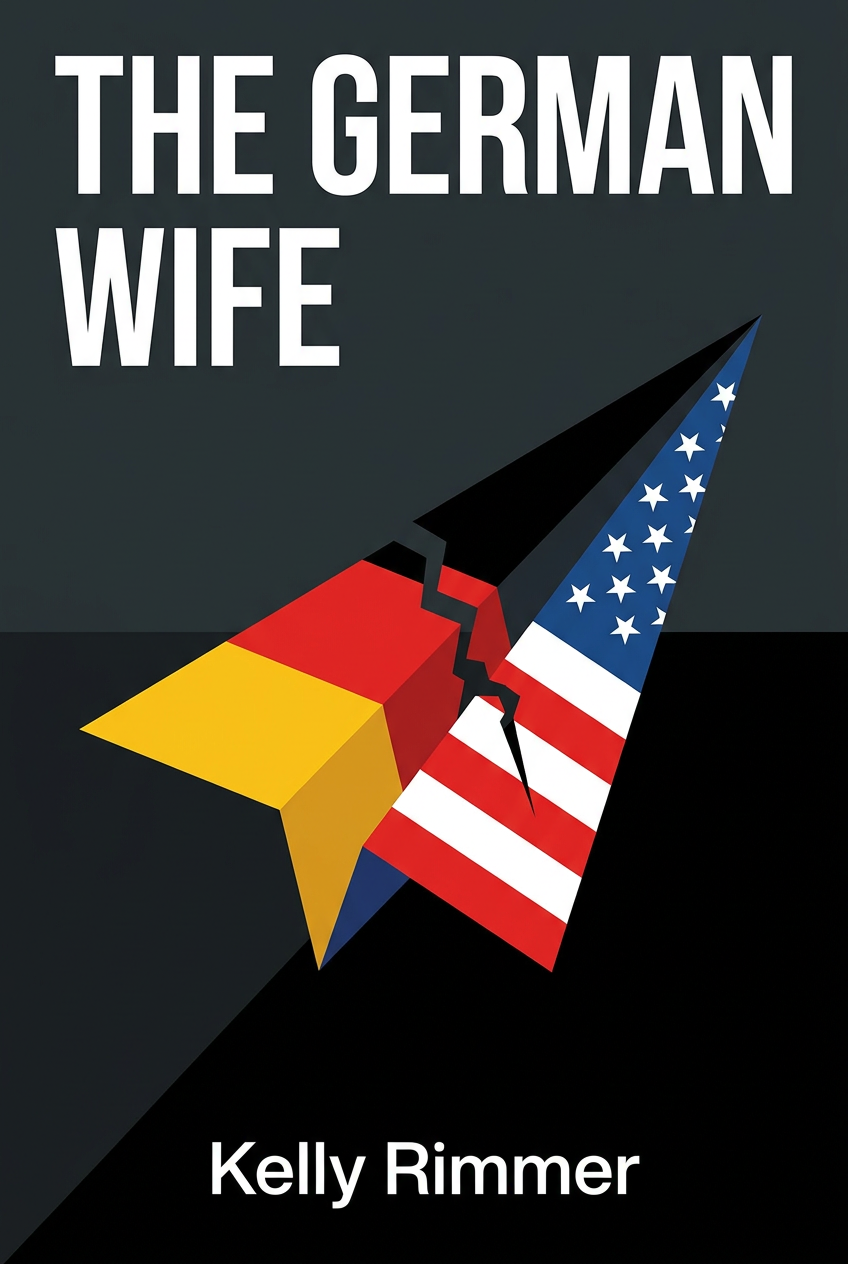
The German Wife
A Novel – A WWII Historical Fiction Story Inspired by True Secret Intelligence Programs
What's it about
What if the brilliant mind that saved your country belonged to your sworn enemy? Discover the impossible choices two women face when a top-secret post-WWII program brings a German scientist’s family to America, forcing a collision between a German wife haunted by her past and an American widow seeking justice. You’ll uncover the hidden history of Operation Paperclip, a controversial U.S. intelligence program that recruited Nazi Germany's top scientific minds. This story explores the moral complexities of forgiveness, the secrets buried within a marriage, and whether a nation's security can ever justify collaborating with those who committed unspeakable acts.
Meet the author
Kelly Rimmer is a New York Times, Wall Street Journal, and USA Today bestselling author of historical fiction, renowned for her emotionally resonant stories. Her deep dive into the real-life complexities of Operation Paperclip, a controversial post-WWII US intelligence program, inspired this gripping exploration of moral ambiguity. Rimmer’s passion for uncovering the hidden human stories behind major historical events brings a powerful and intimate perspective to the past, making her a worldwide reader favorite.
Opens the App Store to download Voxbrief

The Script
Imagine a wedding day. Not the ceremony, but the morning after. The bride wakes in a new home, a new life stretching before her. She holds two identical, pristine white handkerchiefs. One was a gift from her mother, embroidered with a single blue thread, a token of hope and continuity. The other was a gift from her new mother-in-law, plain and stark, a symbol of a different kind of duty, a different future. To an outsider, they are just two squares of cloth. But for the bride, they represent two irreconcilable worlds. One is the world she comes from, full of love, memory, and personal dreams. The other is the world she has just entered, one of immense pressure, public expectation, and secrets she is only beginning to understand. The choice of which handkerchief to tuck into her pocket for the day feels impossibly heavy, a silent declaration of allegiance in a war she didn't know she was fighting.
This tension between a private, cherished past and a public, demanding future is the emotional core that drove author Kelly Rimmer to write this story. Rimmer, a bestselling author known for her deeply researched historical fiction, stumbled upon a little-known piece of American history: Operation Paperclip, a post-WWII program that brought German scientists—some with dark pasts—to the United States. While exploring the historical facts, she became captivated by a more intimate question: What was it like for the women, the wives, who were caught in the middle? She wanted to explore the lives of two women on opposite sides of the war, bound by circumstances and the choices made by their husbands, each holding onto her own version of truth and survival. The result is a story that moves beyond the headlines of history to explore the deeply personal cost of loyalty, love, and impossible choices.
Module 1: The Slow Poison of a Nation
The story opens in two timelines. One is post-war America. The other is pre-war Germany. It’s the German timeline that shows us how catastrophe happens. It’s a slow, creeping poison. The book makes it clear that societal collapse begins with the normalization of casual prejudice.
In 1930s Berlin, we meet Sofie and her best friend, Mayim, who is Jewish. Their friendship is deep. It’s sisterly. But around them, the world is changing. After the 1929 stock market crash, Germany is reeling. Unemployment is high. People are scared. And in this fear, the Nazi party finds fertile ground.
We see this through small, chilling moments. Sofie’s friend Lydia makes a casual, anti-Semitic comment. "You know how the Jews are," she says. "They just love their money." Sofie is shocked. But she tells herself it was just a silly stereotype. No harm was done. This is the first drop of poison. It’s easy to dismiss. It’s easy to ignore. The author shows how these "throwaway lines" reveal a deep-seated bias. They are the cracks in the foundation of a society.
This brings us to a critical insight. Political extremism thrives on economic instability and manufactured crises. The Nazi party’s rise was about offering a simple solution to complex problems. They promised stability. They promised jobs. They promised a return to national pride. For a population gripped by fear, this message was powerful.
Jürgen, Sofie’s husband, is a brilliant scientist. He’s skeptical of the Nazis. He sees their propaganda for what it is. After the Reichstag fire, the German parliament building, the Nazis declare a state of emergency. They suspend civil liberties. They seize control of the press. Jürgen points out the convenient timing. He suspects the Nazis staged the crisis to consolidate power. But his voice is drowned out. In a nation of millions of unemployed, fear is a more powerful motivator than reason. People were voting for a paycheck.
And here’s the thing. This political shift begins to corrode personal relationships. Ideological pressure systematically fractures friendships and family bonds. Sofie and Jürgen’s friends, Karl and Lydia, join the Nazi Party. Slowly, they begin to exclude Mayim. At first, it’s polite excuses. Limited tickets to the opera. A private work discussion. But the pattern becomes clear. Mayim’s family lost their fortune in the crash. This provides a convenient, socially acceptable excuse to distance themselves. But Mayim knows the real reason. It’s about her being Jewish.
This process is slow. It’s incremental. Sofie compares it to the formation of a cave. Millions of tiny waves, each one insignificant on its own, eventually carve out a vast, dark space. This is how their world changes. Not with a bang, but with a thousand small, silent compromises.
Let's transition now to the consequences of these changes.
Module 2: The Impossible Price of Survival
We've seen how the world changes. Next up: what it costs to live in that new world. As the Nazi regime solidifies its power, the choices become harder. The stakes become higher. The central theme of this section is stark: under an oppressive regime, survival requires a constant, soul-crushing performance.
Sofie and Jürgen find themselves trapped. Jürgen is a rocket scientist. The regime needs his expertise. He is offered a prestigious job, but he knows the rockets will be used as weapons. He initially refuses. Then, the pressure mounts. He is mysteriously fired from his university job. The bank threatens to foreclose on their home. His friend Karl, now a Nazi official, makes it clear: there is no other option. To survive, Jürgen must work for the regime.
From this point on, their lives become a performance. They discover their home is bugged. They can’t speak freely anywhere. They must whisper under blankets at night. They must drive into the countryside for a private conversation. In their own home, they act as "good Nazi parents." They say the right things. They perform the Hitler salute. They know they are being watched. Always.
This leads to a devastating realization for them. Complicity is a thousand daily compromises that erode the soul. Sofie allows her children to read anti-Semitic propaganda from school. She bites her tongue when a Nazi official spews hatred at her dinner table. She does this to protect her family. But she knows, with each small act of silence, she is becoming part of the problem. Jürgen feels this even more acutely. He is building weapons of terror. He is haunted by the "theoretical family" his rockets will kill. He tells Sofie he feels he should hang for what he is doing.
But the most brutal compromise is yet to come. The Gestapo, the secret police, gives them an ultimatum. They must "erase" Mayim, their Jewish friend who lives with them, from their lives. If they refuse, they will be made a public example. The choice is impossible. Protect their friend and risk their children’s lives? Or sacrifice their friend to save their family? This is the heart of the book’s moral dilemma. Totalitarian pressure forces impossible choices, where protecting one loved one means betraying another.
They are forced to send Mayim away. They burn her photos. They pretend she never existed. It’s an act of moral amputation. Sofie’s aunt gives her the only advice possible for survival. "They insist you become a Nazi," she says, "so you pretend to be the best damned Nazi you can be." You separate your true, inner self from the required outer performance. But the book asks: how long can you do that before you lose yourself completely?
This desperate performance carries them through the war. Jürgen is even forced to accept a rank in the SS. But the war ends. And a new, equally complicated chapter begins.