All Books
Self-Growth
Business & Career
Health & Wellness
Society & Culture
Money & Finance
Relationships
Science & Tech
Fiction
Topics
Blog
Download on the App Store

The Joy Luck Club

A Novel

14 minAmy Tan

What's it about

Have you ever felt like you and your parents are from different worlds? Discover the unspoken hopes, hidden heartaches, and cultural clashes that shape the powerful, complex bonds between mothers and daughters. This is your chance to understand the secrets that bind you together. You'll explore the lives of four Chinese mothers and their American-born daughters in San Francisco. Through their weekly mahjong games, you'll uncover stories of war, loss, and immigration, learning how their pasts in China continue to influence their daughters' futures in America.

Meet the author

Amy Tan is the acclaimed, bestselling author of The Joy Luck Club, a landmark novel that has been translated into 35 languages and adapted into a major motion picture. Born to Chinese immigrant parents in Oakland, California, Tan drew upon the complex, often unspoken stories of her mother's past to explore the deep, generational bonds between immigrant mothers and their American-born daughters. Her work gives a powerful voice to the Chinese American experience, illuminating universal truths about family, memory, and identity.
Listen Now
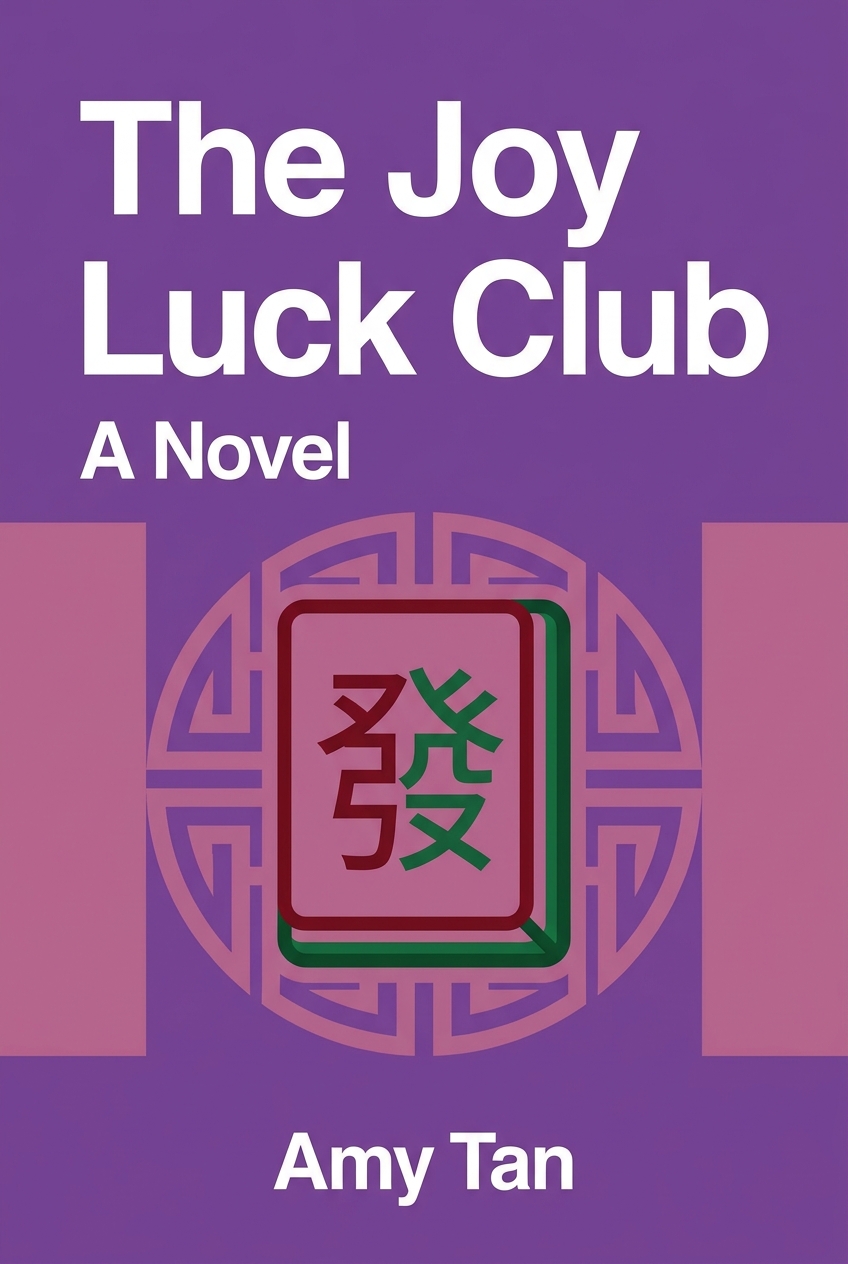
The Joy Luck Club book cover

The Script

At a family gathering, an aunt pulls you aside and hands you a small, lacquered box. She doesn't explain it, but you know it’s important. Inside, nested in silk, is a single, intricately carved mahjong tile. It feels cool and heavy in your palm, its surface worn smooth by countless hands. You recognize the character—not from lessons, but from a vague, dreamlike memory of your grandmother's voice. Your mother, seeing the tile, offers a completely different story for its meaning, one tied to a difficult journey and a forgotten promise. The stories don't match. One speaks of luck and prosperity, the other of sacrifice and loss. The tile remains the same, but its history feels like it's splitting in two, leaving you holding a beautiful object that is also a silent, heavy question.

This feeling of holding two conflicting truths in one hand is the very heart of Amy Tan’s “The Joy Luck Club.” Tan began writing as a way to process her own complex relationship with her mother, who was facing a life-threatening illness. She started crafting fictional vignettes, short stories that allowed her to explore the immense, unspoken gap between her own American experience and her mother's Chinese past. These stories were a way to ask the questions she couldn't ask directly, to understand the history that felt both a part of her and completely foreign. What began as a personal, therapeutic exercise for a freelance business writer soon took on a life of its own, weaving together into a powerful narrative that gave voice to the silent questions held by countless immigrant families.

Module 1: The Unspoken Contract of Mothers and Daughters

The core tension in The Joy Luck Club is the profound gap between immigrant mothers and their American-born daughters. This is about a fundamental clash of operating systems. The mothers see life through the lens of sacrifice, duty, and collective survival. The daughters see it through the lens of individual ambition, personal happiness, and self-discovery.

This dynamic creates a painful cycle. Maternal expectations are often projections of a mother's own lost hopes. Suyuan Woo, the founder of the Joy Luck Club, lost everything in China. She arrives in America and channels all her deferred dreams into her daughter, Jing-mei. She believes Jing-mei can be a prodigy—a chess champion, a piano virtuoso, anything. This is a desperate attempt to redeem her own tragic past. For Jing-mei, this pressure feels like a denial of her true self. She rebels out of a need for her own identity. She weaponizes failure, deliberately falling short of her mother's expectations to carve out her own space. This is a pattern seen across all four families. The mothers push, and the daughters pull away.

Building on that idea, the daughters often misinterpret their mothers' love as criticism. When Lindo Jong critiques her daughter Waverly's haircut or her fiancé, Waverly sees it as an attack. She fears her mother's disapproval will "poison" her happiness, just as it seemed to ruin her first marriage. But from Lindo's perspective, this criticism is a form of protection. A mother’s warnings, often rooted in cultural lore, are a tool for protection. Lindo is vetting Waverly's life for weaknesses, for dangers Waverly can't see. She's applying the same strategic thinking that helped her escape a terrible arranged marriage in China. What Waverly hears as judgment, Lindo intends as guidance. The tragedy is that neither can articulate their true intent to the other. The love is lost in translation.

So here's what that means for us. When we face intergenerational friction, we need to look for the unspoken story. Is a parent's criticism actually a fear of you repeating their mistakes? Is a child's rebellion a desperate plea to be seen for who they are, not who you want them to be? The book suggests a powerful shift in perspective. Instead of reacting to the words, try to decode the history behind them.

This leads to a crucial insight. Understanding is achieved when the daughter finally steps into her mother's story. For Jing-mei, this happens only after her mother's death. She takes her mother's seat at the mah jong table. She travels to China to meet the sisters her mother was forced to abandon. As she crosses the border, she feels a physical change, a sense that she is "becoming Chinese." When she finally sees her sisters, she sees her mother in their faces. In that moment, the prodigy narrative, the years of fighting, all fall away. She understands her mother not as a source of pressure, but as a woman defined by a great and tragic love. That's the breakthrough. It’s about empathy born from walking, even for a moment, in another's shoes.

Read More